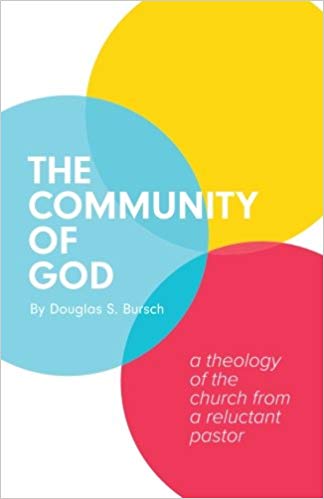
Douglas Bursch: The Community of God

 Douglas S. Bursch, The Community of God: A Theology of the Church from a Reluctant Pastor (Seattle, WA: Fairly Spiritual, 2017), 240 pages, ISBN 9780692868386.
As the last word of the title of this book indicates Douglas Bursch is a pastor; he is affiliated with the Foursquare Church. In addition to pastoring he serves on the Doctrine Committee and Education Commission of his denomination. He has also taught theology at Life Pacific College and Life Ministry Institute.
The Community of God consists of 18 chapters. At the end of each chapter there are discussion questions to help the reader remember, and reflect on, the significant topics covered in the chapter. In the book Pastor Bursch shares some of his own experiences in ministry. However, a significant portion of the text, as the title indicates, is given to developing a theology of the church. That being the case, the book contains a considerable amount of biblical teaching. This teaching demonstrates that community is God’s idea. The author points out that the larger culture in America is moving away from the practice of community (pages 15-16). The church, however, is not to follow this trend, we are called to be a community.
Bursch points out that before creation, God existed in community (and He still does); the Father, the Son, and the Holy Spirit interact with one another regularly. He goes on to show that with the creation of Eve community was introduced to the human race.  He also shows that the concept of community can be found in God’s promise to Abraham (Gen. 12) and in the outpouring of the Holy Spirit (Acts 2). We as believers in Jesus Christ are not to live individualistic lives, we are to participate in community. The author maintains that the church should place greater value on the importance of community. We, at least in the West, tend to place more emphasis on our individual needs and desires. Bursch says that in isolation “we cannot fully understand the relational nature and love of God†(page 32).
Sin is a major part of our brokenness. The author points out that sin divides, it can fracture a community. Using Scripture, history, and experience he demonstrates that sin divides marriages, families, nations, and churches (chapter 5). Bursch is very transparent regarding his own feelings about community. A self-confessed introvert, he does not normally gravitate toward people, at least do so for long periods of time. However, he stretches himself out of his comfort zone because he realizes, first, that community is biblical, and second, that it has value. There is much to be gained in community, not just for the individual, but for the gathered body as well. We can benefit one another, the use of the gifts of the Holy Spirit is one example of this. Bursch says “In relationship with the body of Christ, we find out who we are and why we exist†(page 139).
Reviewed by John Lathrop