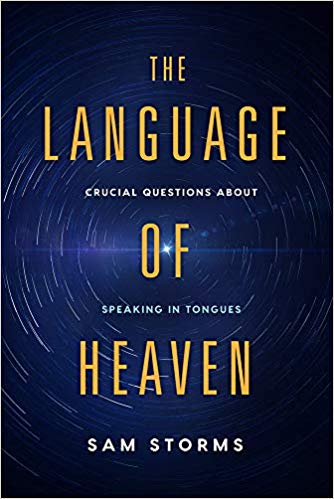
Sam Storms: The Language of Heaven

 Sam Storms, The Language of Heaven: Crucial Questions About Speaking in Tongues (Lake Mary, FL: Charisma House, 2019), 272 pages, ISBN 9781629996073.
Sam Storms has served the Lord in a number of different capacities. He is a pastor and has served as an associate professor of theology at a major Christian college. These experiences show that he has served the church in both the practical “grass roots” expression of Christianity in the local church and in the academic setting, where he has helped train people for Christian service. In addition, he has authored a number of books. Some of his previous works have dealt with the subject of spiritual gifts. For example, he wrote The Beginner’s Guide to Spiritual Gifts (Bethany House, 2013), Convergence: Spiritual Journeys of a Charismatic Calvinist (Enjoying God Ministries, 2005), and Practicing the Power: Welcoming the Gifts of the Holy Spirit in Your Life (Zondervan, 2017) [Editor’s note: See Review of Practicing the Power]. But this current volume is focused on the New Testament gift of speaking in tongues. As the author deals with this controversial subject, he brings pastoral sensitivity and theological precision to the task. He dedicated this book to Jackie Pullinger, an English missionary, who has spent over fifty years in Hong Kong ministering to gang members, drug addicts, and prostitutes. The dedication of this volume to her is appropriate because Pullinger saw a dramatic change in her ministry when she began to pray in tongues on a daily basis. Before we look at the contents of the book I would like to mention that Sam Storms does speak in tongues.
The Language of Heaven consists of an introduction and fourteen chapters. In these chapters Storms answers thirty questions that people often have about speaking in tongues. Some of the questions that he addresses are: “Does the gift of tongues always and invariably follow Spirit baptism as its initial physical evidence?”, “Are tongues always human languages previously unlearned by the speaker? If not, what kind of language is speaking in tongues?”, “Is tongues-speech primarily directed to men or to God?”, “Can a person pray for another person in uninterpreted tongues?”, and “If I don’t have the gift of tongues but want it, what should I do?”
One thing that Storms does especially well is address cessationist objections to, or misunderstandings about, speaking in tongues. He does this by appealing to Scripture. It is obvious from what he has written that he is well acquainted with the issues that cessationists raise. It is also clear that he knows how to use the Scriptures to address their viewpoint.
In chapters 13 and 14, the book takes a brief look at speaking in tongues outside of the New Testament. In chapter 13, Storms demonstrates that the gifts of the Spirit, including tongues, were in operation at various points in church history after the first century. In chapter 14, there are testimonies from people in more recent times who share about their experiences with speaking in tongues.
Much can be learned from this book even if the reader does not agree with everything that the author says. It is a book of significant spiritual substance. It is thoughtfully written, rich in biblical theology, and pastoral in tone. This book is a great resource for anyone who is seeking to gain a better understanding of speaking in tongues. It may especially be helpful to pastors who are seeking to lead their congregations into a greater understanding of, and experience of, the gift.
Reviewed by John Lathrop