J. Keir Howard’s Medicine, Miracle and Myth in the New Testament, reviewed by David Seal

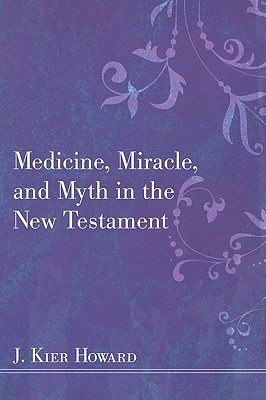
 J. Keir Howard, Medicine, Miracle and Myth in the New Testament (Eugene, OR: Wipf & Stock, 2010), 121 pages, ISBN 9781608992447.
In his book Medicine, Miracle and Myth in the New Testament, J. Keir Howard has a simple aim, “to apply modern medical knowledge” to the study of miracles and illnesses recounted in the New Testament (vii). His intended audience consists of the modern reader, ministers and students. Howard holds doctorates in medicine and theology and therefore possesses the necessary background to converse about these topics.
Howard writes that disease and pathology have not changed significantly through the centuries, but the understanding of the causes of illness, their prevention and treatment have changed (viii). Consequently, he feels medical explanations are better suited to interpret the miracles in the New Testament instead of what many scholars usually employ—details of magic and spirit possession (viii).
Medicine consists of five chapters, a glossary, bibliography and a Scripture index. Howard’s use of medical terminology throughout the work, which will be unfamiliar to most readers, makes the glossary a nice feature of the book. The first chapter serves as an introduction to diseases and medicine in the first century. In this chapter, Howard introduces the term “abreaction,” defined as a type of treatment, which results in a discharge of emotion leading to a rapid and often temporary resolution of medical symptoms (9). This term is important for many of Howard’s conclusions about the miracles recounted in the New Testament.
In the each of the remaining chapters, Howard addresses the miracles described in the Gospel of Mark, the remaining gospels, the book of Acts and the Epistles. A final chapter is dedicated to medical metaphors and allusions in the New Testament.
One criticism of the book is the absence of references at important junctures in the text. While Howard shares some important background about medicine in the first century, he fails to provide references for this information. For example, he discusses some of the techniques utilized by folk healers, supposedly practiced during the time of Jesus’ ministry (7). One of these techniques, known as couching, purportedly would grant some healing or relief of cataracts. However, the reader is not provided with the source of this information. The entire work, consisting of one hundred and twenty-one pages, contains less than a dozen footnotes.
Howard’s diagnosis of the various medical issues that Jesus attends to diminishes the miraculous nature of his healings. An example of Howard’s approach is found in the description of the healing of the lame man recounted in the Synoptic Gospels (Mark 2:1-12; Matt 9:1-8; Luke 5:21-32). He claims the lame person suffered from a psychosomatic disorder, thus rendering him unable to walk. According to Howard, Jesus’ forgiveness of the man’s sins removed his feelings of guilt. With this anxiety gone, Jesus’ command to “get up” created an environment charged with emotion thereby allowing the man to walk again. A couple of other examples that Howard labels as psychosomatic disorders are: the man with the speech defect (Mark 7:31-37) and the women with the hemorrhage (Mark 5:25-34; Matt 9:20-22; Luke 8:43-48). While Howard notes that stress related issues can reduce menstrual bleeding, he states there are cases when excessive bleeding could be attributed to psychological factors.
In the narrative of the nobleman’s son (Matt 8:5-13; Luke 7:1-10; John 4:46-54), Howard offers interesting commentary. In this account, he believes that no actual healing occurred through any efforts on Jesus’ part. Instead, Jesus merely gave the official “assurance the crisis had past” and informed him that his son would recover (63).
Howard posits that most of the cases Jesus dealt with in the gospels were psychosomatic in nature, as opposed to illnesses of “anatomical pathology” (28). According to Howard, Jesus administers “abreactive techniques,” which were intended to relieve symptoms in individuals who were afflicted with hysterical illnesses (33). Howard rightly calls attention to the fact there are no records of Jesus healing any broken limbs in the gospel traditions (58). In the end, Howard’s approach leads one to speculate if Jesus should be considered a divine psychiatrist rather than a divine physician.
Despite its medical emphasis, the book is easy to read and informative. Is Howard’s analysis convincing? It is certainly plausible in some of his examples. However, it will be up to the reader to make his or her own diagnosis.
Reviewed by David Seal
Originally published on the Pneuma Foundation (parent organization of PneumaReview.com) website. Later included in the Spring 2021 issue.