
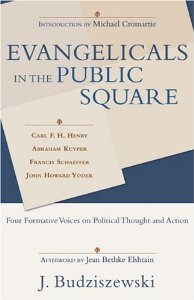
Evangelicals in the Public Square

 J. Budziszewski, et al., Evangelicals in the Public Square: Four Formative Voices on Political Thought and Action (Grand Rapids: Baker Academic, 2006), 218 pages, ISBN 9780801031564.
J. Budziszewski is professor of philosophy and government at the University of Texas at Austin, and has written a number of well-recognized books on political theory, politics and virtue ethics, tolerance and liberalism, and natural law ethics, among other topics. For the project which formed the backbone to this book, a conference was sponsored by the Ethics and Public Policy Center in Prouts Neck, Maine, in September of 2003, where initial drafts of the essays published here were presented. In this review, I will summarize the book’s structure and arguments, briefly explicate on the central dilemma plaguing the formation of an evangelical political theology, and comment on why these matters are of relevance also to Pentecostal and charismatic Christians today.
After a short introduction by Michael Cromartie of the Ethics and Public Policy Center, the two lead essays by Budziszewski, which constitute more than half of the book, lay out the basic issues and set the tone of discussion for the volume. In the first essay, Budziszewski suggests that one major reason why evangelicals have not yet developed a robust political theology is that their commitments to grounding any theological agenda biblically do not work well with the fact that there are insufficient biblical guidelines for such a task. In fact, political theology needs a more hearty acknowledgment of the role of general revelation precisely in order to provide a theological justification for evangelical engagement in matters related to the wider public square, as well as theological guidelines for how evangelicals might concretely proceed. But, as Budziszewski then attempts to show in his second longer essay on the four formative thinkers announced in the book’s subtitle— Carl F. H. Henry, Abraham Kuyper, Francis Schaeffer, and John Howard Yoder — evangelical hesitation about embracing this particular theological idea (of general revelation) further complicates their already difficult task. In Budziszewski’s analysis, the political theology each of these evangelical thinkers suffers because they falters at key points in their projects with regard to the doctrine of general revelation: Henry is hampered by a nagging premillennial and dispensationalist defeatism in addition to an ambivalence about the (perhaps all to Catholic) idea of general revelation; Kuyper by an underdevelopment of his ideas of common grace, sphere sovereignty (of the state, society, and the church), and principled pluralism; Schaeffer by an unbalanced emphasis on apologetics which in turn neglected the pragmatic dimensions of engaging the public square, as well as by his acceptance of the presuppositionalist school of apologetics along with its suspicion regarding general revelation; and Yoder by a sectarian and countercultural orientation which is not predisposed to exploring the continuities between Christians and non-Christians, even for the purposes of public engagement. As a result, these four evangelical theologians, as formative as any for evangelical thought and action, have been unable to bequeath to their descendents the much needed resources to more fully develop the kinds of orienting ideas, practical programs, and cultural apologetics needed for a more vibrant evangelical political theology today.
The remainder of the volume includes four essays by scholars responding to Budziszewski’s readings of these evangelical theologians and a concluding after word reflecting on the conference discussion as a whole. David Weeks, a Henry scholar and political science professor at Azusa Pacific University, attempts to provide a thicker description of Henry as an evangelical theologian as well as fill out, in dialogue with Henry, some of the details which Budziszewski has identified with regard to the formulation of an evangelical political theology. Similarly, John Bolt, a Kuyper scholar and systematician at Calvin Theological Seminary, basically agrees with Budziszewski’s remarks about Kuyper, but provides a further elaboration of how the Kuyperian theological vision can be reappropriated in the service of evangelical thought and political action. Not surprisingly, William Edgar, a presuppositionalist philosopher and theologian at Westminster Theological Seminary, responds to Budziszewski both by locating the larger socio-cultural, political, and theological framework of Schaeffer’s apologetics and by explicating how the logic of presuppositionalism leads to a different set of concerns that may be complementary rather than opposed to the logic derived from a commitment to the doctrine of general revelation. Finally, Ashley Woodiwiss, a political scientist at Wheaton College, responds that even if one cannot go all the way with Yoder, yet one must respect how his Anabaptist and Mennonite perspective informed his scholarship and produced vision of the gospel focuses on the church as an alternative politics, an distinctive praxis, and a subversive mode of cultural engagement, all of which combine to perhaps even undermine the received framework of questions concerning evangelicalism as well as political theology. The book concludes with Jean Bethke Elshtain’s (Laura Spelman Rockefeller Professor of Social and Political Ethics at the University of Chicago “A Friendly Outsider’s Reflections” (her title) on the entire exchange.
I came to this volume with my own ideas about the state of evangelical theology vis-Ã -vis political theology, and found my more-or-less uninformed intuitions confirmed by what I read. In particular, I note Budziszewski’s framing of the issues in terms of what he called “the evangelical dilemma”: “The problem for evangelical political thinkers is not that the Bible contains no political teachings (for it does) but that the Bible does not provide enough by itself for an adequate political theory” (p. 23). Given the evangelical credentials of each of the respondents (with the exception of Elshtain the “friendly outsider”), none questioned Budziszewski’s framing of “the evangelical dilemma.” Rather, upon acceptance of the evangelical commitment to scripture as the foundation for all theological reflection, one wonders what the options are. Weeks goes so far as to state: “Given that the authority of Scripture is the hallmark of evangelicalism, it may be both undesirable and unrealistic to expect evangelicals to craft a distinctive view of politics…. [I]f the Bible does not fully address political life, then a biblical politics is also unrealistic, because evangelicals are precariously building an edifice on an inadequate foundation” (p. 139). These basic assumptions and their implications are also echoed by Bolt: “If…an evangelical public theology or political philosophy ought to be, minimally, a biblically illumined one, on what do we focus the light of biblical revelation? I wonder if evangelicals have made a major mistake by attempting to create a biblical sociology, a biblical theory of social institutions, such as the state” (p. 161). His proposal is to reformulate evangelical public theology not on a theory of politics but rather on a biblical anthropology.
These trajectories of thought encapsulate both the promise and the challenge of evangelical theology today. On the one hand, the evangelical commitment to a biblically informed theology, worldview, and way of life may represent its gift to the church ecumenical. On the other hand, in a post-critical rather than modernist framework, what the Bible says is no longer a matter of appealing to a select number of proof texts. This situation results in the quandary explored by Evangelicals in the Public Square: that evangelicals looking for guidance for if and how to engage this public domain go to the Bible for help to think about their politics, but what they find instead is either the multiplicity of biblically informed perspectives or the lack of any substantive and coherent biblical view of political engagement. Is the response then to follow Weeks, Bolt, and perhaps many others and jettison any attempt to formulate a systematic biblical and theological vision for political engagement?
Readers of this journal will now sense why I have been led to explore precisely this question. Growing up Pentecostal — and we can defer for our purposes the question of whether Pentecostalism is a sub-culture of evangelicalism or vice-versa — I absorbed “the evangelical dilemma” and was swept up in the bandwagon that not only was attracted to the proposals of Weeks and Bolt, but took their suggestions to their logical conclusions and eschewed not only the task of political theology but also the practices of political engagement. In my Pentecostal worldview, being biblical meant many things, but it certainly did not mean develop a theology of political involvement as well as an agenda for political life. That was what “liberals” did, and those folk justified their beliefs and practices by foisting an extraneous and illegitimate set of concerns on the biblical text. The logic of a biblical worldview was this: if it could not be clearly read off the pages of scripture — and assuredly, as this book clearly articulates, a political theology could not be so identified — then it was from God’s point of view a secondary concern at best. And since God’s primary mandates — e.g., the Great Commission — could take up our entire lifetimes, one needed to be vigilant so as not to be sidetracked from what was truly important.
There is only space for two sets of remarks in concluding this already lengthy review. First, the preceding set of reflections summarizes some of the major reasons why I identify myself first and foremost as a Pentecostal rather than an evangelical theologian. While I wish to uphold the authority of scripture with evangelicals, I have come to see that evangelical mantras such as sola scriptura, however qualified, are insufficient for any political theology, much less any robustly theological perspective on much of life in our late modern context. This is not because I think the Bible is irrelevant to our concerns — far from it! Rather, it is because I don’t think that evangelical approaches to the Bible are adequate for developing holistic theological understandings of modern life, much less contemporary political theory and practice. Budziszewski’s proposal to retrieve the doctrine of general revelation for the purposes of evangelical political reflection highlights precisely my point: there is no plain sense reading of the Bible relative to contemporary concerns that is non-theological (or non-historical, non-political, non-socioeconomic, non-ethnic, etc.).
Hence, second, if I did not agree with Budziszewski’s specific suggestions, my response is either 1) propose an alternative theological perspective to complement or perhaps even replace the role he sees being played by the doctrine of general revelation, or 2) shift the terms of the conversation completely, perhaps as suggested by Weeks and Bolt, but, perhaps more radically, toward a Yoderian vision of the church as an alternative politics. What I don’t have is the luxury to embrace the non-politically engaged posture of my (classical) Pentecostal upbringing because that in itself is a political response. Now there may indeed be some overlap between (classical) Pentecostal sectarianism and the Yoderian account of what it means to be church in a post-Constantinian and even post-Christian world. However, even if we were to adopt such a posture of being church as a form of cultural criticism, as Woodiwiss’ comments show, there is still the need for some concrete suggestions for how to live as political creatures in a modern democracy such as we have in North America. Hence the task of political theology cannot be completely ignored. And for this assignment, might I suggest that Pentecostals and charismatics have theological resources at their disposal in the Pentecost narrative — e.g., in the Lukan account of the Spirit’s having been poured out on all flesh (Acts 2:17) — which can complement either the Kuyperian notion of common grace or Budziszewski’s affirmation of general revelation. But the details of what such a distinctive Pentecostal political theology might look like will have to await another occasion.
Reviewed by Amos Yong
Originally published on the Pneuma Foundation (parent organization of PneumaReview.com) website. Later included in the Fall 2024 issue.








JS wrote: “Great review. He identifies the key areas of concern that we all need to work on to develop a theological basis for a robust engagement with our culture through politics.
If we abandon politics to the ideologues we have muted the voice of Christ speaking into the political regimes of our day.”
Do you have any recommendations for books or articles that talk about Christians in the public square?
This response from Darrin Rodgers appeared in the Spring 2008 issue:
Thanks for the copy of the Winter 2008 issue of Pneuma Review! I appreciated the opportunity to contribute. I read with interest Amos Yong’s online review of J. Budziszewski’s book. I was quite pleased—I have been very intrigued by Catholic moral theology and natural law and this was the first time I had seen a Pentecostal scholar interact with the subject. Most of my Pentecostal and evangelical friends who are scholars in political philosophy have ended up converting to the Catholic, Orthodox, or Anglican churches.
Blessings!
Darrin J. Rodgers, Director
Flower Pentecostal Heritage Center
website: http://www.iFPHC.org