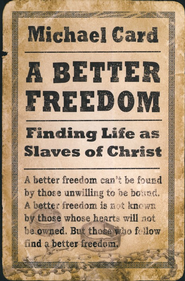
A Better Freedom: Finding Life as Slaves of Christ

Michael Card, A Better Freedom: Finding Life as Slaves of Christ (Downer’s Grove: IVP, 2009), 166 pages, ISBN 9780830837144.
As would be expected from a Christian musician who combines depth of experience with theological training, Michael Card balances devotional and scholarly insights. Motivated by his experiences among African American churches and their moving tendency to address Jesus as Master, Card uses both personal anecdotes and stories from the history of American slavery as a lens through which to take the reader on a journey through the old and new testament worlds of slavery, and particularly to draw out the new testament theme of Christian life being deliverance from one slavery, that of the world, into the freedom that comes only from setting apart Jesus as a new Master. The book is divided into three main parts, each of which engages the reader at the level of the imagination to allow stories of African American slavery to help illuminate Biblical contexts. The first and shortest articulates the beginning of Card’s aforementioned journey, namely among African American communities, and the inspiration from the early church that, in the words of Ignatius, a ‘better freedom’ comes only through setting apart Christ as Lord. He also describes something of the three contexts of Old Testament, New Testament and African American slavery. The first is dealt with somewhat swiftly (and one suspects potentially idealistically) and is not really mentioned after this brief treatment. The latter two he sees as similarly brutal and demeaning, and it is the New Testament witness, illustrated with African American stories, that he focuses on in the rest of the book.
The second, much lengthier, part of the book deals with the life and teaching of the apostle Paul and his emphasis on Christian discipleship as characterised by being a ‘slave of Christ’. Card’s focus on the theme is illuminating and the reader is struck by the sheer extent of such teaching and references to slavery throughout Paul’s life and writings. Of particular note is his insight that the Pauline words used to describe three of the greatest gifts of grace, namely justification, redemption and reconciliation, all come to us from the world of slavery. Being a slave of Christ, however, is not like the slavery to the world that oppresses people in captivity, but Christian disciples are freed from such an old life and freed to a discipleship that involves pleasing our Master, healing divisions through our common identity, and a life of service. Card admirably does not shy away from difficult questions and points out that although Paul was not ostensibly an abolitionist, this was because his main emphasis was that all Christians, slave or free, were to find their identity not in their literal freedom, or lack of it, but rather in their common identity of having Jesus as Master. Nevertheless, if they could, they should take their opportunity for freedom.
The third and longest part of the book is an exploration of the theme of slavery in the identity, life and teaching of Christ. Card points out the centrality of Christ as suffering servant and of the Philippian hymn (Phil. 2:6-11) to the early church. Christ as servant is, of course, in continuity with the descriptions of each of the heralds of the new Kingdom seen in the gospels, namely Mary, Simeon and John the Baptist, each of whom is described in vocabulary pregnant with the idea of slavery and belonging to a ‘Master’. A shocking and particularly revealing statistic is that almost half of the parables of Jesus involve slaves or slave-like characters, and Jesus invites the listener to identify with such characters and their respective roles. Card challenges the reader to consider what the church might look like if Christians ceased to ask ‘Do I feel like doing it?’ but rather ‘What does the Master command?’ Of course, no servant is greater than his Master and Card movingly drives home the truth that Jesus, who washed his disciples’ feet and then taught that whoever wants to be the greatest should also do this task of a slave, is the Master who died to pay the ransom or slave price for us. Jesus was a Master whose life was paid for with the Old Testament slave value of thirty pieces of silver, who had the placard of a slave around his neck, who was offered the drink of a slave (sour wine), who received the flogging of a slave, and who was executed by means of the apparatus reserved for slaves and the worthless—the cross.
In sum, Card is successful in reminding us of the centrality of the slavery motif to the Christian narrative, in the lives of Jesus, Paul, and of ourselves. As a song writer he fittingly draws a devotional response from the reader, while also illuminating the historical and biblical contexts, and finally flagging some attention to the ongoing problem of slavery in our times. The reader is left in awe of the risen Christ, who, despite his exalted state, still cooks breakfast for his disciples.
Reviewed by David Purves
Preview this book:Â http://books.google.com/books?id=rQUzwCpFskgC