Alister McGrath: Surprised by Meaning

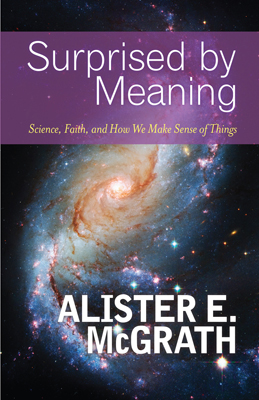
 Alister E. McGrath, Surprised by Meaning: Science, Faith, and How We Make Sense of Things (Louisville, KY: Westminster John Knox Press, 2011), 136 pages, ISBN 9780664236922.
McGrath’s Surprised by Meaning is a fairly accessible and slender volume that quickly immerses the reader into the ongoing conversation between radical atheism, science, and Christianity, centering on the latter’s ability to provide meaning to experience. As the title, an allusion to C.S. Lewis’ work, suggests, Surprised by Meaning falls into the tradition of intellectually robust and academically informed yet pietistic apologetics. It seeks to navigate and renegotiate this tradition through modern scientism and militant atheism. In the process, McGrath builds an irenic yet polemical argument that comes to crescendo in a more deeply appreciable presentation of the Gospel.
Alister McGrath, a North Irish theologian, is currently a faculty member of Theology and Religion at the University of Oxford. He is also an ordained Anglican priest. Prior to his work as a theologian and priest, McGrath pursued studies in biochemistry and molecular biology, earning a D. Phil in the latter. He has written a number of other books on the relationship between science and faith, the New Atheism, and historical theology. He has recently written a biography on C.S. Lewis (2013) and a book on Swiss theologian Emil Brunner. As a conservative and intellectually engaged Christian, McGrath’s work represents some of the best thought engaging influential currents in contemporary, Western society. However, for some American Evangelicals, McGrath would be considered somewhat liberal, as he endorses a type of theistic evolution and appropriates truth from literature and philosophy as well as the Scriptures.

Surprised moves slowly, especially through the first seven chapters. McGrath, accustomed to writing tomes, tends towards the same pace with this text. It is almost a quarter of the way through the book before he describes the thesis of the book by quoting Bernard Lonergan, “‘God is the unrestricted act of understanding, the eternal rapture glimpsed in every Archimedean cry of Eureka’†(29).
Several more pages later, the thesis is clearer:
The argument of this book is that Christianity offers an intellectual sun that illuminates an otherwise dark and enigmatic world: it gives a deeply satisfying “empirical fit†between theory and observation, which suggests that the map of reality that it offers is reliable and may be trusted (57).
Prior to this, McGrath traces his own turn from atheism to faith, the contours of the New Atheism and some of its fallacies, and the proper role, use, and definition of science. He writes: “[T]hings that are really worth believing in lie beyond proof. Our most important beliefs are the ones that simply cannot be proved†(19) and “Science is about warranted belief, not about rational belief. The history of science is about the recalibration of notions of ‘rationality’ in the light of what was actually discovered about the deeper structure of nature†(27). In more philosophical argot, McGrath seeks to provide the beginnings of a Christian epistemology. In another sense, the first half of the book feels more like a prolegomenon than the building of a sustained thesis. Nonetheless, many of the threads pulled out in the first seven chapters are interwoven in the final six.
The other half of Surprised seeks to display how the intellectual sun of Christianity illuminates the world. McGrath begins this endeavor by looking at cosmology. Although at times too dense for the non-specialist, his main point in this section unpacks the anthropic principle at a universal and biological level. In short, the universe is “fine tuned†for life (61, 66, 68). He then discusses the latest developments in regards to teleology and evolutionary theory. Here he argues that there seems to be purpose in the evolutionary process and this suggestively coheres with what could be called Providence.
Moving from developments in science and their illumination by the Christian sun, McGrath explores the meaning of history, culture and faith vis-Ã -vis an atheistic account. He charts his course by centering on the concepts of the image of God and the sinfulness of humanity (86). Keeping interpretations of history and humanity oscillating between these two poles provides a necessary realism, neither angel nor devil.
Through a discussion about the existential quest for significance mediated by the grander narrative of Christianity, McGrath leads the reader to his conclusion. Here he takes the big questions of identity, value, purpose, and agency and provides a biblically supported account of how Christianity makes sense of these issues. Somewhat unsurprisingly, McGrath argues that we cannot actually find the meaning we seek, but we have to have it shown to us (104). This disclosure, or revelation, is the Gospel.
This book is an important synthesis and update of the status of the faith-science-atheism conversation, even though many of its sparing partners are dated as well as its contemporary supporters. Nonetheless, a more updated version of the same conversation may require a degree of technical, scientific, and philosophical knowledge so as to preclude the popular reader. McGrath, on the other hand, understands that cutting edge science or scientism as it is distilled to the masses is years behind actual science and rightly, in my opinion, seeks to engage older articulations and arguments.
For Pentecostal and Charismatic Christians, McGrath’s argument is pneumatologically weak. Even though he mentions the Spirit as the One Who “creates, redeems, and sanctifies†(53), he does not go on to apply the Trinitarian formula to his ideas of providence, fine-tuning, revelation, and so on. Concerning revelation and imagination, McGrath overlooks the Spirit’s role in disclosing meaning and sourcing vision within the Christian imaginary. Nor does McGrath consider the Spirit’s role as an intercessor on the behalf of creation. This, to me, helps provide an account for the immanence of God’s involvement in the project of creation suggested by the anthropic principle.
McGrath, perhaps for reasons of time and space, does not engage with the issues related to natural theology. Nor does he investigate some of the newer scholarship concerning Romans 1 and the soteriological inadequacies of theologies (or even supplements to theologies) derived from observation.
In short, McGrath’s work serves as a close mile-marker on the long road through late modernity. It is not essential reading but helpful.
Reviewed by Benjamin Crace
Publisher’s page: https://www.wjkbooks.com/Products/0664236928/surprised-by-meaning.aspx