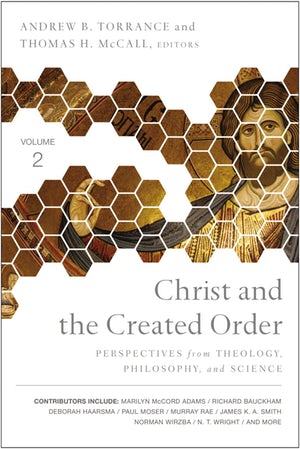
Christ and the Created Order: Perspectives from Theology, Philosophy, and Science, reviewed by Stephen Vantassel

 Andrew B. Torrance and Thomas H. McCall, eds., Christ and the Created Order: Perspectives from Theology, Philosophy, and Science, Vol. 2 (Grand Rapids, MI: Zondervan, 2018), 11-301 pages.
In this second volume, Torrance and McCall have collected 16 articles exploring the implications for science and theology regarding Christ’s incarnation and role as creator and sustainer of the universe (Col 1:15-17). As in the first volume, the text lacks a unified theology. However, for scientists, theologians, philosophers, and researchers interested in tackling ideas of science and faith as they intersect in the person and work of Jesus, this text would be a worthy place to begin. For if you are not interested in the focus of one article, simply turn a few pages and an entirely different focus will be explicated in the next.
The book opens with a splendid, and dare I say, must-read introduction by the editors, where they set the table for the articles that follow. The articles are organized into four sections, theological perspectives, biblical and historical perspectives, philosophical perspectives and scientific perspectives. This organization is helpful in relating to the reader what the writer’s point of view is. Nevertheless, in each case, authors bring, to varying degrees and intensities, their Christian faith into the discussion. In other words, the authors are not disinterested and objective writers but are those writing from a faith position. I have spotlighted a handful of publications to help readers in getting a sense of the diversity of topics and will end with some summary observations.
Murray Rae’s article, “Jesus Christ, the Order of Creationâ€, opens the Theological Perspectives section by arguing that science’s understanding of reality and the explanation given by Scripture (Col 1:15-17; 1 Cor 8:6, etc.) can be reconciled by recognizing that explanation for phenomena can occur at differing levels. He uses the music of Chopin to illustrate how science can explain a song by looking at the notes, and theology explains by looking at the score. As valuable as this heuristic is, Rae recognizes that we must also consider the impact that sin has fractured our world so that the score is in a sense broken. Nevertheless, God has left enough of the score intact to let us see the beauty and a glimmer of the ultimate purpose.
Brian Brock’s “Jesus Christ the Divine Animal?: The Human Distinctive Reconsidered†responds to Darwin’s denial that humans are qualitatively different from animals by reframing the issue. Brock contends that looking for something intrinsically different in humans when compared to animals, is a dead end. Rather, we should look extrinsically, namely to our relationship with God. From this perspective, Brock believes that evolution and a high view of scripture (i.e. Genesis story) may be reconciled while avoiding ensnarement with other problems such as the presence of evil. Brock’s idea here is an interesting rephrasing of the functional view of human identity (Gen 1:28).
The problem of evil is addressed in Brian Curry’s “Christ, Creation and the Powers: Elements in a Christian Doctrine of Creation.†Curry contends that the typical binary discussion of God and creation fails to account for the biblical testimony, which includes a third element, the evil powers. The presence of evil powers is necessary because scripture says that God is not satisfied with creation. God continues to work towards redemption and fights the powers to achieve those ends. Curry provocatively says that science can be a power that both enslaves and benefits its users. Readers will be stimulated by Curry’s forceful discussion, but some may be put off by the apparent leaning toward open theism.
Richard Bauckham’s article, “Gospel Narratives and the Psychology of Eyewitness Memory†is the second article in the biblical and historical perspectives section. Bauckham contends that arguments claiming that eyewitness testimony (as found in the Gospels) cannot be trusted is simplistic and fails to recognize that not all memory stories suffer challenges of accuracy equally. His discussion is superb for its focus, brevity, and attention to recent psychological research. I suggest this article alone is a must-read.
Erin Heim’s, “In Him and Through Him from the Foundation of the World: Adoption and Christocentric Anthropology†explores Paul’s use of adoption language. She shows that when Greco-Roman adoption practices are understood, Paul’s use of adoption language for the people of God stands in remarkable contrast, underscoring God’s graciousness, while maintaining God’s qualitative uniqueness along with Christ’s status. She contends that adoption metaphors can help the western church better appreciate the Orthodox theology of theosis. Readers will also find that her argument has implications for the Church’s understanding of gender roles as they relate to Church government.
The book’s final section, Scientific Perspectives, concludes with Ruth M. Bancewicz’s article “The Scientist-Believer: Following Christ as We Uncover the Wonders of the Living World†where she reaffirms the teaching that all Christian activities, including our labor, is to be done to the glory of God. Using personal stories from several researchers, Bancewicz shows that Christian scientists do not have to leave their faith at the door of the laboratory.
Readers should be aware that some authors leaned toward a sort of mysticism as they endeavored to baptize their scientific thinking with theological meaning. Awe of God’s workings in the Cosmos is certainly an appropriate response, and who better informed to be awed than a scientist, but at times the conversation felt a bit too non-rational. Some authors showed an overreliance on sacramental language related to the Lord’s Supper. As a non-sacramentalist, I found it odd that scientists would read realism in the Lord’s Supper but read Genesis 1-2 as metaphorical. How that hermeneutical stance was grounded was unfortunately never explained by any of the authors that used it. Likewise, authors who agree with evolution (which needs death to work) would complain about the suffering in the world. It never seemed to occur to those writers that if death and suffering were problems then how would God’s use of evolution fit into that? As I argued in, Dominion over Wildlife? An Environmental-Theology of Human-Wildlife Relations, animal suffering is not necessarily a moral problem as Adam and Eve were to express dominion over animals prior to the Fall. But if the authors believe that animal suffering is a problem then how does that square with their acceptance of evolution? Unfortunately, they did not provide an explanation.
Like all collections of articles sourced from a variety of authors, quality is uneven. Nevertheless, graduate students, well-read and educated laypersons, and specialists interested in the relationship between Christian faith and science will likely find something in each article that will either inform, challenge, or instigate further thought.
Reviewed by Stephen M. Vantassel
Preview Christ and the Created Order: https://books.google.com/books/about/Christ_and_the_Created_Order.html?id=z4EoDwAAQBAJ
Publisher’s page: https://www.zondervan.com/9780310536086/christ-and-the-created-order/
Further Reading:
 Read Stephen Vantassel’s review of Andrew B. Torrance and Thomas H. McCall, eds., Knowing Creation: Perspectives from Theology, Philosophy, and Science, Volume 1 (Zondervan, 2018).