Cornelius G. Hunter: Darwin’s Proof, reviewed by Amos Yong

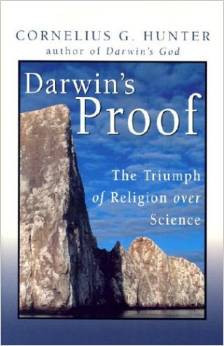
 Cornelius G. Hunter, Darwin’s Proof: The Triumph of Religion over Science (Grand Rapids: Brazos Press, 2003), 168 pages, ISBN 9781587430565.
The volume under review is a sequel to Hunter’s Darwin’s God: Evolution and the Problem of Evil (Brazos Press, 2001). The central thesis of the former book is that the theory—rather than fact—of evolution originally emerged in the mid-nineteenth century out of the deistic the concept of God with the added benefit of distancing God from the waste, pain, suffering, and evil so evident in the natural and human worlds. In Darwin’s Proof, Hunter further develops this main idea, but provides a creationist alternative to the naturalistic theory of evolutionary origins.
Hunter’s Ph.D. in biophysics (University of Illinois) means not that his interpretation of the alleged evidence for evolution is correct in all respects, but that it cannot be easily dismissed. This is especially the case in the first five chapters of the book where he lays out what he discerns to be the fundamental arguments against Darwinian evolution—its inability to account for the complexity of DNA structures, protein functions, enzyme pathways and cycles, nerve cells, and other life forms—and the inconclusiveness of the scientific evidence for evolution, especially the fossil evidence, data from comparative anatomy, and molecular, genomic, and phylogenetic (related to the evolutionary tree) similarities. Chapters six and seven then make more explicit the internal philosophical and theological contradictions (as Hunter sees them) of evolutionism.
The last four chapters constitute Hunter’s own proposal regarding the origins of life: adherence to a fairly traditional rendition of the biblical account of creation, fall and redemption as providing a narrative and philosophical framework for scientific inquiry in general and biological origins in particular (chapters eight and nine), and advocacy of the recently emergent and increasingly popular intelligent design theory as being compatible with Christian theistic approaches to rigorous scientific investigation (chapters ten and eleven).
Both Darwin’s God and Darwin’s Proof will be welcomed by creationists and anti-evolutionists. It appears that these are the audiences that Hunter is addressing, at least in part, by publishing this very accessible book with a press targeting evangelical laypersons. Be warned, however, that while many of the arguments in these two volumes may be simplistically called into serving traditionalist apologetic purposes prevalent in evangelical, fundamentalist, creationist, and even Pentecostal and charismatic circles, Hunter’s approach signals a subtle but very important shift in the contemporary science and religion conversation. That is to say, while Hunter’s own theological commitments seem fairly traditionalistic, his engagement with the sciences is rigorous (rather than merely instrumentalistic or apologetic), his rhetorical approach is fair (rather than merely polemical), and his interaction with evolution and its supposed evidences is sophisticated (rather than merely dismissive). I would urge even those who agree with Hunter’s theological position to read him in order to learn something about science in general and evolutionary science in particular. On the other side, defenders of Darwinian evolution will be challenged not only at the presuppositional level (that is, with regard to the ideological, religious and metaphysical commitments undergirding evolution) but also at the evidential level (that is, with regard to the specific interpretation of the scientific and, especially, biological data).
On the other side, perhaps Hunter’s work is so good precisely because he raises all the right questions, not only for Darwinian evolution, but also—for those with the appropriate intellectual background who are committed to the quest for truth—for the science and religion conversation in general (e.g., regarding intelligent design), and for the Christian understanding of creation in particular (whether that of theistic evolution or creationistic science). As first and foremost a Christian theologian, this reviewer could not help but be struck by the results of Hunter’s own efforts to bring together his Christian faith and theology and his scientific learning; what appeared in many cases to be unsuccessful attempts at synthesis seemed to function coherently for Hunter himself, raising the question of who is and is not quite seeing straight. As someone sympathetic but not yet convinced about intelligent design, this reviewer found the arguments in Darwin’s Proof terribly underdeveloped, thereby providing further motivation to continue engaging with both sides of this particular conversation. As a relative newcomer to the science and religion dialogue I am in no position to critique Hunter’s science and others will have to provide perspective on the scientific arguments in this book.
In any case, Darwin’s Proof provides a model for those in evangelical, pentecostal and charismatic circles who wish to take up rather than shy away from the challenges of modern science, and do so in ways that take both science and faith seriously rather than engaging either (or both) superficially.
Reviewed by Amos Yong