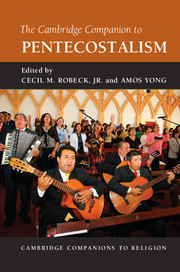
 Cecil M. Robeck, Jr., and Amos Yong, eds., The Cambridge Companion to Pentecostalism (New York: Cambridge University Press, 2014), xiii + 340 pages, ISBN 9780521188388.
The serious scholar of Pentecostalism recognizes the incredible complexity of Pentecostal/Charismatic Christianity. The numerical and geographical explosion of Pentecostals continues to produce an ever-diversifying movement that proves both challenging and exciting for researchers. For this volume, coeditors Cecil Robeck and Amos Yong assemble a team of well-respected scholars, skilled in multiple disciplines and from across the globe, to lead us into and not through this spaghetti junction. True to the nature of a Companion volume, the contributors refuse to provide easy answers and choose instead to offer sufficient introduction to chosen topics so that readers may navigate their way through the maze of scholarship. The editors divide the book into three parts.
What is the glue that holds this worldwide movement together?
The historical section consists of chapters on the origins of the three major strands of modern Pentecostalism. Robeck introduces the volume with a survey of numerous attempts to discern the beginnings of Classical Pentecostalism. He exposes readers to various methodological approaches employed to locate the movement’s origin. Similarly, Michael McClymond narrates the emergence of the Charismatic renewal not as a Big Bang – with origins around a single locale or theme – but as a “String-of-Firecrackers†– a vast array of renewal movements across North America and around the world. David Reed explores the origins of Oneness Pentecostalism and refuses to reduce their origins simply to early separation or expulsion from opponents such as Trinitarian Pentecostals (and indeed by Christendom in general). Instead, he surveys a movement made up of manifold independent streams not only with little internal coherence, but often in isolation from one another. It goes without saying that the multiple roots of the Pentecostal/Charismatic Christianity do not generate a uniform renewal movement.
What are the basic family resemblances among Pentecostals around the world?
In the second section, five contributors take readers on a world tour of Pentecostal/Charismatic Christianity. From the Global North (North America and Europe including the former U.S.S.R.) to the Global South (Latin America, Africa, and Asia), each writer provides a short historical introduction to his respective region with particular attention to indigenous contexts. The contributors highlight critical issues relevant to specific regions such as political engagement, socio-cultural integration, current trends, and prospective areas for optimism and concern. Given the diversity of African or Asian Pentecostalism, careful readers will recognize the struggle of contributors to not succumb to generalizations that reduce or ignore the significant differences within such expansive continents (e.g., between Nigerian and South African Pentecostalism or Chinese and Korean Pentecostalism). Because these writers must work with a limited word count, they seek to locate Pentecostalism on a global map and whet the appetite for readers to zoom into specific nations of the various continents. Robeck and Yong utilize contributors who share ethnic and/or geographic identity with their assigned region.
Pentecostalism is an expansive movement that cannot easily be categorized.
The final section turns to method. How does one study Pentecostalism or, better stated, the multiple Pentecostalisms? Beyond questions of origins and the general hisstories of a movement now spread across the globe, what might be the glue that holds such a movement together? What are the basic family resemblances among Pentecostals around the world? On the other hand, how does one celebrate yet evaluate the expansive nature of a movement that defies easy categorization? Contributors in this section assess the emergence, growth, and future of Pentecostalism through the lens of politics and economics, cultural anthropology, sociological narratives, spiritualities (beliefs, practices, liturgies), ecumenism, and interreligious dialogue. To my dismay, however, the volume includes no female contributors and also fails to produce a chapter on the role of gender issues in Pentecostalism. The convoluted history of the role of women in Pentecostalism surely warrants analysis for such a volume.
Pentecostals are more than Evangelicals who speak in tongues.
While much of the Pentecostal story must yet be told and evaluated, Robeck and Yong produce a thorough introductory volume for those newly interested in Pentecostalism and at the same time incite scholars and students to delve further into this rich field of study. Each contributor provides valuable endnotes and suggestions for further reading. As I think of the broader
Pneuma Review readership, I also recommend this volume for ministers and local church educators. This work would serve well both as a resource for pastors or a book study volume for an informed Bible study or small group setting. Finally, I have already adopted this work for the course I teach on Pentecostal history and theology at Evangel University and would recommend it for similar courses whether at confessional or secular institutions. I often start the first day of class with the question, “what is a Pentecostal?†The most common refrain is akin to “we’re Evangelicals who speak in tongues.†I know this volume will help me guide my students to discover that “there’s more to Pentecostalism than this!†It should come as no surprise that the answer(s) to this question be found in the fitting title for the final chapter to the volume; in typical Yongian fashion, “Instead of a Conclusionâ€, there remains so much more to understand, explore, and evaluate. To this end, readers will only desire more.
Reviewed by Martin W. Mittelstadt
Publisher’s page: http://www.cambridge.org/US/academic/subjects/religion/church-history/cambridge-companion-pentecostalism
Preview The Cambridge Companion to Pentecostalism: https://books.google.com/books?id=wNEHBAAAQBAJ