
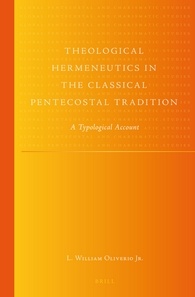
Bill Oliverio: Theological Hermeneutics in the Classical Pentecostal Tradition

 L. William Oliverio, Jr., Theological Hermeneutics in the Classical Pentecostal Tradition: A Typological Account (Netherlands: Brill, 2012), ISBN 9789004280175.
I just finished reading L. William Oliverio, Jr., monograph, Theological Hermeneutics in the Classical Pentecostal Tradition: A Typological Account. In the first six chapters, Oliverio maps the historical development of Pentecostal theology through a taxonomy of five types of historical Pentecostal hermeneutics. Along with their illustrative exemplars, these are: 1. the “original classical pentecostal hermeneutic†(Charles F. Parham, William J. Seymour, Charles H. Mason, Garfield T. Haywood); 2. the “early evangelical-pentecostal hermeneutic†(Daniel W. Kerr, P.C. Nelson, Myer Pearlman); 3. the “contemporary evangelical-pentecostal hermeneutic†(Gordon Fee, Roger Stronstad, Robert Menzies); 4. the “contextual-pentecostal hermeneutic†(Amos Yong, James Smith, John Christopher Thomas, Kenneth Archer); and 5. the “ecumenical-pentecostal hermeneutic†(Cecil M. Robeck Jr., Veli-Matti Kärkkäinen, Frank Macchia, Simon Chan and Koo Dong Yun).
Oliverio concludes by proposing a theological hermeneutic he finds most congruent towards ongoing 21st century challenges to both the worldwide Pentecostal tradition and the broader Christian tradition. One weakness to his taxonomy is that he admittedly works largely from North American Classical Pentecostal historiography. However, the interdependence between globalisation and globally diverse local Pentecostalisms, would suggest that his taxonomy comprises sufficient broadness for assessing emerging and local Pentecostal hermeneutical models worldwide.
Oliverio argues that the “original classical pentecostal hermeneutic†marked the “beginning of a new Christian tradition.†He also contends that even as the early Pentecostal movement understood its apostolic calling as that of calling the whole Church back to the root of New Testament “Pentecostal†experience, it was thereby highly ecumenical in orientation and moreover— comprising a broad range of theological diversity.
The “early evangelical-pentecostal hermeneutic†later emerged through the influences of fundamentalism and modern evangelicalism, which led to a new stress on the inerrancy doctrine and creation of a “pentecostal scholasticism.†The “contemporary evangelical-pentecostal hermeneutic,†emerged in the 1970’s, largely via the Lukan scholarship debates. It signified a new Pentecostal reliance on Evangelical hermeneutical methodologies, for arguing Classical Pentecostal doctrines of Spirit baptism along with the evidential tongues doctrine. Hence, this era marked a newfound appreciation for historical-grammatical methods of exegetical methods, focusing on identifying authorial meanings of scriptural texts.
I find it important to note Oliverio’s observation that the “contemporary evangelical-pentecostal hermeneutic’s stress on authorial meaning was itself philosophically rooted to the Hirschian (E.D. Hirsch) author-centered hermeneutic theory. Meanwhile, the “contextual-pentecostal hermeneutic,†which emerged in the latter part of the 1990’s, followed the Gadamerian school of thought (Hans-George Gadamer; fusion of the reader’s linguistic and conceptual horizon with the horizon of the text). Hence, this Pentecostal hermeneutic has stressed the reader’s contextual situation (especially the cultural-linguistic context) towards readings of Scripture, and the formative role this context plays towards theologizing. Oliverio identifies this phase as demarking the beginning of a truly authentic Pentecostal manner of theologizing. Yet Oliverio laments the historical wedge that has developed between these two hermeneutics, which he seeks to address through themes emerging from the “ecumenical-pentecostal hermeneutic†and his proposed “hermeneutical realism.
Historically paralleling the “contextual-pentecostal hermeneutic,†the “ecumenical-pentecostal hermeneutic†stresses need for consensual engagement with older Christian traditions in order to draw out theological resources that are compatible and helpful towards developing Pentecostal theological methods. Oliverio thus urges further development of this hermeneutic within present-day Pentecostalism, because it decisively recovers the ecumenical vision of early classical Pentecostalism while forwarding that vision, by recognizing the needful role of all church and theological traditions towards funding spiritual renewal and advancing theological knowledge (e.g., growing in the knowledge of God) throughout the whole Church Catholic.
What I have surveyed thus far builds towards Olivero’s concluding chapter titled, “Towards a Hermeneutical Realism for Pentecostal Theological Hermeneutics.†This is his most dense chapter. Yet I will try to briefly summarise his proposal and raise some important implications. As I understand him, Oliverio foremost premises his proposal on James Smith’s “creational-pneumatic†hermeneutical model (The Fall of Interpretation: Philosophical Foundations for a Creational Hermeneutic [Baker, 2012]). In contrast to common hermeneutical models influencing much of Evangelical hermeneutics that presumes the act of interpretation (and hence the phenomena of hermeneutical pluralism) as resulting from human fallen-ness, Smith argues that hermeneutical pluralism emerges not from human fallen-ness but from God’s commissional blessing on the perspectival pluralism constitutive of creational goodness. Hermeneutical acts thus emerge from God’s pronounced Edenic blessing (Gen. 1:31), and His blessing on our embodied creaturehood. He therefore argues that “interpretation†is a “creational task,†and that hermeneutical pluralism emerges from our commissioned hermeneutical vocation.
Oliverio forwards Smith’s project vis-à -vis Thomas S. Kuhn’s work on the emergence of new “paradigms†and Imre Lakato’s scientific research methodology that requires openness to new knowledge. Keep in mind that Oliverio affirms that in any given point, some paradigms provide better accounts of reality than others. Yet he also refers to Miroslav Volf’s suggestion that God’s truth is “panlocal,†comprising “the truth about each and all perspectives†(Volf, Exclusion and Embrace).
In his final paragraph, Oliverio writes, “After recounting my typology of the development of Pentecostal theological hermeneutics, I have described what I consider to be the best way forward for Pentecostal theology. It is found in a hermeneutical realism which allows for multiple productive hermeneutics to emerge that can faithfully account for the reality of the faith. While new beliefs and practices will surely emerge as a result of the continuing growth of Pentecostalism, this approach allows for more truth to be manifest than what would come through a single prescribed methodology. The complex and holistic tasks of discerning between these understandings is thus of special importance for the implementation of this approach. The attempt to achieve certainty, as least for now, is a hopeless and potentially idolatrous quest. But to mature into adulthood in the faith, cultivating understanding and to be filled with faith, hope and love, is to embody and speak a life of faith the God who is love (1 Ocr. 13:8-13).â€
Therefore, and this is my afterword to Oliverio’s conclusion—the diversifying power of Pentecost towards theological pluralism (in contrast to the hegemonic drives of Babel) is what funds our historical journey towards the ever-expanding knowledge of God. Hence, as I have elsewhere expressed, Oliverio and Smith’s respective projects imply a teleological aim to theological pluralism, and thereby also to fostering engagements between diverse theological paradigms. This aim comprises movement towards higher levels of generative-emergent theological reflection, translating the global multidimensionalities of salvation experience and resultant epistemic resources, into prophesied potentialities for human and creational flourishing, albeit in manners filial to the Christian vision of God’s mission (missio Dei) within history and towards creation. This trajectory thus allies Wolfgang Vondey’s suggestion that whereas the history of Pentecostal scholarship historically shifted from the formation of missionaries, to historians, biblical scholarship, and then to theologians, its future may now evolve moreover to the formation of Pentecostal scientists, who will fund the human and natural sciences with the epistemic resources of global Pentecostal spirituality.
Reviewed by Monte Lee Rice
Publisher’s page: http://www.brill.com/theological-hermeneutics-classical-pentecostal-tradition







Monte, thanks for the review.
There are too much talk on Pentacostal theology, but so few walk along spirituality. Empty vessels make the most noise.