David Martin: Pentecostalism

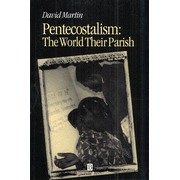
 David Martin, Pentecostalism: The World Their Parish (Oxford: Blackwell Publishers Ltd., 2002), 197+xviii pages, ISBN 9780631231219.
How is Pentecostalism shaping the world? David Martin’s thesis is the sociological argument that Pentecostalism functions to advance modernism through the process of secularization. Secularization does not mean a loss of faith, but a reconfiguration of faith in non-traditional ways. Martin’s work is a sweeping survey of the place of Pentecostalism in a global context.
Pentecostalism is a diverse and complex global phenomenon. As a movement, it advocates pluralism in Latin America. In Africa, it encourages a volunteerism that represents a form of secularization that separates church from state, gives priority to territory over community, while rejecting traditional hierarchies and legitimizations. Nevertheless, Pentecostalism does not promote the moral values of modernity.
Martin is selective in his examination of global Pentecostalism. He pays homage to Pentecostalism in North America, the spiritual roots of the movement, and then quickly shifts to Europe. Pentecostalism replicates Methodism, insists Martin, especially in its entrepreneurship and adaptability, lay participation and enthusiasm, but also in its splintering and schisms. Still, it offered more equality to blacks and women, despite later racist and patriarchal attitudes. Curiously, Pentecostalism was more successful in North America than Britain, possibly because class distinctions were more fixed in England.
The African context is different than Latin America, argues Martin, in that both Catholicism and anti-clericalism were imported from France while the British colonial powers ruled indirectly. In this context Pentecostalism is viewed as subverting traditional power structures by allowing Africans to share in the benefits of modernity as seen through the lens of spirituality. In contrast to the African independent churches, which blend African and Christian spirituality, Pentecostalism renounces adapting African religious symbols into Christian spirituality, but pursues social mobility, freedom and advancement. Pentecostal conversion, claims Martin, contrasts helplessness with empowerment, in which people without material wealth gain equality and worth. Like Latin America, women are encouraged to participate in leadership and are encouraged to take pride in their achievements. Church offers a place to find stable husbands who are peaceable and respectful. Pentecostals are encouraged to become individuals, thereby loosening traditional family ties.
The value of Martin’s work is that it liberates our understanding of global Pentecostalism from the straight jacket of North American fundamentalism. The true heart of Pentecostalism lies in empowerment through spiritual gifting, volunteerism, competitive pluralism and the advancement of modernism. The book is scholarly and rigorous, but the average reader needs to have a dictionary handy. Martin tends, however, to lump Pentecostalism, Neo-Pentecostalism and Evangelicalism together. A clear distinction between these subgroups is needed. Moreover, in offering a global overview of the movement, he tends to make generalizations that need a more detailed critical analysis, albeit he is working at a macro-sociological level rather than a micro one. Nevertheless, this book challenges us to see that even though Pentecostalism denunciates the process of secularization it is part of that very process.
Reviewed by Peter Althouse