David McKenna: Christ-centered Leadership

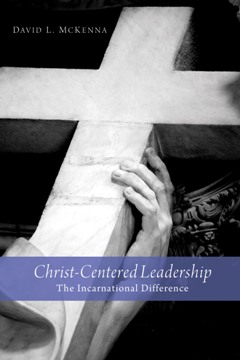
 David L. McKenna, Christ-Centered Leadership: The Incarnational Difference (Eugene, OR: Cascade Books, 2013), 118 pages, ISBN 9781620328477.
If you haven’t had your leadership paradigm shifted in a while, this book will jumpstart the process. McKenna has more work experience than the average minister’s lifespan and yet he states at the outset of the book that he is only now ready to lead. This book is written for emerging leaders, and yet as someone who is an octogenarian, McKenna recognizes that any leader can benefit from practicing sacrificial leadership. He states, “Leadership development without the crucifixion of self is not Christian” (p. 11). He is well-versed in leadership theories and has decades of practical experience, and yet with humility and wisdom he lays out what is lacking in contemporary leadership theories and provides a new model called incarnational leadership. Even servant leadership does not fully meet McKenna’s standard for Christ-centered leadership. “[Christian leaders] are ready and willing to be servants, but we do everything we can to divert the call to sacrifice” (p. 26). McKenna asserts that the sacrifice of our own desires, dreams, and wishes to lead without all the trappings that accompany the position is what Christ-centered leadership is all about. Thus, it is our first move toward incarnate leadership. Using Philippians 2:5-8 as a framework, he lays out over several chapters various ways in which a leader can lead with an incarnational mindset.
The first section of the book focuses on the various aspects of the Self that are developed in leadership through life experiences and training. The Principled Self is, McKenna says, the culmination of transformation from self-interest to serving the needs of others. Nevertheless, the Principled Self fails for several reasons to enter fully into the kind of leadership that leads with the mind of Christ. Only through dying to self, can individuals reach their full potential as Christ-centered leaders. McKenna shows us how this transformation is accomplished in the second section.
To fully lead with the mind of Christ, McKenna asserts that would-be Christ-centered leaders must first empty themselves of self-interest. Jesus, in becoming human, had the same needs as we: self-preservation, self-control, and self-esteem. Yet, he emptied himself of privilege (Phil. 2:6) and his human desires. Jesus led from nothing. What this means is that “he made himself of no reputation†(Phil. 2:7, NKJV). Leadership often comes with position, power, and prestige. Jesus forsook those things by emptying himself of his privilege to become vulnerable, humble, and obedient to the will of God. Leaders with the mind of Christ are willing also to deny those same needs and become vulnerable, humble, and obedient to the call of God.
The next step in the incarnational model is to die to all and crucify our selfish desires daily. It is not what matters to us but what matters to God that should drive our leadership vision and attendant attitudes and behaviors. McKenna laments that Christian leaders are held to a double standard, in which they are told they should be humble and avoid the temptations of leadership, and yet at the same time, they are held to secular standards of success. Leaders are judged by the results they bring to and for their organization. The proper response, for McKenna, is for leaders to leave the results to God. When leaders submit themselves to God’s will for themselves and their organization, at the risk of being seen as weak or crazy, God will bring the results he wants. Only in this way do leaders lead with the mind of Christ. Indeed, the mind of Christ takes us to our full potential as human beings. McKenna declares that “our highest calling as leaders is to be models, mentors, and mediators in the Spirit of the exalted Christ on behalf of others†(p. 83). Emerging leaders depend on mature models of Christian leadership, wise mentors, and compassionate mediators. Just as Christ mediates on our behalf to the Father, so ought Christ-centered leaders to mediate for others in a spirit of reconciliation.
If you’re not already convinced that this is a book you should read, consider that McKenna advises executive search committees to consider what kind of candidate they want and suggests they ask pointed questions that discern the candidate’s character. In the final section, McKenna asks what if the disciplines of the mind of Christ were included in the profile for selecting Christian leaders. What if committees asked candidates questions such as: 1) How strong is your sense of God’s call to this position? 2) What will you have to give up in order to answer God’s call? 3) If you take away the position, power, and prestige of this role, with what qualities of character would you lead? 4) How have you resolved the drive for success with Christ’s example of being faithful and letting God do the honors? McKenna also provides questions to ask of the candidate’s references related to calling, character, and sacrifice. He asserts that where there is no sacrifice, there is no call from God. He warns, “If you can’t stand to suffer, stay away from leadership†(p. 94). At the end of every chapter, McKenna offers readers the opportunity to reflect on a question to discern their motivation for leading.
Readers may not agree with everything McKenna writes, but this book is a particularly useful tool for provoking emerging Christian leaders to think beyond the prevailing servant leadership model to consider a model of sacrificial leadership that is truly Christ-centered.
Reviewed by Michelle Vondey
Publisher’s page:Â http://wipfandstock.com/christ-centered-leadership.html
Preview Christ-Centered Leadership: https://books.google.com/books?id=a75NAwAAQBAJ