
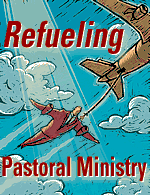
H. B. London: Stemming the Tide of Clergy Fallout

H. B. London Jr., “Stemming the Tide of Clergy Fallout: Lessons from a Marriage†Enrichment (Winter 2003), pages 42-51.
Dr. London and the pastoral ministry team at Focus on the Family take an insightful look at the contemporary problem of ministers leaving the ministry. They take the rich picture of marriage and compare it to the relationship between the church and those who lead the church.
As I read this article, I reflected on the 40 years I have been privileged to be in the ministry. I know from talking with many young ministers that they really have no idea what to expect or what may happen in the work of the ministry.

Though I had heard the statistics before, it is hard to read that 23 to 27 percent of pastors have experienced a forced termination at some time in their ministry. When I read in this article that the Southern Baptist Convention reported that 23 of their pastors are terminated each week; my heart was broken. What may be happening to these persons and their families, not to mention the repercussion that it would have on the congregation, is very painful. I have observed that when a pastor failed or the church leadership requested the pastor to resign that so many times the congregation floundered, and the next pastor coming in had to rebuild the congregation.
“To say the role of the pastor is a difficult assignment is a great understatement; but like all relationships, it can be very fulfilling when it functions well. It also can be hurtful when it is sabotaged. The bond between pastor and church is so much like a marriage that it would be appropriate to draw some comparisons to building strong families†(page 44). For example, if good communication does not exist between the pastor and the congregation, there will be much misunderstanding.
Congregations often have a tendency to expect unrealistic goals for a pastor. In the article is pointed out that George Barna has said that congregations expect the pastor to fulfill 17 to 20 roles, be available 24/7 and to perform all of the roles at a high level. Because of this pressure a pastor may leave a church or even drop out of the ministry entirely. It is when pastors think they are the only one doing anything in the ministry that mentally and emotionally they will feel alone and isolated.
I talked to a colleague recently who is now driving a truck to make a living. He commented to me that, “It is refreshing to have a job that is not stressful on me and my family.†I asked myself this question, “God, was he called into fulltime ministry?†If he was, how does he live with the fact of the call? Now I realize that he could be an effective witness in his occupation. However, this is an example of the importance of how all of the church needs to be equipped to do the work of the ministry so that so much is not expected of the pastor.
Where there are people, there are going to be problems. The article points out that in the early church there were conflicts that had to be worked out and we should expect the same today. One early church difficulty that most of us think of is recorded in Acts 6:1-7. The Jewish community that had been influenced by Greek culture did not think their widows were being treated fairly. To resolve this conflict the leaders had the congregation look for seven men full of the Holy Spirit to oversee that ministry. It sounds easy enough, but it could have been more complicated than what we think.
As I read the article what came to my mind is that we are family, siblings, if you please. I do not know how your home was, but I know how my sisters and I got into it when we were growing up. As a pastor I remind people in the congregation that we are spiritual siblings, and siblings at times will not agree and need to work out the differences.
The way you build a strong relationship is by spending time together. If you do not spend time with your spouse, you will not get to know him or her. You will grow apart instead of bonding. I found through the years of pastoring that as I would spend time with my congregation I got to know their needs. This gave me opportunity to minister to them—and through that ministry, build a strong relationship. The interaction was so beneficial.
H. B. London points out that there must be a balance of priorities. I agree heartily with him. You can become burned out if you do not allow time for yourself, with God, your family, and even some rest and relaxation. Apathy can creep in if we are not prioritizing our responsibilities.
He talked about being committed. “One man celebrating his 50th anniversary responded to the question, ‘Are you surprised that your marriage lasted so long?’ by saying, ‘I never considered an alternative’†(page 46). Commitment requires that there be trust between individuals. When trust is present, no longer will there be a revolving door with pastors coming in and pastors leaving.
One point made by this article was how important it is to express appreciation. How appreciation is needed! I have seen people work hard because they were praised for what they did. I believe that good communication and expressing appreciation work hand in hand. If people know what the pastor feels the Lord wants, they know that there is direction whether they like it or not. “Healthy relationships find ways to reinforce good decisions, communicate constructive criticism, and celebrate confidence in decisions†(page 48).
The developing of a vital spiritual life was discussed in this article. Some might ask if this needs to be mentioned in reference to pastors. However, pastors are like everyone else. We can get lost in the routine: preparing messages and Bible studies, preparation for counseling sessions, not to mention the many administrative duties can all become time consuming. Visitation—another vital ministry—takes time. All of these things are legitimate. As the article points out, we need personal time for reading God’s Word, praying, and fasting. These disciplines are necessary. We can become task oriented if we do not keep a good balance in our spiritual life. “A visible shell of spiritual life exists, but the pastor knows he is empty inside†(page 48). H. B. London reminds us that we need to attend to our emotional, mental, physical and spiritual health. If we do not, we will lack the energy that is needed to do the work of the ministry and our spiritual development will be curtailed.
A good reminder is “Vital spiritual life can also be lost on the altar of spiritual pride that sees oneself as the only person who can do these great things for God. We may begin to define success as the world or as a colleague does; thereby, no longer giving the time and energy necessary to develop good spiritual balance in our lives. We look very busy and find we are driving more, but ultimately this produces an isolation that leaves a majority of pastors without a close friend†(page 51). Our personal life is very important. As a pastor, we along with our spouse must know that we have been divinely called by God into the ministry. Because of this call we must keep a life of integrity with our family as well as the church family.
Personally I have a prayer partner. I have found that to be a tremendous blessing. He and I meet once in a while for lunch. We share needs we have in our lives and in our families, and we have seen God answer so many of our prayers. It also keeps me accountable. This helps to keep me from falling out. I know I have someone beside the Lord to answer to. At the present time I am on staff and serving as Pastoral Care Minister. I have our Senior Pastor to whom I answer. But I have found that it is good to have someone else beside him to answer to. It helps to keep me from running on empty.
The final thought in the article is put in a question. “Is Reentry Realistic? Reentry into ministry after a failure can be difficult—but not impossible. If restoration were not possible, Paul would never have written Galatians 6:1. However, timing is quite strategic when returning to ministry. Likewise, developing a support group and an accountability system is of great importance so that the one who is returning to ministry does not become isolated.
The article reminds us that God loves, and there is nothing too difficult for God to work out in our lives. So let us heed Paul’s advice, “Let us not become weary in doing good, for at the proper time we will reap a harvest if we do not give up†(Galatians 6:9, NIV).
I would encourage every minister to read this article. Even though I have served in the ministry for 40 years, I found the article to be informative and a good reminder of setting my priorities. The older you get, the temptations that the devil brings against you do not lighten up. If anything it seems they are stronger than when I was young. I have to keep up my guard and my armor on all the time.
Reviewed by Carl J. Halquist
Index of the Winter 2003 issue of Enrichment: http://enrichmentjournal.ag.org/200301/index.cfm
Â