

Holiness in African Perspective

Missionary-scholar Jim Harries discusses the difference between the biblical categories of clean and unclean, holy and common. He argues that neither Africa or the West have a correct understanding of these concepts.
A story about man whose neighbours describe as a good Christian. The man was a passenger on a bus. He went to talk to the driver. Something upset him. He struck out at the driver. As a result, the bus crashed and everyone in it was killed. His neighbours argue, did the man go to heaven or hell?
Abstract
Many African people, as the Rekabites praised by God in Jeremiah 35, keep strictly to ancestral requirements. In parts of Africa, this is done to avoid death. Biblically we find two levels of holiness. Akathartos (unclean) contrasts to katharos (clean), but also bebelos (common) as distinct from hagios (holy). The latter (hagios) presupposes the existence of katharos, whereas something may be katharos without being hagios. These categories are largely forgotten in the West. African languages do not distinguish them clearly. Jesus’ emphasis was on achievement of hagios. This important and very positive orientation can easily be lost in contemporary theological education.
Introduction

The two categories – cleanliness and Godliness – have strong parallels. The distinction between them is often unclear. This article suggests that confusion in distinguishing these categories is exaggerated by Western people’s tendency to presuppose themselves to be hagios (holy instead of being common), while African people’s tendency is to seek to be katharos (clean) while remaining akathartos (unclean) and failing to perceive hagios.
Greek terms are used to represent biblical standards so as to avoid confusion with misunderstanding of translations of those terms on the part of Africa and of the West. The categories of ‘Africa’ and ‘Western’ are used loosely with the understanding that they are generalisations and that there are in both cases exceptions to what is herein stated.
Clean and unclean in African Churches
A group of KIST students [Kima International School of Theology in Maseno, Kenya] joined me a few years ago on a visit to an indigenous (African founded and African led) church near Yala. Many things struck them as interesting. One was to find that even while the service was going on and although the church was not full, some members sat listening to the service sitting outside the church building. When the students asked the pastor later, he told them that those people sitting outside were ‘unclean’. There were various reasons for them to have been unclean; some ladies were having their period, other people had been to funerals and handled a dead body, and so on. According to this church, such unclean people should not be in the holy place, i.e. the church building. I have in recent months asked a number of congregations in Luoland about a particular traditional law, and their take on its importance. Luo tradition states that a son should build his house in front of and below the parental house, with the door at right angles to the door of the main house, facing into the middle of the homestead. If you travel around Luo areas in Kenya, you will find that this pattern is almost invariably followed. On visiting church congregations, I have asked them whether they would be ready to contravene this ‘law’ and allow their sons to build their houses behind the parental house, if paid to compensate them for doing so. I have asked, would they be ready to allow their son to build behind their house, if given KSh100,000 [about $1,000]? Everyone in the church congregation expressed clear refusal. Then I asked if they would be ready to allow their son to build behind their house if offered KSh1,000,000 [almost $10,000]? Still everyone has refused. On a few occasions someone has taken the trouble to explain the justification for their refusal; having their son build behind the parental house would very likely result in his death, and no way would these people take any amount of money that would result in the death of their children.
Praising the Rekabites
Jeremiah 35 tells us of the Rekabites. These are a people who were very intent on following the laws handed down to them from their ancestors, particularly one Jonadab (son to Rekab). Jeremiah praises the Rekabites for their adherence to the law they have been given by their forefathers. By comparison, he accuses the Jews and people of Jerusalem of failing to keep God’s laws. It would seem from this comparison that the laws given to the Jewish people are different in nature from those given to people through their ancestors. It would seem that whereas laws handed down from one’s ancestors intend to achieve a state of katharos (cleanliness), God’s laws given to his people are more difficult to follow and are oriented to producing a state of hagios (holiness). This is illustrated by diagram 1 below.
Diagram 1. Achieving different levels of holiness 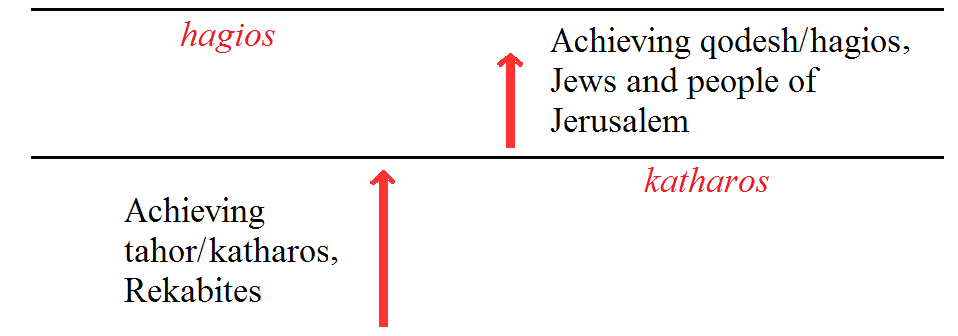 Many of our African people are very preoccupied with staying holy, i.e. keeping numerous laws (such as the above). Very often the root concern in the keeping of these laws is the avoidance of death. Cause of death is invariably connected to either witchcraft powers, or to so-called spirits.
Biblical and Traditional ‘Holiness’ I draw on Mojola (2003) on making some of the analyses below. I note that the Bible speaks of holiness on two levels:[1]
Lev. 10:10 “You must distinguish between the holy [hagios] and the common [bebelos], between the unclean [akathartos] and the clean [katharos].â€
Ez. 22:26 “The priests … profane [bebelos] my holy [hagios] things; that they do not distinguish between the holy [hagios] and the common [bebelos]; they teach there is no difference between the unclean [akathartos] and the clean [katharos]; and they shut their eyes to the keeping of my Sabbaths, so that I am profaned [bebelos] among them.â€
Ez. 44:23. “They are to teach my people the difference between the holy [hagios] and the common [bebelos] and show them how to distinguish between the unclean [akathartos] and the clean [katharos].â€
Having identified the two levels of holiness above, I give them in tabulated form in Table 1 below in five languages: Greek, English, Kiswahili, Dholuo and Kinyore.
Table 1. Old Testament Holiness; terms from the above references tabulated 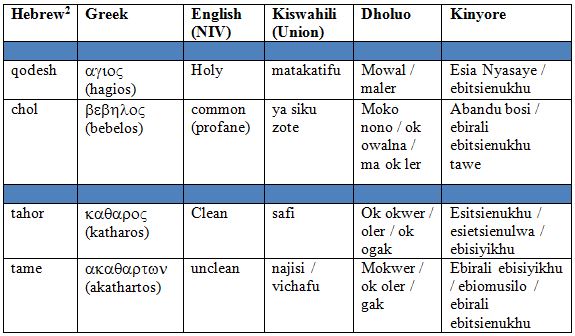
In the Old Testament, priests were instructed to explain holiness to people (Leviticus 10:10 and Ezekiel 44:23). They were to tell them that there is a difference between unclean (akathartos) and clean (katharos), and between what we could call another category of holiness, being holy (hagios) or being common (bebelos). A state of katharos is a prerequisite for the achievement of a state of hagios (Milgrom 1991:616).[3]
The above distinction could be the basis for the development of modernism and secularism in the West. This is because it set up a dualism that was over and above and strictly independent from issues of cleansing that troubled people on a day-to-day basis. One could argue that as a result ‘God’ became promoted into a separate realm, thus leaving the world to function on the basis of entirely mechanical principles. This distinction between ‘God’ and the ‘world’ is these days much questioned. The man-on-the street in Europe however often continues to follow the distinction.
The difference between akathartos and katharos that preoccupies much of Africa is in many Western countries today seen as irrelevant. When it comes to the difference between hagios and bebelos, it seems that Western people presuppose themselves to be hagios (hence someone is despised for claiming to be ‘holier than thou’). They also consider themselves, by default, to be katharos. In Africa, we find little awareness of the category of hagios. People may be presupposed to be akathartos (Harries 2007:201).
The difference between akathartos and katharos is very closely related to sin. Sin renders someone akathartos. The particular sin often in mind in the Old Testament is that of adultery with other gods. This links in with the widespread African understanding of sin as being that which arises from the breaking of ancestral taboo (Dholuo; ketho kwer) that results in the activity of troublesome spirits. Cleansing (‘making holy’, i.e. returning someone to a state of katharos) occurs through a removal of the spirits that have found occupancy as a result of breaking taboo.
Notice that in Western Christian theology, the identity of sin bridges both categories, akathartos versus katharos and hagios versus bebelos. This is because of the assumption that presence of hagios presupposes that someone has already achieved katharos (Milgrom 1991:616 – as above). Sin, then, is foundationally ‘against God’. In Africa on the other hand, sin tends to be ‘against ancestors’ and to be equated with breaking of taboo. Committing sin in Africa exposes one to evil spirits. Solutions traditionally included animal sacrifice and various rituals, but among Christians casting out the evil spirits in the name of Jesus.
Mojola points to confusion in the identity of ‘holy’ in Luyia dialects (2003). We see this confusion in Table 1 resulting from the absence of a distinction between the hagios and katharos categories in Africa. The Holy Spirit as a result tends to be known for his role as bringing katharos rather than hagios.
Terminology in the Luo Bible examined above illustrates this kind of confusion. Pneuma Hagios (Greek) is in Luo often known as Roho Maler. We have seen in the above bible passages that the term ler is used to describe both the states of katharos and of hagios. In some cases mowal is used to describe hagios, whereas mokwer is used to describe akathartos. In normal use, ler can also mean clean (e.g. you have washed so now you are ler) and light (bring the lamp so that we have ler), this adding to potential confusion.
The term matakatifu leaves room for confusion in Kiswahili. Matakatifu is clearly related to kutakaswa, which is to be cleansed of untoward spiritual powers, i.e. evil spirits. As a result what is matakatifu in Kiswahili that should biblically be hagios can be taken as katharos. (Although I have included Kinyore terms in my table, I will not comment on them in this paper. I leave the Wanyore to consider them further.)
The research underlying the above table is limited to just three Biblical passages. Extending our investigations to more Bible passages, and from the Old to the New Testament, could lead to the discovery of additional complexity.
The Swept House
43 “When an impure [akathartos] spirit comes out of a person, it goes through arid places seeking rest and does not find it. 44 Then it says, ‘I will return to the house I left.’ When it arrives, it finds the house unoccupied, swept clean [sesaroemenon, no mention of ‘clean’ in the original Greek] and put in order. 45 Then it goes and takes with it seven other spirits more wicked [poneirotera] than itself, and they go in and live there. And the final condition of that person is worse than the first. That is how it will be with this wicked [poneira] generation†(Matthew 12:43-45).
This teaching of Jesus implies that merely chasing out a spirit is not enough. That is to say, katharos is not enough. A katharos state leaves no defence against evil spirits. By implication hagios is needed as a means of defence against incoming evil spirits. This is the basis for the renowned Church of God doctrine, that hagios can be complete (olotoleis), thus apparently barring access to evil spirits (Thessalonians 5:23).
Cleansing the Temple
In Luke 19:45-48 (and also Matthew 21:12-17, Mark 11:15-19, John 2:13-22) it seems that people were expecting Jesus to cleanse Jerusalem (render it katharos by chasing away the Romans), but Jesus was preoccupied with making Jerusalem holy (rendering it hagios) through his action in the temple. The use of the English term ‘cleansing’ for what Jesus did in the temple seems to be unfortunate.
Conclusion
I raise this issue in this Maarifa lecture because it seems to be in various ways consequential for African society. The African understanding articulated above has at least two consequences:
- Theological education materials from the West tend to presuppose that issues of akathartos are already dealt with and past. They focus on the achievement of hagios. Secular texts presuppose that hagios has also been achieved. This leaves little room for dealing with African issues of akathartos. While African churches are heavily occupied in dealing with akathartos, such has little or no recognition in theological literature, especially that which is in English or other European languages.
- The achievement of hagios is a positive. In many respects, dealing with akathartos is an attempt at doing away with a negative. The emphasis in Africa on dealing with akathartos, where even biblical reference to hagios is taken as being to katharos, leaves African Christianity with the rest of African culture being pre-occupied in dealing with negatives instead of building positives.
The solution of the above difficulties requires close attention to language uses, especially translation of theological texts and discourses between European and African languages. Failure to consider translation sufficiently carefully can result in the occlusion of very real African issues out of sight of formal Christian theological education as widely practiced.
PR
This paper was originally presented as a Maarifa Lecture, Kima International School of Theology, Maseno, Kenya, 19th June 2013.
Notes
[1] The Old Testament Greek terms I have included in the above are from the Septuagint (Brenton 1851). Bible quotes in English are from the NIV.
[2] Taken from Young (1982).
[3] “whereas the common may be either pure or impure the sacred may not be impure …â€.
Bibliography
Brenton, Sir. Lancelot, C.L., 1851. The Septuagint with Apocrypha: Greek and English. London: Hendrickson Publishers.
Milgrom, Jacob, 1991. Leviticus 1-16 – a new translation with introduction and commentary. New York: The Anchor Bible, Doubleday.
Harries, Jim, 2007. ‘Pragmatic Theory Applied to Christian Mission in Africa: with special reference to Luo responses to ‘bad’ in Gem, Kenya.’ PhD Thesis. The University of Birmingham. http://etheses.bham.ac.uk/15/ (accessed 2nd January 2010).
Mojola, Aloo Osotsi, 2003, ‘Holiness and Purity in the Book of Leviticus – a problem in the Luyia dialects.’ A paper presented at AICMAR – AST, Butere, Kenya on August 12-15, 2003. (Also published in AICMAR Bulletin, Volume 3, 2004, pp41-53.)
Young, Robert, 1982, Young’s Analytical Concordance to the Bible. London: Thomas Nelson Publishers.








A reader wrote to PneumaReview.com about this article: “Interesting paper that brings out some things I’ve noticed but could never put my finger on. I will have to think on this more. However, I’m concerned that you are missing the message of grace as expressed in the NT. You wrote: ‘A state of katharos is a prerequisite for the achievement of a state of hagios’. Does this mean that one cannot be statefully holy and temporarily unclean?” – EE
A reader wrote to PneumaReview.com about this article: “Interesting paper that brings out some things I’ve noticed but could never put my finger on. I will have to think on this more. However, I’m concerned that you are missing the message of grace as expressed in the NT. You wrote: ‘A state of katharos is a prerequisite for the achievement of a state of hagios’. Does this mean that one cannot be statefully holy and temporarily unclean?” – EE