Between Two Extremes: Balancing Word-Christianity and Spirit-Christianity

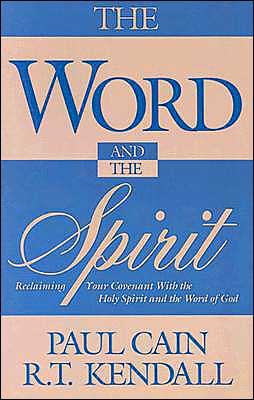
 Paul Cain and R. T. Kendall, The Word and the Spirit: Reclaiming Your Covenant with the Holy Spirit and the Word of God (Eastbourne, E. Sussex: Kingsway Publications, 1996; Orlando, Florida: Creation House, 1998), xviii + 87 pages, ISBN 9780884195443.
In 1992, Paul Cain and R.T. Kendall together gave six addresses at the Wembley Conference Center in London. This book is a compilation of those messages, reissuing the perennial challenge for the Church to “marry” the Word and the Spirit. I say “perennial” because since the time of Tertullian and Irenaeus, there has been a tendency toward either Word-Christianity or Spirit-Christianity. It seems that either one or the other of these “two hands of the Father” have held prominence, but never quite both at once.
The history of the church has seen the pendulum swing to and fro from dry institutionalism on one side—with its hierarchy, authoritarianism, and hyper-orthodoxy—to radical and subjective Spirit movements on the other side. The balance of Word and Spirit has been a strikingly elusive goal and ideal for those following the Christian way. All the more importantly then, the authors insist, that such a balance should be sought today.
To that end, Cain and Kendall released these sermons as words of exhortation to the contemporary Church and in anticipation of the next—perhaps even final—move of God in and through the Church. Clearly, as the rhetoric of the book indicates, their message is addressed primarily to Pentecostals, charismatics, and those in the broad range of Third Wave and other renewal and prophetic movements. These are the individuals and groups who are most susceptible to either a neglect of the Word, or a subordination of the Word to the Spirit. It is for this reason that Kendall—whose prior fame has been as a Biblical expositor—and Cain both emphasize the importance of returning to the Word, re-emphasizing the Word, or being further grounded in Scripture. Their objective, however, is not only to call attention to the Word, but to present the conjunction of Word and Spirit as an imperative for Christians. With this in mind the authors include practical suggestions as to how this remarriage of Word and Spirit can be enabled, such as discussions of “how to obtain power” (Kendall, pp. 12-17), and the elements of Spirit-filled living (Cain, Ch. 3). Kendall’s “The Preaching of the Word and the Spirit” (Ch. 4) also provides explicit guidance on how to allow the sermon to be a medium for the Spirit’s presence and activity rather than for the preacher’s.
As I read through The Word and the Spirit, however, I could not help but think that the authors are aware not only of the gargantuan task confronting the Church on this matter, but also of its truly revolutionary implications. Let me make a few brief comments on that task in order to lead into a look at these implications.
Both theologians and practitioners of the faith know well that it is difficult or impossible to define or confine the Spirit. It may surprise readers of this book, however, to hear me say that defining the Word may be just as troublesome. This is especially the case since both Cain and Kendall unequivocally equate the Word with the Bible (pp. 3, 23). For both of them, then, the marriage of Word and Spirit consists of a Christianity marked by a passion for Scripture and by spiritual power. “Word and Spirit” is the convergence of the Bible and the Spirit’s unction (they cite 1 Cor. 2:4 and 1 Thess. 1:5 on a number of occasions in this connection).
The question that arises, however, is whether we can equate the Word and Scripture while remaining exegetically truthful. The Logos in John’s writings, for example, is clearly the divine Word who was incarnate as Jesus the Christ. It is for this reason that many have been hesitant to limit the Word to Scripture itself, preferring instead to say that Scripture reveals, points to, or mediates the divine Logos to human beings. Orthodox Christian theology, therefore, has always insisted that the Word referred primarily to the second person of the Trinity, and only secondarily to the written Word of God.
Cain does make an interesting distinction between the Word and the Name (pp. 8-12, Ch. 6). He suggests that the former refers to God’s integrity, honor, and reliability, while His Name denotes His influence, power, and reputation. In this way, Word and Name are synonymous, for Cain, with Word and Spirit. Here, however, is where the problem with defining the relationship between Word and Spirit takes on the kind of revolutionary implications that even charismatic prophets such as Cain recoil from. He writes that while “God cares about both His Word and His name, His Word and His Spirit . . . compared side by side, I assure you that God’s integrity is more important to Him than His reputation” (p. 81). This tends to lead quickly to the kind of subordination of Spirit to Word prevalent throughout the history of Christianity. Among the last words of this book are Cain’s admonition that, “We will be kept from experiencing the power as I am presenting it now unless we remember two things: God is more interested in the upholding of His Word until we meet the criteria for the demonstration of His power. . . . We must not allow the Word of God to be replaced or upstaged by anything, including the prophetic things that we are saying here” (p. 87). Ultimately, it would seem, the attempt to remarry Word and Spirit by Cain and Kendall appears to understand the Spirit, metaphorically at least, as the “submissive spouse,” under the authority of the Word.
In this, however, there is an underlying problem which I believe both Cain and Kendall sense, but refuse to accept. To sound the clarion call for the “holy unity of the Word and the Spirit” (back flap) is to prepare for the mysterious union and tension between these two. Now while there is no tension in God, for us, this “unity” should mean that the Word defines the Spirit even as the Spirit defines the Word. In the New Testament, we clearly see that the Spirit lifts up and points to Jesus even as the Spirit anointed and empowered the person and ministry of Jesus. We see, then, that Jesus is of the Spirit even as the Spirit is the Spirit of Jesus. Each defines the other mutually. At the same time, we cannot just equate the two since to do so would collapse the Trinity as we understand it. Equating the Word with the Spirit would also render the Biblical distinctions between the two unnecessary and excessive. The problem is how to understand the Word and Spirit as both distinct and independent on the one hand, and yet mutually related and interdependent on the other. To follow through with this project fully, however, we must not force a subordination of either Word or Spirit to the other. It is to open ourselves to the possibility that Word and Spirit are mutually defining and yet relatively independent. Otherwise we will fall into the error of Word-Christianity by reading Spirit in the light of Word, or the error of Spirit-Christianity by understanding Word in light of Spirit.
To understand Word and Spirit in this way has some revolutionary implications. This may mean that understanding Scripture as the standard for what is norm is only one-half of discerning the truth. The other half may be the prerequisite openness to the Spirit to give new life to Scripture as we engage the uncertainties of the present and the future. This may mean that discerning the Spirit would always be a somewhat ambiguous affair. Emphasizing the Word over the Spirit is one way to justify our subordinating the wild winds of the Spirit (John 3:6) to a Biblical text that we control much more easily. However, a genuine marriage of Word and Spirit would force us to confront the tension without a simple resolution. Paul Cain, whom many believe to be a prophet to the Christian Church in our time, recognizes the risks involved in a true union of Word and Spirit. It seems to me, however, that Cain prefers to be safe rather than sorry. He seems to be emphasizing the primacy of the Word, instead of fully embracing the challenge of faith. For us to go down this road with Cain may mean that we finally quench the Spirit. The reason I say this is because our tendency will always be to subjugate the Spirit to our own genuinely sincere albeit ideological and sinful manipulations of the Word.
On the other hand, Kendall acknowledges that whereas Cain “was to have represented the ‘Spirit’ side,” and Kendall himself the Word, yet “he [Cain] turned out to emphasize the Word more and I the prophetic” (p. x). Cain is coming from a charismatic tradition which has generally neglected the Scriptures and understand any emphasis on Scripture as “dead orthodoxy.” Clearly, then, Cain has been and remains on guard against the kinds of charismatic excesses that occur in environments devoid of an adequate Biblical foundation. Kendall, meanwhile, being a newcomer to the charismatic movement from a High-Church tradition, has found renewal and revival in the ways of the Spirit. It is Kendall who prophetically calls for a “post-charismatic era” (Ch. 5). This heralds not a new theology of Christ or even of the Spirit, but a new Ecclesiology—a new way in which the Church goes about the business of being the Church. So, both Cain and Kendall anticipate a fresh outpouring of God in this convergence of Word and Spirit.
I would simply add that as keen-sighted as the vision of both these men of God is, what they or any of us may envision would still be relatively short-sighted in comparison to the glory that will be revealed. The work of God is both “nothing new under the sun,” and yet something that “eye has not seen and ear has not heard.” There is something exciting and truly unforeseeable in the unity of Word and Spirit that Cain and Kendall speak so forcefully about.
Unlike the Biblical shepherd from Tekoa after whom I was named, I am neither a prophet, nor the son of a prophet (Amos 7:14). However, insofar as we are all obligated to discern the messages of prophets (1 Cor. 14:29), this book should be read prayerfully. Through it and other instruments sovereignly appointed by God, may the Holy Spirit continue to blow fresh winds and renew the Church, and indeed—the whole world…
Reviewed by Amos Yong