
Latino Pentecostalism, a review essay by Amos Yong


 Gastón Espinosa, Latino Pentecostals in America: Faith and Politics in Action (Cambridge, MA, and London: Harvard University Press, 2014), xi + 505 pages.
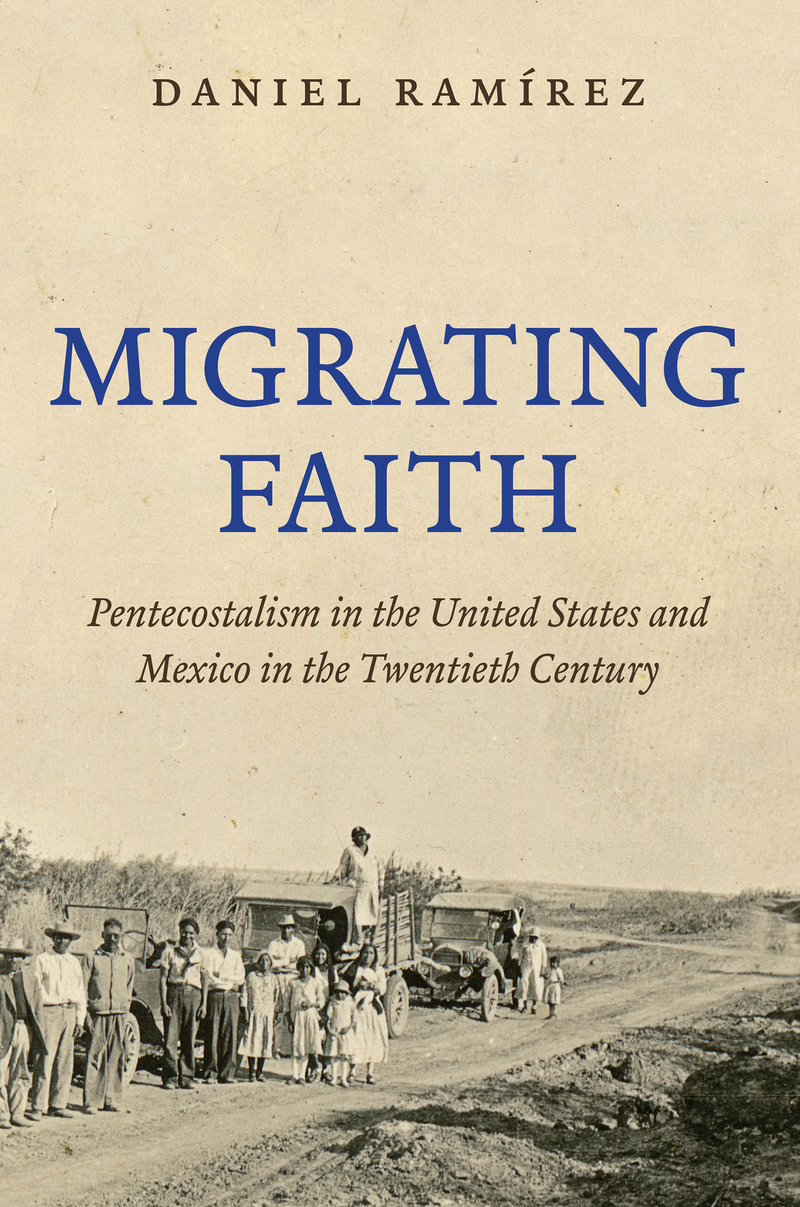
Daniel Ramírez, Migrating Faith: Pentecostalism in the United States and Mexico in the Twentieth Century (Chapel Hill, NC: The University of North Carolina Press, 2015), xix + 283 pages.
Why should readers of The Pneuma Review look up these books under review? Although the answers to this question may seem obvious, they nevertheless need to be reiterated: because the center of Christianity has now shifted from the Euro-American West to the global South; consistent with the foregoing, because of the so-called “browning” of the North American church such that the its vitality is currently being sustained, and is projected to be increasingly carried over the next few decades, by migration from the rest of Latin America; and because, for the North American Pentecostal movement in general and the Assemblies of God denomination specifically, one third of all adherents are non-white and one-fourth – and growing percentage-wise as well as in aggregate – are Latino (see, e.g., Pew Research Center demographics from July 2015). Beyond other rationales that might motivate the present constituency, the above ought to prompt curiosity at least, if not a sense of urgency about becoming more acquainted with what Espinosa and Ramírez have to say. To be as pointed as possible: despite their “Decade of Harvest” initiative in the 1990s, the Assemblies of God would be in no less severe of a decline compared to mainline Protestant denominations if not for growth in Latinos within its ranks over the last two decades!

The authors and their books covered in this review are quite distinct. Ramírez is a more recently established academic who is shifting, at the time of this writing, from the University of Michigan, Ann Arbor (their Department of American Culture and Latino/a Studies) to Claremont School of Theology (Claremont, California). This is his first book, his Duke University PhD thesis, which has been substantially revised and extended, appearing after almost a decade. Espinosa, meanwhile, began his scholarly work on the origins of Latino Pentecostalism in the first half of the twentieth century (completing his PhD on this topic in 1999 at the University of California, Santa Barbara) and has become renowned as one of the foremost specialists on Latino religions with more than a half dozen books from Oxford University Press, Harvard University Press, and other prestigious scholarly publishers. From his post at Claremont McKenna College, since 2009 as the Arthur V. Stoughton Professor of Religious Studies, Espinosa’s Latino Pentecostals in America builds on his research trajectory going back more than two decades, carrying forward to the present the more historically focused coverage of his preceding monograph, William J. Seymour and the Origins of Global Pentecostalism: A Biography and Documentary History (Duke University Press, 2014). Both have been participants at least in some respects of the histories they are narrating and thereby provide superb and complementary guidance to anyone interested in understanding further the Latino side of North American Pentecostal history.
Migrating Faith: Pentecostalism in the United States and Mexico in the Twentieth Century is in some senses more expansive but in other aspects narrower. Both books overview the first century of North American Latino Pentecostalism although Ramírez is focused not on the Latino AG across the USA but mostly, if not only, on Mexican apostolic churches and groups in the Southwest and borderlands territories. Taken together, readers will not only get a solid discussion of the trinitarian-Oneness spectrum in North American Pentecostalism but also receive insight into North-South Latino linkages, with Ramírez’s exposition of USA-Mexican transnationalism on the Western frontier paralleling Espinosa’s retelling of the Puerto Rican presence and activity in the Latino AG on the Eastern seaboard. Ramírez goes deeper in elaborating on border crossings over the hundred years and hence highlights the apostolic Pentecostalism facilitated by migration in its various permutations. He talks about the Bracero guest workers program in the mid-twentieth century or developments and initiatives before and after that led laborers to cross the border in supplying the demands of the market. He also talks about the so-called Operation Wetback in the mid- to late-1950s and in other times and periods that were reactions to the perceived threat of the Mexican illegal workers. The latter resulted in cycles of mass deportations, sometimes of citizens unable to provide documentation, but almost always including the fragmentation of families. This trauma had to be addressed by the churches. So just as the more renowned and widely published scholar is intentional about bringing to light and therefore correcting the record about the Latino Pentecostal contribution in the ecclesial (AG) and political domains, Migrating Faith documents apostolic origins and transformations on the transnational, political, and economic ground on both sides of the US-Mexican border in ways that stretch the lenses of Pentecostal studies beyond nation-state categories and conventional political scientific and political economic analyses.
Yet if Espinosa’s historical and political interests open up to an interdisciplinary approach, Ramírez’s consciously interdisciplinary endeavor includes Chicano/Latino studies and religious history, borderland studies, transnationalism, and migration, all as brought to bear on North American religion in general and Pentecostalism in particular. Congruently on the methodological front, whereas the slightly earlier book relies on archival materials but also oral histories (Espinosa draws from interviews with almost two dozen individuals, some from research originally conducted for his doctoral thesis in the mid-1990s), the later work, while similarly resourced, also retrieves the stories of these largely otherwise forgotten actors via attentiveness to their testimonies, songs (coritos), and hymnody of welcome and hospitality. There is an appendix of apostolic discography although no identifiable website or accompanying DVD of apostolic singing or musicking, unfortunately. Such an analytical framework foregrounds the creative, affective, and imaginative dimensions of Pentecostal orality much acknowledged in the scholarly literature but little investigated or analyzed. In this respect, Ramírez allows apostolic history from the migrant (both legal and not legal) margins to be “heard” not just “seen” as it recognizes and attempts to follow the triadic and interrelated acoustemology of “corporeality, musicality, and emotion” (p. 166) operative along the migrant trails rather than rely solely upon the visual optic of documentary evidence. To be sure there is an anti-Catholic tenor in the apostolic repertoire, but that is also consistent with the broader ecumenical solidarity (aside from the more sectarian Luz de Mundo apostolic group) that brought Pentecostals, trinitarian and Oneness alike, and Protestants together amidst the Roman Catholic hegemony, at least as perceived in Latino communities for much of the earlier century.
In the end then, both volumes recount histories that beg for further theological analysis. Pentecostal ministers, ecclesiarchs, and academics ought to familiarize themselves with this side of the North American Pentecostal experience in order to reconsider the implications for Pentecostal spirituality and theology, not just vis-à-vis the political dimension but certainly also for ecumenical and doctrinal purposes. After 100 years, we might wonder why such trans-ethnic dialogue and rethinking has not commenced (the paternalism of white AG leaders described by Espinosa actually explains this matter), but better late than never.
Reviewed by Amos Yong
Preview Latino Pentecostals in America: https://books.google.com/books/about/Latino_Pentecostals_in_America.html?id=BhFXBAAAQBAJ
Publisher’s page for Latino Pentecostals in America: http://www.hup.harvard.edu/catalog.php?isbn=9780674728875
Listen to Gastón Espinosa discuss Latino Pentecostals in America on the Aqueduct Project’s God Talk podcast: https://soundcloud.com/anastasia-hall-1/gaston-espinosa-latino-pentecostals-in-america
Preview Migrating Faith: https://aerbook.com/books/Migrating_Faith-13332.html?store_id=137&product_id=2182724
Publisher’s page for Migrating Faith: http://uncpress.unc.edu/books/T-9315.html