
New Wine Leadership Conference 2016

I have been a part of the New Wine Movement since being persuaded by the curate of the church I was attending back in 2007. I encountered the Holy Spirit in such a powerful way at their week long national summer gathering that I thought I was going to explode. I have returned, every year since, to serve on the prayer ministry team to see what God was doing first hand. Every year the same wrestle would ensue, was I to serve in this way or not. It felt almost too good, to get to see what Jesus would do. I was converted to ‘tenting’ it and then ‘caravanning’ it, saying I would do this week holiday in a cardboard box if I had to. New Wine is far more than a Bible camp on an annual basis, it is a force for renewal across the denominations but beginning first in the Anglican church. I am now an Anglican church vicar and the New Wine movement invests in me, keeps me grounded and yet believing in the supernatural power of our supernatural God. When I need refreshment; when I need to be reminded to whom I belong, I head to a New Wine gathering. My family, two tweenage girls and a husband, have since joined me as those who identify with the movement and have our faith fuelled by it.

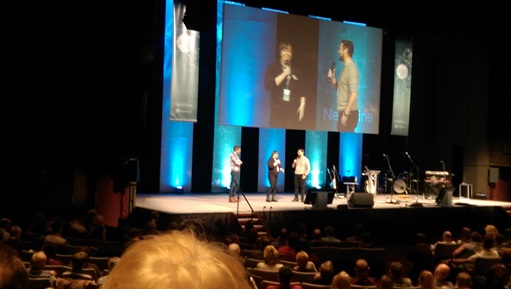
This March the New Wine Leadership Conference happened in Harrogate, England and brought 1700 church leaders together to listen to speakers such as Mark Batterson from National Community Church, Washington DC; Nicky Gumbel from Holy Trinity Brompton, London; Justin Welby, the Archbishop of Canterbury; Revd Dr Kate Coleman, President of the Baptist Union; Pastor Edward from Damascus and Charlotte Gambill, Pastor of Life Church Bradford. I will say a little about what four of these speakers had me hear. I say that because speaking and hearing seem to be such different mediums. What I heard is perhaps what God had for me, and as you will probably know too, is not always the same as what was said. I know that too now, as a preacher, myself. One person’s reaction to something spoken is rarely repeated in another and often I am told of things that have been heard that I never said at all, hence I still script out everything I am going to say, just so I am able to check and then give thanks to God that some of the rubbish didn’t get remembered and he spoke to people in ways that I hadn’t even explored.
I have learnt along the way to be less of a Joseph and it was only a few weeks ago that someone said to me rather seriously ‘Be careful who you tell your dreams to, Rachel.’ I still have a lot to learn. Some of my dreams have been realised, like my work towards the launch of a Street Pastor project but many are yet to be realised and maybe never will be. Nicky spoke to me about how it hadn’t been very wise of Joseph to talk about his dreams in the way he had.


Kate Coleman began acknowledging that the New Wine movement is facing some challenging times. She began her preaching by describing a man who wanted to change the world but set his vision too wide. So he thought instead he would change his country, but again this proved difficult so he focused on his neighbourhood. He began in the end to work only on himself and this is how the world came to change. We are all praying and sharing our grief since the leader of the movement fell from grace and in some ways the Leadership Conference revealed to me how much of a family we are as we took stock together of this challenge. There was a humility expressed about our obvious vulnerabilities and fragilities as leaders and I saw nothing but grace within that framework of loving discipline that I had hoped to see, from the front, and in people’s making reference to the challenge we are facing.
Kate explored Moses’ leadership challenges; his growing pains on the way to maturity; the maturation process being more a spiral than an upward curve with no simple linear progression. She called me to consider what she described as ‘What you know about yourself that no one else knows’, ‘What others know about you but no one else knows’ and ‘What only God knows about you.’

She focussed on the life of Moses and how he tries to evade God’s call, wants validation of God’s authenticity. Then there was this seeming mismatch for Moses; has God really understood Moses fully? Is he a credible choice, does God really know him, to choose him as he does. Finally God’s authenticity is validated, Moses’ credibility is validated but there is this final recourse motivated by fear or false pride which tries to persuade God that there should be someone else whom he chooses as a deliverer. I suspect all of us leaders can relate to the life of Moses. Sometimes the voices protesting are not always the internal ones, we have to deal with our external critics too. This is where Kate’s experience as a coach and mentor shone through. I have just finished a year of coaching as I transitioned from second chair to first chair in ministry and I had been asked to always find the kernel of truth in the claims of my critics, where are they right? What can I learn?

Correction comes to deal with those things that others know about you that you cannot see for yourself. If correction is received badly, we can stagnate. But if received well, it can be for our growth (Heb 6:12). Kate encouraged me to think about those others, within my current church, who are carrying the wisdom of God for me and blessed with my Lay leader wardens, I knew immediately who it was I was being asked to give thanks to God for. We develop only with the help of others. We are to give people permission to speak into our lives and we are to listen. Jethro insisted that his son-in-law, Moses, share the leadership load and collaborate.
The remaining speakers seemed to me to say something to me about this very idea of collaboration, sharing the leadership load, about legacy, how I am to pass on a baton and whether I love God more than I love the vision he has given me of what is possible.
Justin Welby began with a synopsis of our current instability, the secularist agenda, the acceptance that there are no absolutes except that there are no absolutes which is, of course, an absolute. He made the congregation laugh with this. My best friend and colleague through theological college shared with me her reflections, similar to my own, that we hadn’t known our A B of C to have such a sense of humour. ‘There’s our boss,’ she said, ‘I never knew he was so hilarious.’ Like Nicky Gumble, Justin Welby focussed on the absolute confidence we should have in the God who has raised Jesus from the dead; that as Christians we swim well in a secular sea of uncertainty and are not intimidated when Jesus’ first words coming to the disciples over the water are those cautioning them against fear.
He referenced Westerhoff’s ‘Will our Children have Faith?’ to describe how the Christian community must have a sense of the past, the present reality of God and the God who is to come. New Wine is called to remember its past in shaping the Anglican church and its influence on Justin Welby himself was acknowledged.
We are, though, to stay alert to what God is doing presently and not dwell in the past because God is always doing a new thing. The long years of winter in the Church of England are thawing and a new spring is coming. This was the phrase on everyone’s lips for the rest of the conference and it seemed to have a very prophetic weight about it.

This led on neatly to Charlotte Gambill’s exploration of the dysfunctionality of the church. She was going to dare to talk about awkwardness in ministry and tensions between teams of people leading. She explored the difficult conversations we have to have and how Jesus had incredibly hard conversations with his disciples. She focussed on Elijah and Elisha, how Elijah dealt with his issues, wanting at first to give up but listened to God, wanting to lie down under the tree and quit he was encouraged to eat, simply that. God cares about our everyday needs. We get tired and he cares – we have to know that becoming tired is expected and Jesus provides for this, telling us to find rest in him. We are all tempted to just lie down under a tree sometimes but tiredness shrinks our vision as it causes our eyes to droop; we see disappointment far more obviously; our focus gets skewed. I could relate to this having been only recently cured of workaholic tendencies that cost me my health at times in my last post and during my former vocation as a secondary school teacher. God has given back to me that capacity for joy from the other calls in my life that I had lost temporarily as I got busy for God. The life I lead now pastoring a church as an Anglican vicar is much more of a balanced one. I could relate to Charlotte’s insight that God’s answer is not always super spiritual, he answers in the natural and sometimes simply recommends food and rest. I have had times when I have not listened to this in the past and learnt some heavy lessons along the way.
God’s answer for Elijah, a little like Kate’s focus on Jethro’s advice to Moses, is to share the load, Charlotte advocated. Elisha is to wear Elijah’s mantle. What God has planned will be fulfilled through Elisha. God is concentrating less on success and more on succession and this was in many ways where we were being led by Justin Welby as he considered the Hall of fame that he walks past in Lambeth Palace and our over-concerns with our legacy and being great leaders when we have one leader Jesus Christ who is sufficient.
Charlotte explored our resistance regarding investing in the next generation, sometimes subconsciously requiring they have it as tough as we did; sometimes not wanting them to wear the leadership mantle better than we have. She explored how we can feel let down by the reactions of those we pass the mantle on to; they are not wearing it the way we had hoped; they are not receiving it in the way we had anticipated. Elisha wants to go home first and kiss his parents before he moves on to the next stage of life that Elijah is inviting him into and this would have come as some disappointment to Elijah when it is so costly for Elijah to throw such a symbolic garment over the shoulders of Elisha. In this garment he had seen good times with God, wanted to crawl under and quit. It had protected him through trials and cold nights. Throwing his cloak would leave him exposed, vulnerable. Without it he has to be real because as he passes the mantle on, his own exposure is simultaneous.
Charlotte reminded me that I have to be willing to throw a cloak a little more often in ministry, rather than throw a title, an accomplishment. We have to let go of controlling the response in the other person too.

The journey to kiss goodbye before moving on Charlotte advocates as healthy, there are healthy leave-takings, as we move into new seasons, we are to leave the last one well. Elisha knows he has things to deal with before he can deal with what Elijah is asking of him. Elijah’s not giving up under that tree was because God had succession in mind and similarly we are to realise that when we do not accomplish all we had hoped, we are not simply to quit, we are to think of all that God has invested in us and pass that on to the next person who is stepping in to continue God’s vision for that place. We are to think of those who put cloaks over our shoulders and we are to have in mind the future generations to whom we will give a cloak. We are to get out from under our trees and ensure there is a double anointing available for God’s person for the future.
I came back from the leadership conference reminded again of the awesomeness of God. My roomy and I, my best friend from theological college, also side-stepped one talk and simply drank tea and cried together as we remembered the giddy days of our first being called; those years when the Holy Spirit was working so hard to call us, to have us kiss goodbye to what once was and walk step by tiny step into God’s future that we were quite undone by Him. We promised to hold each other to account, to not lose our first love, as God becomes ‘job’ as well as ‘call’ as we both serve the Anglican church in all its everyday stuff. We dried eyes and returned to the auditorium to receive from God before making our way back home to put into practice and to put into prayer all we had heard (and heard!).
Event website: https://www.new-wine.org/events/leadership-conference-2016