
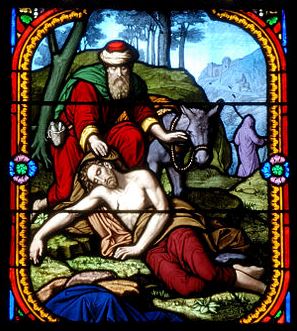
Transforming: The Church as Agent of Change in the Parable of the Good Samaritan

The shocking parable of the Good Samaritan provides an example of how the church can be an agent of transformation. In this story from Luke 10, a despised minority person demonstrates God’s love and shows today’s Christians the essence of authentic social transformation.

The story of the Good Samaritan is one of the best-known and best-loved of Jesus’ parables. For many it has become the story of the archetypal good guy who unselfishly helps a stricken stranger. What is more, he does so at great personal expense and inconvenience and without the prospect of getting anything in return. To be sure the above portrayal is there, but the story is much more than that. In fact, beneath the story is a paradigm of how God wants those in His kingdom to affect their world.
A Lawyer’s Bold Question
The Lawyer’s Astute Answer, But Hidden Motive vv. 27-29
Without hesitation (I imagine), the lawyer quotes two verses that summarize the heart of the Decalogue, or Ten Commandments: “’You shall love the Lord your God with all your heart, and with all your soul and with all your strength, and with all your mind’ [Deut. 6:5]; and, ‘Love your neighbor as yourself’” [Lev. 19:17]. His answer actually distills Israel’s covenantal responsibility to two all-encompassing principles of the Torah, i.e., to love God supremely and to love your neighbor as yourself. Jesus can hardly find fault with this answer. After all, on another occasion, the Pharisees asked Jesus to identify the greatest commandment in the Law, and he answered with the same two scriptures adding, “All the Law and the Prophets hang on these two commandments” (See Matt. 22: 37-40). Consequently, Jesus affirms the correctness of his answer and says, “Do this and you will live.”4 Nevertheless, the answer raises the fundamental dilemma for a Jew. Under the Law, the covenant responsibility of loving God is inseparable from loving ones neighbor as oneself. Jewish teachers tended to identify “neighbor” with “fellow countryman” (i.e., Israelite).5 However, the broader context of Moses’ instruction was given to all the congregation of Israel (Lev. 19:2) and dealt with how they were to conduct themselves as a “holy” people. This included how they were to treat the “stranger” (v. 10) in the land. The lawyer’s question, “Who is my neighbor?” is really asking, “To whom do I owe that covenantal love Moses spoke about?”
Jesus’ Parabolic Answer
Rather than answer the question directly, Jesus tells a parable that expounds God’s love. One obvious and inescapable truth is that there is no love of God without the love of one’s neighbor.6 Nevertheless, Jesus advances to challenge the lawyer’s application of that principle: The circle of God’s love encompasses not just Israel, but the alien and stranger (Cf. Lev. 19:9,10). To do this he tells a story/parable that is both believable and incredible. It is believable because the event was common in that day; incredible because of the actions and roles of the main characters. Through the parable, Jesus answers the lawyer’s question and a more fundamental one: “What does God’s love of neighbor look like?”
God’s Love Is Impartial and Without Prejudice
God’s Love Has Compassion
The Samaritan shows the covenantal love and compassion of Yahweh to his neighbor. He acts spontaneously, without regard to social or religious prejudice, out of pity for a fellow human being in need. Jesus thus paints a picture of the true lover of God who has God’s merciful heart toward the victims of sin in this world. He reveals a loving heart of someone who stands in solidarity with hurting humanity and has the capacity to feel their pain.
God’s Love Shows Mercy
God’s Love Practices Justice
Parabolic Conclusions
How does this parable instruct the church in becoming a transformational agent in society? The answer surely is coming into focus. In verse 36, Jesus inverts the question. It is not “Who is the neighbor I ought to love,” but “Who showed the love of God and demonstrated he was a neighbor to the stricken Jew?” From the parable, the character of God’s love is clear. It requires a compassionate heart, active benevolent action or intervention and sacrificial involvement. This kind of love is expressed by God’s covenant people toward all those who fall victim to sin in all forms of injustice, exploitation and oppression. It is due to all those in need of mercy.
PR
Notes
1. Given the challenges and opposition Jesus faces from the religious leaders in Luke’s Gospel up to this point, it also possible that the question was offered in an attempt to expose some unorthodox teaching that could be condemned. See 4:28-30; 5:21, 30:6:2, 7-10; 7:29-30, 36-39; and especially all of chapter 11.
2. All biblical citations are from the New International Version (NIV).
3. See Craig S. Keener’s remarks in IVP Bible Background Commentary: New Testament. (Downers Grove, IL: InterVarsity Press, 1993), 217.
4. Jesus words are reminiscent of Lev. 18:5 which promises life to those who keep the Law. But the life promised in the Torah was a reference to a long life in the land of their inheritance. Later Jewish interpretation expanded this promise to eternal life, which is the same application made by Jesus here. See Keener, Bible Background, p. 217.
5. Ibid.
6. The New Testament expansion of this principle can be found in 1 Jn 4:19-21, “We love, because He first loved us. If someone says, “I love God,” and hates his brother, he is a liar; for the one who does not love his brother whom he has seen, cannot love God whom he has not seen. And this commandment we have from Him, that the one who loves God should love his brother also.”
7. An example is provided for us by Josephus who relates an incident under the procurator Coponius (AD 6-9). He relates how the Samaritans sneaked into the temple precincts on the eve of the Passover and scattered the bones and ashes of the dead in the outer courts. See Josephus, Antiquities, 18.2.2.
8. Burton L. Goodard, “Justice,” in the Baker’ Dictionary of Theology, ed. E. F. Harrison (Grand Rapids: Baker Book House, 1960), p.309
9. R. Duane Thompson, “Justice,” in the Beacon Dictionary of Theology, ed. R. S. Taylor (Kansas City, Missouri: Beacon Hill Press, 1983), p.296.
This article first appeared in the Fall 2004 issue of Encounter. Used with permission. http://www.agts.edu/encounter