
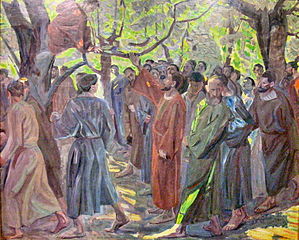
Transforming: The Church as Agent of Change in the Story of Zacchaeus

The power of personal faith in Christ changing people and society around them. A study in Luke 19:1-10 by James D. Hernando.

The story of Zacchaeus is one of the most intriguing in Luke’s gospel—a literary masterpiece filled with vivid imagery, drama, and biting irony. It is the story of the conversion of an arch villain in Jewish society who has a transforming encounter with the Lord. But it also offers marvelous insight into how the church transforms society one converted sinner at a time.
Enter the Villain
Luke quickly opens his story by introducing the main character in the briefest fashion. However, English readers seldom catch the innuendo of the Greek syntax. “There was a man called by name Zacchaeus.” Luke is undoubtedly calling attention to the man’s name, which is derived from the Hebrew root1 meaning “pure” or “acquitted one.” The irony leaps out from Luke’s pen with the ensuing words, “and he was a chief tax collector.” Tax collectors (Gk. telonai) were locals hired by cities and towns to collect taxes for the Romans. Zacchaeus was a “chief” tax collector (Gk. architelones), which meant he probably had supervision over a region and number of tax collectors. Luke’s words “and he was rich” would certainly not go unnoticed by Jews in Jesus’ day. The privilege of collecting taxes was offered at a steep price and those who held that job set tax rates that often exceeded by far any quotas demanded by Rome. While tax-collectors had no authority to confiscate funds or property, they held great leverage over the people as they could exact severe penalties by reporting tax delinquency to the Romans. This they often did whether the charge were true or not.2 And so here Luke presents an arch villain who is ironically named. He was anything but someone of pure or blameless character; he was, in fact, the exact opposite of his name. Keep in mind also that “tax-collectors” were notorious for their corruption and the mere mention of their profession aligned them with “sinners.” (See Matt. 9:11; Mark 2:15f; Luke 5:30).
The Action of Zacchaeus
The Call and Invitation of Jesus
The irony continues when Jesus stops under this “sycamore” tree and calls him to come down. If as some scholars suggest the tree was a variety of “fig” tree (mulberry),3 the irony soars. The great “shake down” artist who could extort excessive taxes by falsely accusing people of tax delinquency is now “shook down” down out of the fig tree!4 But Jesus does not berate him or add to his obvious humiliating posture. Instead he honors him by calling him by name and declaring his intent to be a guest at his house.
The Transforming Fellowship
Concluding Thoughts and Application
The transforming effect that the Church brings to society is only possible through individuals who have had a transforming encounter with Jesus Christ. At conversion sinners experience an inner transformation that reorients their entire lives. In a very real sense, all things become new (cf. 2 Cor. 5:17). Regeneration (“being born again”) and the indwelling presence of the Holy Spirit initiate the process of transformation into the image of Christ (Rom. 8:28f; 2 Cor. 3:18; Titus 3:5). However, all too often Christians think about this work of transformation exclusively in a personal spiritual sense. Seldom do we “think outside the soul,” to borrow a cliché.
The Church can become a transformational agent in society when people, who are daily being transformed into the image of Christ, determine to live out “Kingdom” principles in the various arenas of their personal lives. The effect is magnified when these same individuals collectively ask how those principles might inform and transform the business of being “in this world,” but not “of this world.” This life is made possible by the enabling presence and power of the Holy Spirit who has been given to us as a pledge of the fullness to come (Eph. 1:13-14; 2 Cor. 1:22).
PR
Next Issue (Winter 2009)
Transformation: The Church as Agent of Change in the Parable of the Good Samaritan
Notes
1 If Frederick Danker is correct and Zachaios is derived from the Hebrew Zakkai then his name points to the moral character of purity or uprightness. See F. Danker, ed. A Greek-English Lexicon of the New Testament and other Early Christian Literature (Chicago: University Press, 2000), 214. Cf. R. L. Harris, G.L. Archer and B.K. Waltke, Theological Wordbook of the Old Testament, vol. 1 (Chicago: Moody Press, 1980), 548.
2 Everett Ferguson points out that the word translated “defrauded” in 19:8 (Gk. sukophanteo) actually means to “bring false charges.” See E. Ferguson, Backgrounds of Early Christianity (Grand Rapids: Wm. B. Eerdmans Co., 2nd ed., 1993), 88.
3 See sukomorea in DBAG Lexicon, 955.
4 Thanks goes to my colleague and Academic Dean at the AG Theological Seminary, Joseph Castleberry, for this illuminating metaphor.
5 This undoubtedly they regarded as a gross social and religious indiscretion.
6 Whether this happened on the way to Zacchaeus’ house, or in the house some time during their visit is not certain, although the latter is more probable.
7 The Greek syntax indicates that what is described in the “if” clause of this conditional sentence is assumed to be “true.”
8 The author is not endorsing “friendship” evangelism over all other modes of evangelism, only pointing out the validity and effectiveness of this model to combine the aims of evangelism and discipleship. Recently, a friend of mine shared with me his joy over a friend who had come to Christ, after several years of meeting regularly for coffee and conversation. His friend is now a brother in Christ, attends church and continues to be mentored and discipled. As far as I know, their weekly coffee meetings continue.
This article first appeared in the Summer 2004 issue of Encounter. Used with permission. http://www.agts.edu/encounter