
Chad Gerber: The Spirit of Augustine’s Early Theology

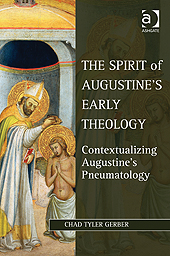 Chad Tyler Gerber, The Spirit of Augustine’s Early Theology: Contextualizing Augustine’s Pneumatology (Farnham, Surrey, UK: Ashgate, 2012), 221 pages, ISBN 9781409424376.
Chad Tyler Gerber is Assistant Professor of Theology at Walsh University, USA. This book is part of the Ashgate Studies in Philosophy and Theology in Late Antiquity. The series focuses on major theologians from the patristic period as individuals immersed in their own culture. It somewhat uniquely aims to understand the convergence or divergence of pagan and Christian thought on issues addressed by both streams. Accordingly, it hopes to ascertain the true creativity of a particular author and to assess the abiding value of his thought for modern times. This text is serious theology so lay people or even many clergy may not find it easily palatable. However, teachers and advanced students of theology will definitely find it a rewarding and worthwhile read. Augustine is indisputably one of the giants of Christian thought, and Gerber offers a fresh and vigorous look at his pneumatology. That alone is cause for acclaim. Accordingly, those interested in patristic studies in general or in Augustine in particular as well as his pneumatology will benefit from The Spirit of Augustine’s Early Theology. I suspect Pentecostal and Charismatic theologians should be especially interested in the depths of Augustine’s theology of the Holy Spirit.
Gerber explains that “Augustine’s pneumatology remains one of his most distinctive, decisive, and ultimately divisive contributions” to Christian theology. Several questions guide Gerber’s work on this text. How did Augustine’s understanding of the Spirit develop? Why does he identify the Spirit with divine love and cosmic order? What were the sources of his inspiration? Gerber focuses on the early Augustine and his first writings in order to get at the seminal roots of his more mature thought. He is particularly interested in the Platonic influence on Augustine’s pneumatology and in the possibility of his continuing commitment to the divinity of the human soul. (In a brief appendix, Gerber sums up his argument that Augustine rejected the divinity of the soul; but, he suggests Augustine appropriated certain functions of the Plotinian Soul regarding the particularity of the Holy Spirit, especially his idea of the Spirit as the “ordinator” of the world.)
Following the contours of Augustine’s early writings and the locale of their construction, Gerber presents his material in four chapters. After a brief introduction, Chapter One on “Nicea and Neoplatonism” (386-87 AD) examines the influence of Nicea and Neoplatonism on the budding theologian’s early Trinitarian theology as he writes from Milan. Gerber concludes that “at bottom” Augustine’s early Trinitarian theology was “pro-Nicene” and also made use of “Plotinian triadology”. He suggests the early Augustine still had much to learn about both Neoplatonism and pro-Nicene theology; but, he had sufficiently grasped the central tenets of both in such as way as to understand and express his theology in terms that would remain essentially the same throughout his subsequent writings.
In Chapter Two, “The Soul of Plotinus and the Spirit of Nicea,” studying the Cassiciacum Dialogues (386-87 AD), Gerber gets to a more specific pneumatology and also to the delicate relation in Augustine between Plotinus’ philosophy and Nicene theology. Gerber suggests that Augustine’s more or less random invocations on pneumatology at this point nevertheless adhere to a consistent “redemptive-historical perspective in which God the Spirit leads fallen souls to God the Son.” Augustine is apparently influenced here by the New Testament and by patristic writings. The theme of “return” is also evident, and Plotinus appears to have provided “a psychological model of ascent” in which the soul’s salvation involves a vision of “archetypal Truth and a ‘return'” to God as “the ultimate source of all things” (although Romans 11:36 is key). Gerber, however, judges the material too scarce at this point to make sweeping conclusions about specific ideas concerning pneumatology and cosmic order.
Augustine’s Roman writings (387-88 AD) form the basis of Chapter Three on “The Spirit of Love.” Here Augustine’s redemptive pneumatology, the preeminent Christian virtue of love, and meditations on the Spirit’s eternal mode of being are distilled and related. According to Gerber, it appears that apparently these writings implicitly present “a tacit intra-Trinitarian love-pneumatology” that will later become prominent in Augustine’s pneumatology.
Chapter Four on “The Creative Spirit of God” from the Thagastan writings (389-91 AD) analyzes profound developments in Augustine’s pneumatology. Now the Spirit is seen to have a distinct place within the economy of creation. Augustine’s earlier “love-pneumatology” now must be understood in the light of this important development regarding his “order-pneumatology” with its triadic structure of creation as created by the Father through the Son in the Holy Spirit. Most significantly, Augustine is able to synthesize these two different emphases in his pneumatology. Gerber concludes that Augustine was committed to the theological tradition of Nicea but extended and expanded it. However, Augustine employed the philosophical tradition also. Above all, Gerber claims, Augustine “As a Catholic theologian was committed to the Spirit of God and to the Spirit’s continuous work in the life and thought of the Church.”
According to Gerber’s analysis, we continue to see signs in Augustine of a careful and creative synthesis of pro-Nicene theology and Neoplatonist philosophy. Early on this seems to have been more of a naïve infatuation that was adjusted with advancing maturity and development. Throughout his career, whenever Augustine discovered conflicts between Neoplationism and Christianity, he always adhered to the latter. However, at his early stage he is obviously enchanted with Plotinus and seeking to express his own theology in terms agreeable to it. Important to remember is that his circle of intellectual Christian friends would have had similar tendencies. In any case, the primary and, more importantly, the determinative, sources of Augustine’s theology were the Holy Scriptures and the pro-Nicene patristic theological heritage.
First, this book is not a study of Augustine’s overall theology or his mature pneumatology. It carefully focuses on the beginnings of Augustine’s thought processes regarding the Holy Spirit. For those wondering, “Where was Augustine coming from with his pneumatology?” this is the book. However, many topics that pneumatologists are often interested in, such Augustine’s monumental impact on subsequent pneumatology through ideas such as “double procession,” or the Holy Spirit’s procession as the Spirit of God and of Christ from both the Father and the Son, and his subsequent and controversial filioque addition to the Nicene Creed, are not the subject of this study. (However, the beginnings of Augustine’s thoughts on the Spirit’s mission and procession may be discerned in a comparative manner.) Further, Pentecostals and Charismatics will not find this book a resource regarding Augustine’s complex positions on the charismata or spiritual gifts. Regarding glossolalia, he was a cessationist in that he claimed speaking in tongues was only for the first century Church. Regarding miracles, he was a non-cessationist in that he described miracles and healings as occurring in his own day. But again, such issues are not the focus of Gerber’s investigation. For a brief survey of historical pneumatology including issues such as these, I’d recommend Stanley Burgess’s article on “Doctrine of the Holy Spirit: The Ancient Fathers,” in The New International Dictionary of the Pentecostal and Charismatic Movements (Zondervan, 2202). For more thorough works, see Veli-Matti Kärkkäinen’s Pneumatology: The Holy Spirit in Ecumenical, International, and Contextual Perspective (Baker 2002) or Mark Cartledge’s Encountering the Spirit: The Charismatic Tradition (Orbis, 2007).
Second, this book should be a great help to Christian theology and pneumatology in several ways. Firstly, it focuses attention on a giant among theologians on pneumatology as a subject worthy of and requiring closer and deeper inspection. This is an absolutely necessary step in a process for overcoming and correcting the lacuna in historical theology regarding pneumatology. Secondly, it demonstrates seminal ways in which the dynamic interplay of Scripture and theology with philosophy and culture were involved in Augustine’s thought—an issue of great relevance even beyond Augustine and his age for us and ours. Thirdly, it amply demonstrates the essentiality of a robust pneumatology for a balanced Christian theology. Clearly, Augustine’s doctrines of the Trinity or of ecclesiology or soteriology are not only incomplete without his pneumatology but actually inconceivable. Pneumatology is interwoven into the fabric of everything!
With extensive footnotes, bibliography, and index, Gerber’s The Spirit of Augustine’s Early Theology: Early Theology: Contextualizing Augustine’s Pneumatology should serve well as a resource for scholars and serious students of historical theology and of Augustinian pneumatology. I highly recommend it!
Reviewed by Tony Richie
Preview The Spirit of Augustine’s Early Theology: books.google.com/books/about/The_Spirit_of_Augustine_s_Early_Theology.html?id=Bfefr9YA8-YC
Originally published on the Pneuma Foundation (parent organization of PneumaReview.com) website. Later included in the Spring 2025 issue.




TW writes: "The philosopher/theologian speaks".