
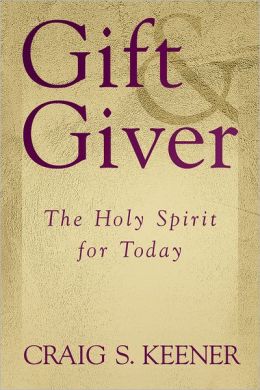
Craig S. Keener’s Gift & Giver: The Holy Spirit for Today, reviewed by Wolfgang Vondey

 Craig S. Keener, Gift & Giver: The Holy Spirit for Today (Grand Rapids: Baker Academic, 2001), 224 pages.
Craig Keener, a New Testament professor at Eastern Baptist Theological Seminary, has already made a name for himself in the world of biblical studies. The present work on the Holy Spirit will undoubtedly introduce his name also to the field of pneumatology. Gift & Giver is a concise and well-written book on the Holy Spirit. Its outline may as well be called exemplary, its goal and informative value priceless. Published by an academic publishing house, the book speaks well to a much wider audience than the academic world. From the perspective of the latter, one could also entitle the book “Discerning the Holy Spirit.” The framework of the book is formed by a discussion of the discernment and recognition of the Spirit and spiritual gifts. However, the decisive question for Keener is, “How do we discern the Spirit’s work today?” It is this question of applicability to our lives today that elevates the book beyond many of its academic contemporaries.
Keener admits that much of the material of the book is based on his earlier work 3 Crucial Questions about the Holy Spirit. However, the reorganization of that material and the application of biblical principles to daily life through personal stories of the author make Gift & Giver a more accessible book for a wider Christian audience than its predecessor. The sharing of personal stories is no longer limited to authors of the charismatic and Pentecostal movements but has long found entrance into theology as a valuable tool of teaching, confirmation and illustration. Difficult biblical and theological issues are dealt with in a scholarly and pastorally sensitive manner that offers a refreshing perspective on the work of the Holy Spirit. Even if one disagrees with Keener’s conclusions and personal insights at some points, the reader will remain challenged by the presentation of the biblical texts and their application to contemporary life.
The organization of the book is motivated by Keener’s perspective on the need for revival and a fresh outpouring of God’s Spirit today. The author’s main concern is that many people are no longer able to discern and recognize the work of the Holy Spirit. In addition, a confusing array of different interpretations of the biblical texts that deal with the manifestations of the Spirit’s work have left many Christians wondering about the correct understanding of the biblical truth. Keener suggests that the biblical text urges us to be more open to appropriate manifestations of the Holy Spirit. In other words, we should conform our experience to the witness of Scripture rather than Scripture to our own experience. Consequently, Keener urges his readers to discern the continuing presence of all spiritual gifts reported in biblical times in their own lives. For Keener, the Gift and the Giver have not changed, and the biblical witness offers all principles and examples necessary for the discernment of God’s continuing work in our lives today.
In spite of the appeal to a wider audience, many Pentecostals will likely not agree with Keener’s perspective on Spirit baptism and speaking in tongues. For example, he suggests that “tongues” in both Acts and 1 Corinthians refer only to genuine languages and that, consequently, any manifestation of tongues today should also be the same. It is Keener’s personal experience which discredits the theological perspective held by many Pentecostals that tongues can also be spoken in a heavenly language. Here, Keener’s principle of using personal testimony to verify and apply his interpretation of a biblical text is confronted with the reality that others have witnessed and described the language of tongues in equally credible terms and therefore hold different interpretations of the visible or audible manifestation of spiritual gifts.
Nevertheless, Keener’s concern in this book is primarily pastoral rather than dogmatic. For him, the emphasis should be placed on the Giver not on the gift, and faith in the reality of a genuine gift does not mean that all manifestations of that gift are also genuine. In other words, Keener does not suggest that his interpretation should be accepted as normative. Instead, he directs the focus away from the diverging interpretations of Spirit baptism and its (sometimes excessive) manifestations toward a discernment of the Spirit’s work as a whole and the purpose of spiritual gifts for evangelism, mission and unity. Keener wishes to provide resources for today’s Christians who are often overwhelmed by a myriad of voices that take them into different directions. Gift & Giver urges all Christians to reexamine the biblical message of the Spirit’s empowerment for the various tasks God has assigned us in the Church and in the world today. In that capacity, the book is a valuable contribution to a better understanding of the Holy Spirit for today.
Reviewed by Wolfgang Vondey
Editor’s note: Read John Lathrop‘s review of Gift & Giver in the October 2017 issue of Jurnal Jaffray, the online journal of Jaffray Theological Seminary in Makassar, Indonesia.







To read Craig S. Keener's review of John MacArthur's *Strange Fire*, goto: http://pneumareview.com/john-macarthurs-strange-fire-reviewed-by-craig-s-keener
To read Craig S. Keener’s review of John MacArthur’s *Strange Fire*, goto: http://pneumareview.com/john-macarthurs-strange-fire-reviewed-by-craig-s-keener