
Darrell Bock: Purpose-Directed Theology

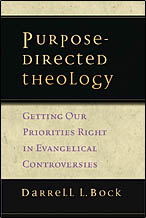 Darrell L. Bock, Purpose-Directed Theology: Getting Our Priorities Right in Evangelical Controversies (Downers Grove, IL: InterVarsity Press, 2002), 114 pages.
Darrell Bock’s Purpose-Directed Theology calls for a biblically grounded, theologically focused and culturally engaged evangelicalism. This work seeks to address both theological scholarship and a wider evangelical public. The back cover of the book summarizes his argument in a succinct and provocative way: “When the stakes are high, evangelicals don’t often engage each other well.” In other words, Bock is concerned with a critical view and correction of the use and direction of “energy” in evangelical spirituality, theology and ministry. The modest size of this volume should not distract from the fundamental issues the author addresses. Here is a proposal for evangelical theology worthy of discussion and application by pastors, teachers, academics, and church leaders.
This book proceeds from a concern about where evangelicals stand today and the question of where they should be going in the future. Bock uses particular localized discussions as examples of how evangelicals have engaged and should engage each other. The first chapter takes on the work of Stanley Grenz, Renewing the Center (Grand Rapids: Baker, 2000), a recent proposal for the direction of evangelicalism. The critical reader is well-advised to read Grenz’s book before reading Purpose-Directed Theology. Bock laments the lack of discussion on the role of Scripture in Renewing the Center and argues for a central place of God’s Word in evangelical theology. The evangelical approach to Scripture he proposes is one of “critical realism”–an awareness and knowledge of reality that should be engaged critically in the way it is perceived. In turn, the reading of Scripture as a divinely rooted and authoritative text should proceed with careful attention to the larger theological, philosophical and hermeneutical debate. Practically, Bock calls for “solidly grounded theologian-philosopher-exegetes in evangelicalism” (p. 33) who operate within a “solid, dialogical community” (p. 34). The subsequent chapters reveal that much of evangelicalism is still far from Bock’s ideal.
Bock sketches the outlines of contemporary evangelicalism from both a historical and an organizational perspective. Historically, he argues, the diverse forms of evangelicalism exhibit a common desire to combine theology and mission as the life-giving center of evangelical growth and vitality. A commitment to Scripture (sola Scriptura), the centrality of Christ (solus Christus) and the salvation he brings by faith (sola fide), the uniqueness of grace (sola gratia) and the desire to give glory to God alone (soli Deo Gloria) represent the major lessons evangelicals glean from its history. From an organizational perspective, these lessons underscore the fundamental need to preserve different types of organizations. Bock distinguishes between tradition-specific, bounded institutions and tradition-inclusive, public-square institutions. In order to fulfill its missionary mandate, he argues, evangelicalism needs public-square institutions that operate ecumenically in order to challenge those outside the evangelical community and invite them to hear God’s voice. Reflection and discussion thus become key components in Bock’s vision of the evangelical future. Tightly defined boundaries in all organizations lead in his opinion to self-consumed debates that keep evangelical’s various strands from developing more intimate contact with each other. As a result, evangelicalism weakens its potential cultural impact, neglects its missionary mandate, and misdirects its energies. He successfully illustrates that too much time and effort is wasted on in-fighting. In Bock’s own words: “an evangelicalism that turns every disagreement into a major battle risks turning all its energy inwards” (p. 79). His advice is simple: go slow! Evangelicals do well to observe the importance of solid biblical interpretation, recognize the insights from the history of Christian thought, resolve disputes communally, practice intellectual empathy, engage in a forthright argument, and only then accept or reject a theological model. Bock concludes with a reminder about priorities. A purpose-directed evangelicalism should focus its energies beyond internal debates to its mission to a lost and dying world.
Purpose-Directed Theology is an important book. Nonetheless, a few questions remain that will have a significant impact on how the book is received. Throughout his work it is not clear what the author means when he uses the term “evangelicalism.” The definition as “people committed to Christ, his gospel and the primacy of Scripture” (p. 53) is too broad to fit only the evangelical community he has in mind. The careful use of the word “church” would have helped in defining Bock’s vision; unfortunately, the term is not sufficiently defined from either an ecclesiological or ecumenical perspective. It is questionable how evangelicalism can escape the apparent inward direction of its energy without also engaging the wider ecumenical community. Bock might have an ecumenical perspective in mind when he refers to the cultural and missionary mandate of evangelicals. However, cultural engagement without explicit ecumenical collaboration runs the risk of resembling mere social activism and fails to address non-evangelical Christians on a fundamental ecclesial level. On the other hand, the missionary mandate of evangelicals should engage other ecclesial communities as partners not objects of their mission. Ecclesial identity and ecumenical involvement go hand in hand if evangelicals wish to get their priorities right. Darrell Bock’s Purpose-Directed Theology offers a significant challenge in these and other aspects, and the book should make its way into all areas of evangelicalism where serious theological discussion and collaboration are appreciated and nourished.
Reviewed by Wolfgang Vondey
Preview Purpose Directed Theology: http://books.google.com/books?id=Tl9_rkSpidcC
Publisher’s page: http://www.ivpress.com/cgi-ivpress/book.pl/code=2725