Jakob Thorsen: Charismatic Practice and Catholic Parish Life

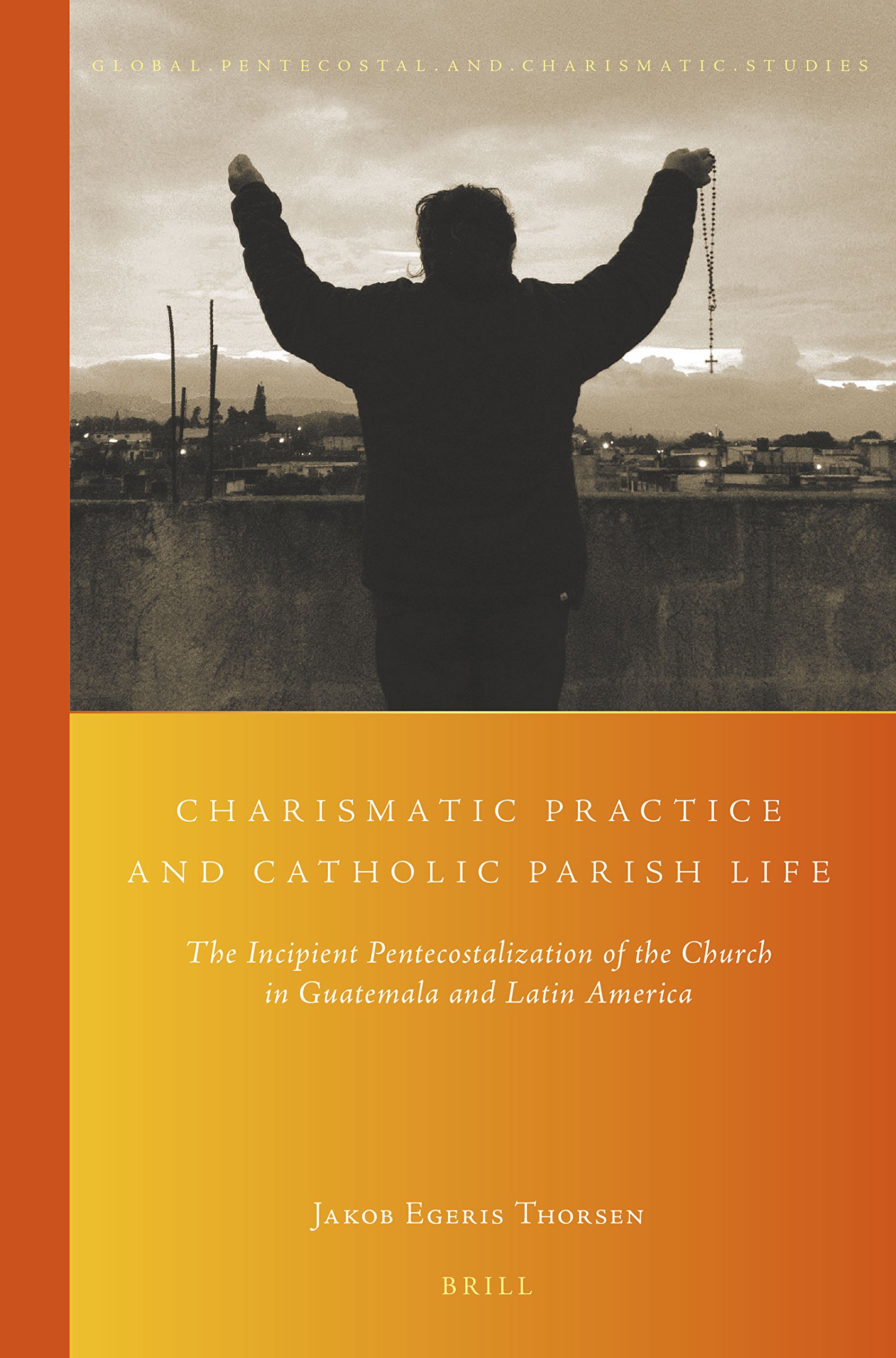
 Jakob Egeris Thorsen, Charismatic Practice and Catholic Parish Life: The Incipient Pentecostalization of the Church in Guatemala and Latin America, Global Pentecostal and Charismatic Studies 17 (Leiden: Brill, 2015) x + 242 pages, ISBN 9789004291669.
Recent scholarship on the rapid expansion of Christianity in the Global South consistently affirms the Pentecostalization of the church. Scholars are producing histories and theologies on the efforts of Pentecostal missionaries from the Global North and the rise of independent Pentecostal churches (hence the series at hand). In this work, Jakob Egeris Thorsen gives a much-needed history and analysis of another dimension of Global South Pentecostalization, namely the role of Charismatic experience and praxis within Catholic parish life.
In this revision of his PhD dissertation defended at Aarhus University in Denmark, Thorsen delivers a Missionwissenschaft, a methodological blend between science of religion and mission theology, to assess the rise of the Catholic Charismatic Renewal (CCR) in Latin America and specifically Guatemala. Thorsen argues that the rapid Pentecostalization of the Catholic Church created increased blurring between CCR and the institutional Church. He discovers renewalists who reject institutional religion for more particularistic and countercultural praxis and witness, but paradoxically remain in the tradition and embrace institutional hierarchy.
Thorsen focuses on the religious life of Charismatic and non-Charismatic Catholics in La Colonia, a small parish in the lower middle-class district of Santísima Trinidad on the outskirts of Guatemala City. He conducted six months of fieldwork in this small Guatemalan Charismatic Catholic parish (from June to December 2009) in order to assess the ecclesial contributions of Guatemalan Charismatics, particularly their negotiation of parish life alongside priests, bishops, non-Charismatics, and non-Catholic Pentecostals. Apart from routine participation in weekly parish events, Thorsen concentrated his research on three Charismatic groups, namely, a full-scale Charismatic youth group, a soft-Charismatic Bible study, and an upper middle-class non-parish based Charismatic youth group. He conducted more than thirty interviews of parish members including Charismatic and non-Charismatic parishioners as well as four priests and two Charismatic auxiliary bishops. Along the way, Thorsen reveals his personal connection and possible motivation for this project; he first came to Guatemala as a sixteen-year-old high school exchange student and subsequently converted to Catholicism in his early twenties. Thorsen’s wife is from this community, and their daughter was baptized in this parish. He describes himself as a non-Charismatic lay theologian and a friendly critic of the CCR.
To defend his thesis, Thorsen turns to Italian sociologist Francesco Alberoni. Thorsen applies to CCR Alberoni’s sociological categorization of the “nascent state,” the temporary status of a movement in a state of dismantling, reshaping, and liberation from institutional prohibitions and repression. According to Alberoni, such movements must choose and/or accept one of three institutional responses: elimination, expulsion, or integration (e.g., the Medieval period response of the Catholic Church to reject the Waldensians but integrate Franciscans). The growing despair and exasperation of Guatemalan Catholics alongside the vision cast by Vatican II produced the perfect storm for change and discontinuity, an Alberonian “nascent state” for theological and ecclesial experimentation (68-71). The Guatemalan CCR, though a decidedly lay movement, benefited from the anarchic upheaval of Catholic and Guatemalan society. In their “nascent state,” the Charismatic Catholics of La Colonia and many of the burgeoning Latin American Charismatic Catholic communities had to choose between expulsion and possible breakaway or integration. Since their proclamation of a “personal encounter with Jesus” and a “personal Pentecost” found rapid acceptance among many of their Catholic peers, the Catholic Church had no choice but to acknowledge the growing presence of the CCR and therefore make integration possible. Similarly, leaders in CCR strove to locate themselves theologically and practically within their local and global Church.
I applaud the editors of this series for untiring commitment to their namesake “Global Pentecostal and Charismatic Studies,” and I heartily commend this book to the collection. Thorsen provides a superb historical and theological survey of CCR in Latin America and a firsthand, nation-specific study on the intersection of Pentecostal experience and praxis in the Catholic tradition. As a Catholic, he embodies the values of his tradition and provides this readership an outsider response to the CCR and Pentecostalism. Thorsen articulates well the beliefs and practices of Guatemalan CCR and positions their efforts within larger contexts such as Latin American society, the global CCR, and various hierarchical vantage points from regional dioceses to the Vatican. Thorsen will be an important reference for students, scholars, and missionaries interested in the growing presence of Pentecostal/Charismatic Christianity in Latin America.
Reviewed by Martin W. Mittelstadt
Publisher page: https://brill.com/view/title/31610