

In Defense of the New Perspective on Paul: Essays and Review, reviewed by Amos Yong

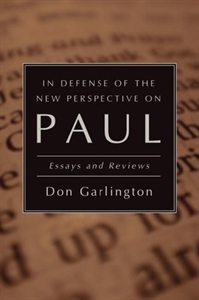 Don Garlington, In Defense of the New Perspective on Paul: Essays and Reviews (Eugene, OR: Wipf and Stock, 2005), viii + 245 pages.
Garlington earned his MDiv and ThM degrees from Westminster Theological Seminary (Philadelphia), and his PhD in New Testament at the University of Durham under James D. G. Dunn. He taught from 1987-2002 at Toronto Baptist Seminary, and has served since as an adjunct professor at Tyndale Seminary in Toronto. Previous to this volume, he had authored four others on various aspects of Pauline theology, including book length treatments of the epistles of Romans and Galatians. From the beginning of his academic career, he has been defending a version of what has come to be known as the New Perspective on Paul (NPP).
What is the NPP? The NPP was initially articulated in 1977 by E. P. Sanders in his important book, Paul and Palestinian Judaism, although it was not given this title phrase until Dunn did so in his Manson Memorial Lecture in 1982. In brief, the NPP can be summarized as making three sets of interlocking claims. First, rather than holding to an exclusively defined religion of works-based righteousness, Second Temple Judaism embraced a form of what might be called “covenantal nomism” (Sanders) whereby God established a covenant relationship with his people (in this case, Israel) which required, as a proper response, human obedience to the commandments of the law. Second, that when understood against this background, St. Paul neither advocates a superseding of the law nor offers a polemic against the law as a means of gaining merit; rather he should be read as defending a view of the law as a way of living within and according to the covenant. Finally, then, the Pauline dictum of justification by faith alone is one aspect of a wider covenant that includes rather than excludes the transformed life and the works of faith. Within this scheme of things, one does not “get into” the covenant via keeping the law; instead, one “stays in” the covenant according to one’s faithful obedience to the terms of the covenant (reflected in the law), even if God also graciously provides for the atonement of sins that are inevitably committed by those who fall short because of either faithlessness or disobedience.
As the title of this volume under review announces, Garlington’s objective is to defend the NPP against its (evangelical) critics. Yet to call this book a “defense” may be a bit overstated for various reasons. In the case of Carson’s book, for example, Garlington rightly points out that many of the contributors to that volume actually embrace one or another aspect of the NPP, and this results in the NPP apologetic being targeted really only at Carson’s introductory and concluding essays, and at one other article (by Mark Seifrid) on the idea of righteousness in the Hebrew Bible. Next, turning to Garlington’s sustained engagement with Piper, the former is at his rhetorical and exegetical best in this part of the book. But Piper’s polemics are directed less at the heart of the NPP debate than at one of its side trajectories: that regarding the doctrine of imputation, especially as seen in the work of Robert Gundry (who Piper considers a representative of the NPP position, if not an actual participant in that “movement”). Of course, Piper and those in his camp are right to be concerned that the NPP has implications that might undermine the traditional view of imputation. Yet the response to Piper could be made, arguably, apart from the NPP. Last (because of space constraints) but not least, Gathercole’s thesis is an interesting one, honed in extensive discussion with his doktorvater, Jimmy Dunn: that the NPP’s overall interpretation of Second Temple Judaism is essentially correct, but not its reading of St. Paul. Rather, Gathercole believes, from what Paul writes in the first five chapters of Romans, that Paul does indeed oppose the view that justification is linked to Torah-obedience. So on this issue Garlington’s defense may be more of St. Paul than the NPP interpretation of Paul.
Overall, however, Garlington consistently makes the following NPP-related triad of arguments: that “covenantal nomism” involves not only the doctrine of justification but also that of liberation from sin and the transformation of believers into conformity with God’s covenant; that while the doctrine of justification includes the classical doctrine of imputation as retrieved by the Reformers, yet the wider framework of St. Paul’s soteriology involves the believer’s life of obedience accomplished through “union with Christ”; and that God’s final judgment requires both faith and “works,” the latter understood in terms of the obedience related to covenantal faithfulness. These theses may place Garlington “outside” the halls of contemporary Reformed-evangelical orthodoxy. However evangelical apologists, whether of the stripe of Carson, Piper, or others, will need to grapple with Garlington’s challenge to approach the texts of the NT in the context of Second Temple Judaism (a central pillar of the NPP) rather than through a confessional theological stance (even if that is one shaped by Reformed and Westminster orthodoxy!).
Readers of the Pneuma Review should be warned that without either an adequate background or interest in contemporary NT scholarship, the reading of In Defense of the New Perspective on Paul will be demanding in many places. There are various technical points of debate, fitting for the halls of the Evangelical Theological Society or the Society of Biblical Literature and often debated within the pages of their respective scholarly journals, but these are for the most part practically inaccessible to most pastors and even informed laypeople in the Renewal movement. Yet those with interest in the scholarly debates will be drawn into the issues via Garlington’s engaging mode of writing, and those who persevere through the volume will be rewarded with insights into the text of the NT itself, as well as into issues in the wider biblical and theological debates.
One such issue of relevance for Renewal scholarship has to do with how to understand the relationship between justification and sanctification on the one hand, and between justification and salvation as a whole, including what Protestants call glorification, on the other. I make this connection as a pentecostal systematic theologian rather than a biblical scholar. What I have observed is not that Renewal (by which I mean pentecostal-and-charismatic, broadly speaking) biblical scholarship has engaged the NPP—they might well have, but I am not as up-to-date in this area—but that pentecostal theologians and, especially, systematicians have made some recent proposals at least consistent with, if not presuming of, some of the basic NPP proposals as defended by Garlington. For instance, one of the main points in Frank D. Macchia’s Baptized in the Spirit: A Global Pentecostal Theology (Zondervan, 2006) concerns the interconnectedness between the doctrines of justification and sanctification. For Macchia, the pentecostal theological emphasis on the Spirit means that justification can never be merely a forensic imputation of alien righteousness, but must also be a pneumatological impartation of the righteousness of Christ resulting in a transformed life. As an extension of this idea (although actually preceding Macchia’s book by two years), pentecostal systematician Veli-Matti Kärkkäinen—although he prefers to call himself an ecumenical theologian—has argued in his One with God: Salvation as Deification and Justification (Liturgical, 2004) that justification is intimately tied in not only with sanctification but also with full salvation understood as glorification. More specifically, drawing from the new Finnish Lutheran scholarship that has unveiled an emphasis in the early Luther on salvation understood as linking justification and what the Eastern Orthodox tradition has called theosis (deification, or union with God), Kärkkäinen claims that such a holistic soteriology is consistent with the pentecostal pneumatological focus on the Spirit’s work from conversion through to sanctification and final union with God in Christ. While both Macchia and Kärkkäinen interact with the NPP, they have done so (thus far) only in passing. Yet it is interesting to note that pentecostal systematicians are coming to similar theological conclusions as is Garlington, even if the latter approaches St. Paul from the intersection of an evangelical Reformed perspective and a covenantal monist hermeneutic arguably in the background of apostolic Christianity.
This raises the question of whether or not Renewal biblical scholars might also find in the NPP new approaches to the Pauline corpus that may open up uncharted paths of inquiry. I hazard to guess that engaging the NPP will lead to an expansion of the traditional Renewal focus on Luke-Acts so that Luke will be read together with Paul rather than either against Paul or only after bracketing the Pauline witness. The NPP, at least as interpreted by Garlington, seems congenial to Renewal sensibilities and commitments. Only the ongoing conversation will determine what else the NPP can offer not only to Renewal biblical scholarship, but also to the wider domain of Christian biblical interpretation.
Reviewed by Amos Yong






[…] In Defense of the New Perspective on Paul: Essays and Review, reviewed by Amos Yong […]
[…] In Defense of the New Perspective on Paul: Essays and Review, reviewed by Amos Yong […]