
Rightly Understanding God’s Word: Context of Genre, Revelation, by Craig S. Keener

In this chapter from the Rightly Understanding God’s Word series, Craig S. Keener concludes Context of Genre with Part 4, the book of Revelation. What can we learn from this book that so many Christians have disagreed about?
As appearing in Pneuma Review Winter 2006.

For an introduction to the Context of Genre, see the Spring 2005 edition of the Pneuma Review.
Revelation
Revelation is a particular kind of prophecy; because of its special importance and the interest it generates, I have devoted an entire section to its discussion. Revelation is a mixture of prophecy and apocalyptic (a special kind of prophecy that appears in Daniel, parts of Isaiah, Ezekiel, and Zechariah), delivered in a letter format.
On any book like Revelation, there will be serious differences of opinion, and we must be charitable in our disagreements. Nevertheless, it is worth exploring to see what the methods introduced previously can teach us, and how they can take us beyond many of the views that have circulated widely. Reading Revelation as a whole (paying attention to whole-book context) and in light of its background (Old Testament and other background) will help us avoid or correct many of the common mistakes we have often inherited from others.
 Revelation is not meant to be an obscure book. It may not be meant to satisfy our curiosity regarding all end-time details, but it certainly is a very practical book that presents God’s demands on our lives. Thus it opens by promising a blessing to those who heed and obey its message (Rev 1:3)—which presumes that we can at least understand enough of it to obey it! An angel told Daniel that the book of Daniel would be sealed up and understood only in the end-time (Dan 12:9); by contrast, the angel told John not to seal up his book, because the end-time was near (Rev 22:10). Revelation may be “hidden” to those who think they need a special key in someone’s teaching to unlock it. It is certainly unclear to those who interpret it only in light of current newspaper headlines—which require us to readjust our interpretations every year or two. But it is not as hidden to those of us who read Revelation straight through and understand it in its whole-book context. All Scripture should be profitable for teaching and instruction in righteousness from the time it was written (2 Tim 3:16-17)—so whatever else it might mean, at least Revelation must mean something relevant for our lives today.
A History of Misinterpretations
Too often people in the past two centuries have used “newspaper hermeneutics” to understand Revelation—that is, they have interpreted it in light of current events. This is why many prophecy teachers have to change their interpretations of the book so often. That they recognize that Jesus could be coming soon, hence that prophecy is being fulfilled now, is commendable, but assertions that some current event definitely fulfills a biblical passage only leads to disillusionment when today’s headlines end up in tomorrow’s trash bin.
One example of newspaper hermeneutics involves interpretations of the “kings of the east” in Rev 16:12. In the early twentieth century, many North American interpreters thought of the “kings of the east” as the Ottoman Empire, headquartered in Turkey. Of course, the seven churches of western Asia Minor could never have conceived of kings of the “east” as Turkey, since Asia Minor is modern Turkey! But to western interpreters over a century ago, the Turks seemed the most threatening “eastern” empire on their horizon. After the Ottoman Empire was dismembered at the end of World War I, the new threatening “eastern” empire was imperial Japan (an empire that also threatened Korea, China, the Philippines and the rest of Asia). After imperial Japan was defeated at the end of World War II, western interpreters shifted the title to Communist China.
Other prophetic interpretation errors abound. Jehovah’s Witnesses, a cult, wrongly predicted Christ’s return or other end-time events for 1874, 1878, 1881, 1910, 1914, 1918, 1925, 1975, and 1984 . Even Bible-loving Christians, however, have made mistakes in setting dates, contrary to our Lord’s teaching (Mk 13:32). The church father Hippolytus concluded that the Lord would come by the year 500. Saint Martin of Tours believed that the Antichrist was already alive in his day; Martin died in 397, so if the final Antichrist is still alive, he possesses remarkable longevity!
 Others have offered “prophetic” interpretations of the news uncritically. Some prophecy teachers in the 1920s embraced a work called The Protocols of the Elders of Zion as confirming their teaching; the work is now known to be a forgery used by the Nazis. Many Christians in the 1970s worried about a computer in Belgium called “the beast”—unaware that the computer existed only in a novel! Around 1980 I heard a prophecy teacher explain that the Soviet Union would, in the next year or two, invade Iran, take control of the world’s oil supply, and precipitate a world war. Needless to say, his prediction is running behind schedule at best.
Various books (including Richard Kyle, The Last Days Are Here Again [Baker, 1998]; Dwight Wilson, Armageddon Now! The Premillenarian Response to Russia and Israel Since 1917 [Grand Rapids: Baker, 1977]) have documented countless claims made by prophecy teachers through history, and especially in the past 150 years, about various contemporary events. These teachers were occasionally right (about as often as astrologers), but were wrong the vast majority of times.
Below is a brief sampling of mistakes in recent history, borrowed from the introduction to my own commentary on Revelation (Revelation, NIV Application Commentary [Grand Rapids: Zondervan, 2000]):
- Christopher Columbus voyaged to the New World hoping to help precipitate the biblical new heaven and earth.
- During the Reformation, Melchior Hoffman allowed himself to be arrested in Strassburg on the belief that it was about to become the New Jerusalem.
- Also during the Reformation, Thomas Müntzer aided the Peasant’s Revolt of 1524, believing that it would precipitate the final judgment; the peasants lost, and Müntzer was executed. In those days, end-time speculations died hard—sometimes literally!
- When King James I persecuted early Baptist leaders in England they feared that they were enduring the final tribulation
- Many Americans believed that King George III (probably one of England’s most pious rulers, as John Wesley recognized) was the final Antichrist.
- Many northern ministers expected the U.S. Civil War to establish God’s kingdom in their favor; some ministers expected God to weigh in on the opposite side.
- William Booth, an apostolic leader in the late nineteenth century whose Salvation Army was doing great works for God, believed that the Salvation Army he had founded “had been chosen by God as the chief agency to finally and fully establish” God’s kingdom.
More recently, in Christians in the U.S. bought over 3 million copies of Edgar Whisenant’s 88 Reasons Why the Rapture Could Be in 1988. A friend of mine worked in a Christian bookstore whose owner urged her to sell as many copies of the book by the end of 1988 as possible; the owner warned that no one would buy the book in 1989. Sure enough, Christians failed to buy many copies of his updated version the next year, rescheduling Jesus’ return to 1989. Let it never be said that North American Christians are easily deceived—at least, twice in a row by the same author the following year. The world was watching, however: the campus newspaper at the university where I was doing my Ph.D. mocked the failed predictions. Others predicted the Lord’s return for various dates in the 1990’s or for the year 2000. As one other writer has pointed out, all predictors of times and seasons have had only one thing in common: they have all been wrong.
Views about Revelation
Traditionally, readers have taken one of the following approaches to interpreting Revelation:
- Preterist: those who believe that everything was fulfilled in the first century.
- Historicist: those who believe that Revelation predicted the details of subsequent history which we can now recognize in history books.
- Idealist: those who believe that Revelation contains timeless principles.
- Futurist: those who believe that Revelation addresses the future.
 The historicist interpretation has been largely abandoned because history does not fit the outline of Revelation very well. (This is true even for the letters to the seven churches, which some once read as stages of church history; very few scholars accept this today even in the “dispensational” tradition where it was once most common. Dispensationalism has also changed a great deal since it was first taught.)
Of the other views, there is something legitimate in each, provided that we do not use one of them to exclude the other views. It is true that Revelation, like other books in the Bible, was written first to an ancient audience (the preterist view); the book explicitly addresses the seven churches in Asia Minor just like Paul addresses churches in his letters (Rev 1:4), and Revelation is written in Greek and uses symbols that first-century readers would understand. This need not mean, however, that it does not speak about the future or (like the rest of the Bible) articulate principles useful for subsequent generations.
Revelation contains timeless principles relevant for the church in every generation. It also speaks about the future, in addition to the present and the past. Readers may disagree on how much of Revelation refers to the future, but almost everyone agrees that Revelation 19-22, at least, is future. Likewise, at least some of it refers directly to the past: the catching up of the child in Revelation 12 (whom most believe to be Jesus) has already happened.
Beyond these points, however, readers have come to startlingly different conclusions about Revelation’s teaching throughout history. We can illustrate this divergence by way of commenting on the “millennium,” the 1000-year period mentioned in Revelation 20. Many readers schooled in a particular tradition may be surprised to learn how many people they respect in church history have held other interpretations. That surprise offers some lessons for us: God does not use his servants solely on the basis of their end-time views, and we should always go back to the Bible to see what it teaches us. Just because everyone we know holds a certain view does not make it right; 150 years ago, most born-again Christians held a different view, and 100 years before that, a still different one.
Most leaders of the Great Awakenings in the eighteenth and especially nineteenth-century United States were postmillennial, including Jonathan Edwards and Charles Finney. During revivals that brought a large percentage of people in the early nineteenth-century United States to Christ, people exercised faith that “the gospel of the kingdom” would be “preached among all nations, and then the end will come” (Matt 24:14). Charles Finney, who may have led as many as half a million people to Christ, and helped lead the movement against slavery, was postmillennial. Postmillennialists believed that they would, through God’s Spirit, establish God’s kingdom on earth, and then Jesus would come back to take his throne. Today many American Christians view postmillennialism as naïve optimism, but it was the dominant view of Christians in the U.S. in the nineteenth century.
We cannot afford the space to debate for or against this view here, but merely wish to point out that most people who hold this view are unaware that no one in church history held this view before 1830. Some today believe that this view is clear; but Christians read the Bible for over 1700 years without anyone, so far as we know, noticing it! (And that, even though most Christians through history believed that they were already in the end-times, and many, like many Christians for the past few generations, that they were in the final generation.) Each view cites verses to defend its position, but each of these verses must be examined in context to be sure of its meaning. That includes views that are widely held today, like dispensationalism; and we should remember that such views widely held today were rarer or (in this case) unheard of in earlier history. For whatever it is worth, the majority of scholars committed to Scripture today are either amillennial or non-dispensational (generally post-tribulational) premillennial, though there are good scholars with other views.
The real issues for us here must be the practical ones that our methods above can help us fathom. Some issues are very practical but no real Christian disputes them: for example, we all recognize that we must be ready for our Lord to return. But other issues are practical and often missed by interpreters who lack access to cultural background or whole-book context methods. Of these I offer a sampling below.
The Use of Symbolism?
Some people argue that we should take everything in the book of Revelation literally. But Revelation is full of images that we cannot take literally. Was a woman literally clothed with the sun in 12:1 (with the moon literally under her feet and twelve stars on her head)? Is Babylon literally the genetic mother of every prostitute in the world (17:5)? Revelation even tells us what some of its symbols represent, making clear that the book includes many symbols (1:20). God could create the sort of monsters described in Revelation 9, but they resemble locusts in Joel’s prophecy, where they are simply a poetic description of either a locust invasion or an invading army (or a combination of both).
Jewish writers in John’s day who imitated the writing style of Old Testament prophets (writing a form of literature later called apocalyptic) frequently used symbolism as well (for example, 1 Enoch portrays angels impregnating women as stars impregnating cows). Just as Jewish teachers often used riddles to provoke thought, apocalyptic writings used enigmatic prophecies to challenge the hearers. Even if we had only the Old Testament as background for Revelation, however, we would expect an abundance of prophetic symbolism (for example, see especially Zechariah, Ezekiel, and many prophecies in Daniel and Isaiah).
Whole-Book Context
Revelation offers a running contrast between two cities: Babylon and the New Jerusalem. Babylon is a prostitute (17:5); the New Jerusalem a bride (21:2). Babylon is decked out with gold and pearls (17:4), like a prostitute seeking to allure us with its offer of sinful, temporary gratification. The New Jerusalem is built of gold and its gates are pearls (21:18, 21). No one with any sense would prefer Babylon to the New Jerusalem; but only those with faith in God’s promise wait for the city from above and resist present temptation.
In the days of Augustine (a North African theologian, AD 354-430), Rome fell to northern barbarian invaders, and Christians were dismayed. Augustine contrasted Rome with the City of God; earthly cities and empires decked with splendor will perish, but God’s city is eternal, and his promise to us will never fail. The world demands that one take the mark of the beast, if one wishes to buy or sell (13:17). But for those who refuse to compromise with the world’s kind of food (2:14, 20), God offers a promise of eternal food (2:7, 17) and manna even when the world persecutes them (12:6). Those who think themselves rich may be poor in what matters (3:17), just as those who seem to be poor may be rich in what matters (2:9). Jesus offers the true gold of the New Jerusalem to those who trust him rather than in their worldly wealth (3:18).
What can we learn about the New Jerusalem? Some translations explain that the New Jerusalem is 1500 miles in every direction, including high (21:16); this would make it about 1495 miles higher than the world’s tallest mountain, where the air is already thin hence difficult to breathe. Admittedly, God could change the laws of physics if he wanted to, but there is another clue that the specific measure given for the New Jerusalem offers a symbolic point: in a city 1500 miles (about 2400 km.), the wall is only 72 yards (about 80 meters).
The list of tribes in 7:4-8 resembles military census lists in the Old Testament, suggesting an end-time army here. Jewish armies were male, and many Jewish people expected an end-time army; some also expected this army to be chaste before the battle. Not surprisingly, Revelation speaks of this group having “overcome” or “triumphed” (15:2-4; cf. 14:3); the beast might overcome God’s servants on a human level (11:7; 13:7), but they overcame by refusing to disobey the Lord who holds the final victory (12:11). But does Revelation mean a literal army of 144,000 Jews? One can interpret it this way, and it would make sense; after all, the Bible does speak of Jewish people turning to the Lord in the end-time (Rom 11:26). But in the context of Revelation, I believe that another interpretation fits better.
Revelation elsewhere speaks of those who are spiritually Jewish (2:9; 3:9). Likewise, in the ancient world lampstands (John’s symbol for the churches in 1:20) are symbolic for Jewish faith. Sometimes a second vision or dream repeated the point of the first one (e.g., Gen 37:7, 9; 40:1-7), and the same is probably true here: in the next paragraph, this triumphant army of 144,000 Israelites turns out to be a numberless crowd from all nations (7:9-17). The promises given to this crowd in 7:15-17 are promises God made to Israel in the Old Testament; but by following Israel’s king these Gentiles have been grafted into Israel’s heritage and promises, hence are spiritually Jewish. Whole-book context clarifies the connection between these two paragraphs. Two chapters earlier, John “hears” about the lion from the tribe of Judah, a symbol Judaism used for the warrior Messiah. But when John turns, what he “sees” is a slain lamb—one who conquered by his own death (5:5-6). Now John “hears” about 144,000 (7:4), but when he turns what he “sees” is a numberless multitude (7:9), possibly of martyrs who have shared Christ’s suffering.
Whole-book context also offers insight into what Revelation may mean when it mentions the mark of the beast. Should we preach about that by simply warning people to avoid something in the future, or does it have something to teach us in the present? Against what most of us have been taught, a consistent reading with the rest of Revelation suggests that this mark may not be visible to people. Notice the other marks written on people in the book of Revelation. For example, believers will become pillars in God’s future temple, and just as other ancient pillars had names inscribed on them, so we will have God’s name and the name of the New Jerusalem inscribed on us (3:12; cf. 2:17). Forever God’s and the lamb’s name will be written on our foreheads (22:4), perhaps like a slave brand or some other kind of brand showing to whom we belong. Jesus comes back with a name written on his thigh (19:12-13, 16), perhaps so John could read his title in the vision. Babylon the great has a name written on her forehead (17:5), but just as Babylon is not a literal woman, we recognize that the inscription is part of the vision, not literally written on a woman’s head.
Just like God placed a mark on the righteous in Ezekiel 9:4-6, so God seals the 144,000 to protect them during his judgments (Rev 7:3). As in Ezekiel, this is a mark that only God himself sees. Because there were no chapter breaks in the original Bible, the first readers would have readily noticed the contrast between the 144,000 and the rest of the world (13:16—14:5). Those who follow the beast bear his name (13:17); those who follow the lamb bear his (14:1). The beast, progeny of its master the dragon, has seven heads and ten horns (12:3; 13:1; 17:3, 7). But a second beast is a deliberate counterfeit of the lamb (compare 5:6): he has two horns like a lamb, but speaks the dragon’s message (13:11). A small army of 144,000 follow the true lamb; the rest of the world (the army of which is at least 200 million, 9:16) follows the beast. Each follower has an identifying mark showing their loyalty, either to the lamb or to the beast. Whether those in the world need to see a literal mark showing who belongs to them or simply signs of allegiance, the preaching point is clear: we must be loyal to God’s side, not the world’s, no matter what the cost.
Background
The seven churches of Asia Minor (1:4) were an audience just as real as any church to which Paul wrote. The churches are in the seven most prominent cities of the Roman province of Asia, and are arranged in precisely the sequence that a messenger traveling from Patmos would deliver the letters. Many issues addressed (such as wealth and distasteful water in Laodicea) address precisely the issues we know were relevant to these particular churches. This is not to say that the message is relevant only for the church addressed; Jesus invites everyone to listen in on his message to each of the churches (2:7). But we learn from their example the same way we learned from the churches Paul addressed: we learn the background so we can understand what issues the inspired writer was really addressing.
 We spoke above about Babylon. This need no more be a literal name than the false prophets’ parents had literally named them “Balaam” or “Jezebel” in 2:14, 20. As most Christians through history have recognized, the Babylon of John’s day is Rome. Everyone knew that Rome was a city on seven hills (17:9); Rome even had an annual festival called “Seven Mountains,” celebrating its founding. The imports in 18:12-13 are precisely the imports we know were most prominent in Rome, and in John’s day Rome was the only mercantile empire to rule the kings of the earth by sea (17:18; 18:15-19). Most importantly, Jewish sources (and probably 1 Pet 5:13) already called Rome “Babylon.” This was because Rome, like Babylon, had enslaved God’s people and destroyed the temple.
The implications of associating Revelation’s “Babylon” with Rome are dramatic. In 18:2-3, John hears a funeral dirge over Babylon (just like the dirge over literal Babylon in Is 21:9). Rome, the mightiest empire the world had yet known, seemed ready to crush the tiny church of Jesus Christ. Rome had exiled the aged prophet John to the island of Patmos (1:9). Yet John hears a funeral dirge over this mighty empire! What faith it must have taken the early Christians to believe this promise that their oppressor would fall; yet John stood on the shoulders of earlier prophets who had prophesied against Assyria, literal Babylon, and so forth, and their prophecies had come to pass. Assyria, Babylon, Rome, and all the other empires of past history now lie in ashes. But the church of Jesus Christ, whom past empires threatened to stamp out, is more widespread than ever before! In a day when the church was established mainly in a few cities of the Roman Empire, John prophesied a church from every tribe and people and nation (5:9; 7:9)—and so it has come to pass!
While “Babylon” for John’s first readers is Rome, that is simply because Rome filled the role in John’s day. If Rome could be a new Babylon, there could be other new Babylons or new Romes, other evil empires that usurp the rightful role of God’s future kingdom. These need not be geographically in Italy any more than Rome as a new Babylon was geographically in the Middle East. In other words, Babylon is the city of the world, like the city called “Sodom” and “Egypt” in 11:8; the world system, in its rebellion against God, is the alternative to the New Jerusalem. But just as the first Babylon fell, just as Rome fell, so likewise the other Babylon’s and Rome’s of history will fall. The final empires will collapse in the day when the kingdom of this world becomes the kingdom of our God and of his Christ (11:15)!
The Roman background might be relevant for understanding the evil king in Rev 13:1-3 and 17:10-11. The first emperor to officially persecute the church was Nero, who burned Christians alive as torches to light his gardens at night. When Nero was killed, however, the belief that he was coming back became so widespread that some impostors rose up claiming to be Nero; a few years before Revelation was written, one false Nero even persuaded the Parthians to follow him across the river Euphrates to invade Asia Minor. Many scholars thus suggest that the head wounded to death and returning to life in 13:3 is a “new Nero.” This does not mean that he is literal Nero come back (any more than the figures in 11:3-6 are a literal Moses or literal Elijah come back); it would simply mean that he comes “in the spirit and power” of Nero (cf. Lk 1:17), i.e., he is being compared with Nero, the terrible persecutor. That is, Revelation uses the language of its day to say, “the future dictator will be like Nero Caesar, just as evil and persecuting Christians just as much.” A Parthian invasion from across the Euphrates was a horrifying image in John’s day, and a new Nero warned of future suffering.
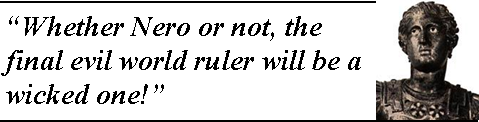 Two further factors support this association with Nero. Revelation speaks of a past king not currently reigning, who would return (17:10-11); Nero was definitely one of the few kings before the current one when Revelation was written. Further, if his name is spelled in Hebrew letters, it comes out to 666. Many early Christians thought that Nero would return as the final Antichrist. There are, of course, other possible interpretations; “beast” in Hebrew letters also comes out to 666, and this point is no less relevant. Whether Nero or not, the final evil world ruler will be a wicked one! And the character of that evil ruler is already at work in others who do evil (2 Thess 2:7; 1 Jn 2:18). Let us never underestimate evil—nor forget that in the final analysis, the righteous God is still in control (Rev 17:17).
Other Reapplications of Old Testament Images
We noted above that the lion turns out to be a lamb. We could also note the reapplication of the plagues of Exodus in Revelation’s judgments (chapters 8, 9, and 16), or the city called “Sodom” and “Egypt.” Revelation is not pretending to “predict” the plagues of Moses’ day, nor is the city of which it speaks the literal Sodom or Egypt of old (as if it could be both!)
In Revelation 21:16, the New Jerusalem’s height is equal to its breadth and length—that is, it is shaped like a cube. This probably evokes the holy of holies in the Old Testament, which only the high priest could enter, and only once a year. In the New Jerusalem, however, all of us who believe in Jesus will be in God’s full presence, as in the most holy place, without any barriers (a glory that our current mortal bodies could not withstand, but we will have glorified bodies then!) God’s tabernacle will be among us, and he will dwell with us, and we will be his people (21:3).
God’s presence is not just a promise for the future New Jerusalem, but also for believers in heaven. Examine the furnishings of heaven in Revelation’s scenes of it: for example, the ark (11:19); an altar of sacrifice (6:9); an altar of incense (8:3-5; 9:13; 14:18); lamps (4:5); a sea (15:2); and harps (5:8; 14:2; 15:2). How is heaven portrayed? It appears like a temple (the Old Testament temple had all of the above-mentioned furnishings). Thus it is not surprising that we find people worshiping in heaven; Revelation portrays it symbolically as a temple to remind us of our main activity there. We are never as close to heaven on this earth as when we worship God, an activity we will continue in a purer and fuller way in his presence forever.
In 6:9-11 we read of souls “under the altar,” martyrs who died to spread the message of Jesus. Why are they “under the altar”? The blood of some sacrifices was poured out at the base of the altar in the Old Testament (Lev 4:7). These servants of God, by dying for the gospel, share in Christ’s sufferings. As the lamb in 5:5-6 was sacrificed, so these servants of Christ have become living sacrifices with him.
Let us take one more example, perhaps the most controversial one possible, namely, the length of Revelation’s tribulation. Are the 1260 days (11:2-3; 12:6, 14; 13:5) literal or figurative? Whether they are literal or figurative, several factors warn us not to assume, before investigating, that Revelation must mean them literally. Revelation gets this length of time from similar figures in Daniel (e.g., Dan 7:25; 12:7, 11); but it may address a different issue than Daniel does. In Daniel, this period involves an abomination of desolation (Dan 11:31; 12:11); Jesus shows that at least one of these happened before Revelation was written, within the generation Jesus spoke of it (Matt 24:15, 34; Mk 13:14, 30). (Those who claim that “generation” means “race” there are making up their own meanings for Greek words; the term always means “generation” in the Gospels.)
Daniel’s literal abomination had already been fulfilled before Revelation was written (Revelation was written over two decades after the temple’s destruction!) Further, Daniel’s chronology rests on a symbolic reapplication of Jeremiah’s “70 years” prophecy, after the 70 years were nearly over (Dan 9:2-3, 24). If Daniel could symbolically reapply a number in Jeremiah, why could not Revelation reapply a number in Daniel? Many of John’s Jewish contemporaries also reapplied Daniel’s period of time symbolically, so everyone would have understood this method if Revelation followed it.
This would not mean that Daniel was not literal on this point (as we said, at least one of Daniel’s abominations was fulfilled literally before Revelation was written, according to Jesus); only that Revelation applies the number differently. Because Revelation often uses numbers (like 12,000 and 144) symbolically, it is possible that Revelation borrows Daniel’s number to tell us less about the length of time than the kind of time. But so far we have only argued that it is possible, not that Revelation actually uses the period symbolically. How can we know whether it employs the number symbolically or literally?
In Revelation 12:1-6, the dragon (the devil) opposes a woman and the child born from her. When the child is caught up to rule the nations with a rod of iron, the woman fled into the wilderness for 1260 days. Almost everyone agrees that the child refers to Jesus (cf. 12:17; 19:15); if so, the 1260 days seem to start when Jesus was exalted to heaven (over 60 years before Revelation was written). It begins with the first coming and ends with the second coming. For Judaism, the final tribulation was the period directly before the end (sometimes three and a half, or seven, or forty, or even 400 years), but we Christians recognize that we are already in the end-time. The coming Messiah has already come once, and we who live between the first and second coming live in the end-time, always awaiting our Lord’s return. Just as the lion is the lamb, Christ’s going and return frame the tribulation; all Jewish expectations take on new meaning in light of Christ’s coming.
It is perfectly likely that there will in fact be further intensification of tribulation just before the end, but Revelation’s point, at least in this passage, has a broader relevance to us than that. Our present time in the world is a time of tribulation, but we can take courage, because Jesus has overcome the world (Jn 16:33). The woman and her other children were in the wilderness (12:6, 17), which tells us about the nature of the in-between time. Israel lived in the wilderness between their redemption from Egypt and their inheritance in the promised land. By Christ’s exaltation we, too, have begun to experience salvation; Satan can no longer accuse us (12:10); but we must still endure in this world until Christ’s return (12:11-12).
Conclusion for Context of Genre
A general principle for interpreting any text is to seek to understand it in light of its full context—the whole book in which it occurs (its themes and plot or argument) and its historical background. Another principle is to take into account the kind of writing a work is; thus, for example, we read Mark as an ancient biography, Acts as a work of ancient history, Isaiah as a book of prophecies (mostly poetic in form), and Psalms as a collection of prayer and praise songs. In the same way, we read Revelation as prophecy or apocalypse (which would include many symbols). Each kind of literature has some special characteristics (for instance, we should interpret most narratives literally, but recognize many symbolic figures of speech in poetry and prophecy).
Once one has mastered the skills mentioned above, one needs outside resources only for help with background (like The IVP Bible Background Commentary: New Testament; for many details, the new International Standard Bible Encyclopedia) and with words or phrases in Greek and Hebrew that might clarify the translations. But this course has focused especially on developing the skills the interpreter needs before pressing deeper. They may be summarized as literary context, cultural context, and context of genre (kind of writing).
PR
Coming in Next Issue: The Reader’s “Social Location”
Professor Keener’s course concludes by asking, how do we apply Scripture in our own culture and situations today?