Edward Irving: Preacher, Prophet and Charismatic Theologian

Introduction
The restoration of the power of the Holy Spirit has come to fruition in the 21st century. The charismatic renewal has touched nearly every segment of the Church around the world. It is exciting to be part of a spiritual movement that has affected literally hundreds of millions of people. Yet this restoration of Pentecostal power did not come about without a countless number of willing servants—pastors, evangelists, theologians and writers—who sacrificed much to proclaim the Word of God in its charismatic fullness. Many of their stories have been told; many have not. Pentecostal pioneers such as William Seymour, John G. Lake & Smith Wigglesworth have been celebrated in books, journal articles and publications. Pre-Pentecostal voices such as A. B. Simpson, R. A. Torrey, A. J. Gordon, Andrew Murray and others have been documented and many of their writings are still in circulation. But there is one story that still remains in the shadows. It is the story of Edward Irving. He lived a life of controversy and spiritual awakening. He was a pastor, leader, theologian and author. The noted British poet, Samuel Coleridge said of Irving, “I hold that Edward Irving possesses more of the spirit and purpose of the first Reformers, that he has more of the Head and Heart, the Life, the Unction, and the genial power of Martin Luther, than any man now alive…”1 Edward Irving was a reformer. He called the Church to reclaim apostolic charismatic power, the power of the Holy Spirit.
Early Years

Image: Wikimedia Commons
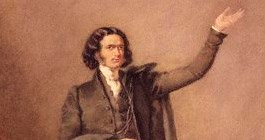
Edward Irving was born on August 4, 1792 in Annan, Scotland, the second son of Gavin and Mary Irving. Edward was baptized at the Annan Parish Church, a local Presbyterian congregation. As a child he attended a school led by Adam Hope, who often led Irving and others to the nearby village of Ecclefechan on Sunday morning. They attended a Seceder Church, which met in a thatched meeting-house with no roof.2 At age ten or eleven, Irving walked with Hope and other men to the church and was intrigued by their conversations about philosophy and theology. As a child, Irving sensed a call to serve the Lord in full time ministry.
At age thirteen, Irving entered the University at Edinburgh to undertake a course of study in liberal arts. After four years of sacrifice, dedication and tireless study, Irving graduated with a Master of Arts degree at the age of seventeen. Within the next year, Irving received a teaching position in Haddington, which gave him financial support to pursue a part-time course of study in Divinity at the University in Edinburgh. By age twenty, Irving was promoted to schoolmaster of a new school in Kirkcaldy. Irving was extremely popular among the students there.3 Irving continued his theological studies and completed his Divinity degree in six years. His degree was accompanied by a license to preach. This was not ordination from the Church of Scotland, but a license that allowed him to speak from the pulpit when invited by a minister. Irving continually developed his preaching style during this time, which consisted of polished oratory and sophisticated sounding phrases. He preached with quite a flamboyant style that somewhat annoyed the people of Kirkcaldy and excited others.
Ministry in Glasgow
In 1819, Irving received the call to serve as the assistant of Dr. Thomas Chalmers at St. John’s Church in Glasgow. As an assistant to Chalmers, Irving was responsible for visiting the poor and sharing the preaching duties. The two men preached in completely different styles. Each appealed to different groups in the church. Some detested Irving’s flamboyant preaching to the degree that if they would find that he was preaching on a Sunday morning, they would walk out. Often Irving passed scores of people walking out of the church, while he was walking in to preach.4 He faithfully administered his duties, but never felt fully satisfied. In 1822, Irving was invited to fill the pulpit at The Caledonian Chapel in London for a few Sundays. The church officials were looking for a pastor and after hearing Irving preach, they unanimously called him to serve as their full time minister. He accepted. After receiving ordination from the Church of Scotland at his home church in Annan, he took on the pastorate of The Caledonian Chapel in London in July of 1822 at the age of thirty.
The Caledonian Chapel
He was formally inducted on October 16th as the ordained minister of The Caledonian Chapel. The church had been without a pastor for a year and attendance shrunk down to fifty, when Irving became pastor. His preaching brought life to the congregation. George Canning, a leader in the House of Commons attended a service and was quite taken by Irving’s preaching. Soon after while addressing parliament, he mentioned that Irving’s sermon was the most eloquent that he had heard.5 Canning began to attend regularly and encourage others to visit as well. Canning called Irving, “the greatest orator of our times.” His influence added to the growing popularity of Irving’s preaching and within nine months the 500-seat sanctuary was overflowing with over 1000 people clamoring for a seat. It was during this time that Samuel Coleridge and other notable people of London came to hear “the greatest orator of our times.”
Irving never lost his zeal for study and theological inquiry. Although he studied theology at the University at Edinburgh as a part-time student, he altogether missed the typical dislike of theology.6 His study led him to publish his first book in 1823, Oracles of God: Four Orations. For Judgement to Come: An Argument. In Nine Parts. This two-part work was a call to reclaim the life of God found in the truth of God’s Word. Biographer Andrew Drummond writes concerning Oracles of God, “Irving is craving for a religion of the heart.”7 In the book Irving writes,
In Catechism, religion is presented to the intellect, chiefly; in the Bible it is presented more frequently to the heart, to the fancy, to all the faculties of the soul. In early youth, an association takes place between religion and intellect…. The solemn stillness so favourable to rapt communion, is destroyed at every turn by suggestion of what is orthodox and evangelical; the spirit of the reader becomes lean, being fed with abstract truths; his temper ungenial; his prayers undevout recital of opinions. Intellect, old intellect hath the sway.8
The second part entitled For Judgement to Come is a continuation of Irving’s commentary on the lack of life in Christian practice and in the ministry of preaching. Drummond remarks, “Irving seems to have realized the weakness of the Presbyterian appeal to the intellect, the Methodist appeal to the emotions and the (contemporary) Anglican appeal to the moral sense.”9
The Regent Square Church
Irving’s popularity continued. The overcrowded Caledonian Chapel caused the board of trustees to look into constructing a new facility. There had been some talk of building a national cathedral for the Church of Scotland in London.10 With the support of Irving, the Caledonian Chapel rallied support from the Scottish population of London to build it. The construction was completed in Regent Square and the doors were officially opened on May 11, 1827. Dr. Chalmers gave the inaugural address. The new Scottish Kirk took on the name “Regent Square Church.”
—Edward Irving
The point at issue is simply this; whether Christ’s flesh had the grace of sinlessness and incorruption from its proper nature, or from the indwelling of the Holy Ghost. I say the latter. I assert, that in its proper nature it was as the flesh of his mother, but, by virtue of the Holy Ghost’s quickening and inhabiting of it, it was preserved sinless and incorruptible. This work of the Holy Ghost, I further assert, was done in consequence of the son’s humbling himself to be made flesh.12
For Irving, the issue was to preserve the inter-relatedness of the Trinity as revealed in the incarnation; Jesus, the Son of God submitted to the Father God and remained set apart from sin by the Holy Spirit of God. Reformed theology driven by the human-centered forces of modernity had overlooked and side-lined the role of the Holy Spirit in the person of Christ. Irving wrote,
My Christ is the Trinity manifested;…I have the Father manifest in everything which He doth; for He did not His own will, but the will of His Father. I have the Son manifested, in uniting His Divinity to a humanity prepared for Him by the Father; and in making the two most contrary things to meet and kiss each other…. I have the Holy Spirit manifested in subduing, restraining, conquering, the evil propensities of the fallen manhood, and making it an apt organ for expressing the will of the Father…13
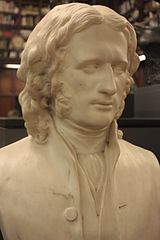
Yet the “sinful substance” of the human nature of Christ as taught by Irving was not received without controversy.14 Henry Cole, an Anglican minister attended an Irving sermon in October 1827 and asked Irving to explain himself in using the term “that sinful substance” in reference to the human body of Christ. Cole published the interview and an accompanying sermon in December detailing the doctrine that Irving preached and declaring it heretical.15 This sparked a six-year “tract war” between Cole and Irving, where each wrote back and forth, Cole attacking the doctrine and Irving defending it.
Also during 1827, Irving preached a series of messages on baptism. In the second sermon, he focused on the second part of Acts 2:39, “and ye shall receive the gift of the Holy Ghost.” The common understanding of this gift during Irving’s time was that it was “the inward gift of sanctification and fruitfulness,” and not “the outward gift of power” displayed at Pentecost and in the New Testament.16 This gift of power was given only during the apostolic age. Irving disagreed. He preached that this gift of power and the spiritual gifts recording in I Corinthians 12 where indeed for the contemporary Church. It did not pass away with the apostles, but disappeared from the life of the Church because of unbelief. Irving preached, “I cannot find by what writ of God any part of the spiritual gift was irrevocably removed from the Church. I see, indeed, that she hath lost the power which heretofore made her terrible as an army with banners.…”17 Irving had made a link from the role of the Spirit in preserving Christ from sin within his fallen flesh, to the role of the Spirit in the operation of the Church. During these sermons, Irving became convinced that supernatural gifts and the power of the Spirit where indeed for today.
Meanwhile back in Scotland…
In 1826, John McLeod Campbell pastored the local parish in Rhu on the Garloch in West Scotland. There he preached on the love of God and the humanity of Christ.18 Thousands came to Christ. Campbell’s assistant was A.J. Scott who served in Rhu from 1826–1828. Scott persistently challenged the cessationist claim that the miraculous gifts of the Spirit had ceased. Irving preached for Campbell during the summers of 1828 and 1829 and his influence was felt upon the congregation.19 Scott returned with Irving to serve as his assistant at the Regent Square Church. In March 1830, Mary Campbell, a young woman living on the Garloch, spoke in an unknown language, which she believed was the biblical gift of speaking in tongues. The very next month, Margaret MacDonald who lived in Port Glasgow across the Clyde River from Rhu received a word of prophecy. She prophesied that “there will be a mighty baptism of the Spirit this day.”20 Margaret attended John McLeod’s church in Rhu with her brothers George and James. They had come to discover that the gift of the Holy Spirit in power was available today.21 At dinner in their home one night, Margaret spoke with her brothers concerning the ministry of the Holy Spirit. Afterwards she prayed for James that “he might at that time be endowed with the Holy Ghost.”22 James stood in silence for a few moments and replied, “I have got it.” He then returned to Margaret where she laid in her bed severely ill. He commanded her to “Arise and stand upright.”23 She was healed. Soon after, James wrote a letter to Mary Campbell to testify of his sister’s healing and command Mary to be healed in a like manner.
By this time, Mary was convinced that the experience of miracles that were all together absent from the Church, where indeed intended to be apart of the post-apostolic Church. While she lay sick in her bed, she believed that God wanted to heal her. At the time Margaret MacDonald was healed, Mary had been challenged by two visitors to accept her sickness and not expect any miracle of healing. Mary quickly replied that they would hear of miracles very soon.24 When her visitors left, Mary felt led by the Spirit to seek God for her healing. While Mary read James’ letter, she was immediately healed and began to speak in tongues.25 The MacDonald’s and Mary Campbell opened up their homes and people from Scotland and England came to investigate, seek and experience what Irving had preached would come—the restoration of the gifts of the Spirit. Reports of the outbreak of tongues and other miracles quickly got back to Irving. Mary herself wrote Irving a letter documenting the manifestations of the Spirit. By the end of the summer 1830, Irving endorsed the revival as a work of the Holy Spirit.
Ecclesiastical persecution & Pentecostal perseverance
Serving as the minister of the National Scotch Church at Regent Square, Irving served under the London Presbytery and willingly submitted to their authority. By the spring of 1830, opposition to Irving’s doctrine of the true (sinful) human nature of Christ had come to the attention of other presbyters. In May 1830, Irving published the third tract defending his position entitled, The Opinions Circulating Concerning Our Lord’s Human Nature, Tried by the Westminster Confession of Faith. But his defense was not persuasive. At the September 20th meeting of the London Presbytery, the issue was raised again to pursue some type of action against Irving’s doctrine. Irving dissented, but his final plea was rejected. Irving attempted to defend his doctrine biblical, historical and theologically through the very creed held by the Presbytery. Finding no solution, Irving withdrew himself from the authority of the London Presbytery in order to make an appeal to the Church of Scotland from whom Irving received ordination. During the November 30th meeting, the London Presbytery ruled that Irving was guilty of heresy.26 Irving continued to preach at Regent Square. After a December 15th meeting, the Elders and Deacons of Regent Square released a public statement of support for Irving and his doctrine.
Unmoved by the claims of heresy, Irving held tight to the expectation that the manifestations of the Spirit in West Scotland who occur in London. A group from Irving’s church led by John Cardale had returned from West Scotland and started prayer meetings in various homes to pray for an outpouring of the Holy Spirit. In the spring of 1831, Irving held a morning prayer meeting Monday through Saturday at 6:30 AM.27 Anywhere from 600 to 1000 attended every morning to pray for a restoration of the power and gifts of the Holy Spirit. On April 30th, their prayers were answered. John Cardale’s wife stood up during the prayer meeting and spoke in tongues and prophesied. People began to speak in tongues privately. Irving judged it to be proper and in order when it was followed by an interpretation that was edifying. He gave his authorization for the gifts to be exercised in the prayer meeting. Although the board of trustees had given their support of Irving, they began to grow increasingly uneasy with the reports of tongues and prophecy in the early morning meetings. Irving defended his authorization of the gifts by firmly stating that he could not hinder the work of the Holy Spirit. Most board members were in opposition to the gifts; one was undecided. All agreed that the gifts of the Spirit should not be introduced during the morning worship service. Many of the prayer meeting attendees were eager to see the gifts in operation during the worship service. Irving was reluctant. The conflict would soon come to a head.
The outbreak of tongues
On October 30, 1831, Irving was preaching during the regular Sunday morning worship service. Miss Hall, a governess in the home of a parliament member, stood up during Irving’s sermon and quickly made her way to the vestry. There she began to speak out loud in other tongues in the hearing of the congregation.28 The crowd of over 1500 was thrown into confusion trying to see where they sound was coming from. They questioned one another trying to understand the meaning of the unintelligible utterance. Irving stopped his sermon and called the congregation to order. He explained that this was the biblical gift of tongues and that it had become a regular occurrence of the morning prayer meeting. Feeling the need for more biblical understanding, Irving opened his Bible to 1 Corinthians 14, where he taught on the use of tongues in the worshiping community. The gift of tongues would continue.
The battle between Irving and the elders continued. The issue of contention was not theological, but ecclesiastical. The elders did not argue that tongues had passed away with the apostles and were therefore not apart of biblical worship. Their concern was that tongues and prophecy from members of the congregation caused interruptions in the church service. Irving’s sister-in-law, Mrs. Hamilton reported that during one meeting a few women began to speak in tongues. Some in the crowd cried out saying, “Silence!” Others vocalized their approval with cheers of “Here, here!” According to Irving, everyone in the congregation turned to each other to say something. The result was commotion. Irving gained control of the meeting.30 Irving was torn over the issue of speaking in tongues. He disliked the commotion, but confidently believed that the gifts of the Spirit were in line with the Word of God concerning the worship of the church. In April 1832, the board of trustees brought the issue before the London Presbytery. On May 2, the Presbytery decided that Irving was in violation of the order of worship for the Church of Scotland by allowing interruptions by the laity. The Presbyters deemed him unfit to minister at the National Scotch Church and ought to be removed from his position of leadership.31 The next day, those who attended the morning prayer meeting found the doors to the church locked.
The Church on Newman Street
With no place to meet, Irving and 800 charismatic enthusiasts from Regent Square used a rented facility to continue their services highlighted by the gifts of the Spirit. After a few months, they found a permanent home on Newman Street in London. Only a handful of people remained in what was left of the National Scotch Church in London. As an independent church, the Newman Street Church presented an opportunity to explore the full “restoration” of New Testament spirituality and church government. In addition to the restoration of the Spirit baptism, tongues and prophecy, many of the emerging leaders at Newman Street anticipated the restoration of apostolic church government. Following a strict interpretation of I Corinthians 12:28,32 Church authority rested first with apostles. In November, John Cardale, who lead the investigation of the charismatic manifestations in Scotland, was appointed as the first apostle. The layout of the platform of the Newman Street Church best expresses the authority structure of the church. There were six levels to the platform, with the top level occupied by the Apostles. The second level sat the Prophets. Levels followed for the Elders, Evangelists & Deacons in descending order. The bottom level was reserved for Edward Irving, who received the title “Angel,” taken from Revelation chapters two and three.
The Newman Street Church experienced the use of the gift of tongues and prophecy and attracted people who had grew weary of the lifeless religiosity of denominational Christianity. The supernatural component of the faith had been restored in a religious climate steeped in intellectualism. Not only did Irving teach on the restoration of the gifts of the Spirit and Spirit baptism, but he also taught on the power of the Church to heal the sick. Irving writes,
…And this we have as the last particular (from Mark 16:17&18): “They shall lay hands on the sick, and they shall recover.” Sickness is sin apparent in the body, the presentiment of death, the forerunner of corruption. Disease of every kind is mortality begun. Now, as Christ came to destroy death, and will yet redeem he body from the bondage of corruption, if the Church is to have a first-fruits or earnest of this power, it must be by receiving power over diseases, which are the first-fruits and earnest of death; and this being given to her, completes the circle of her power.33
In Irving’s theology of healing, he linked together sin and sickness, calling sickness “sin apparent in the body.” For Irving, this is a Christ-centered doctrine. The power of the Lord present to heal is a result of the ministry of Christ. He came in the power of the Spirit to heal. This became a precedent for the Church to follow and the “first fruits” of power over sickness and disease. In a June issue of the Morning Watch, Irving writes in response to the cholera outbreak in England. Irving’s comments concluded that sickness was the result of sin or a Job-like test “and that no man with faith should be overpowered by it.”34
A Life Cut Short
In March 1833, the Church of Scotland in Irving’s hometown of Annan charged him with heresy regarding Irving’s doctrine of the “sinfulness of our Lord’s human nature.” The London Presbytery had already rendered a judgment condemning Irving as a heretic although the lacked the ecclesiastical authority to remove his ordination. Irving was ordained by the Church of Scotland in Annan, therefore the Presbytery that convened there had the authority to revoke Irving’s ordination. The trial was held on March 13th. Irving did not offer a systematic defense as in his trial in London. Instead he delivered a rather lavish speech. With a dramatic flair, Irving addressed the audience and not his accusers. He dismissed their claims concerning his ministry as null and void. The trial was more of a formality than a legal investigation. The Presbytery had already decided upon their judgment—guilty. At the end of the trial, one of the ministers was asked to close in prayer prior to the reading of the verdict. Before the prayer could begin, David Dow, a minister and follower of Irving, stood and broke the silence with an urgent-sounding prophecy. He uttered, “Arise, depart! Arise depart! Flee ye out of her, flee ye out of her! Ye cannot pray! How can ye pray? How can ye pray to Christ whom he deny? Ye cannot pray. Depart, depart! Flee, flee!”35 The crowd erupted into a frenzy. Irving stood and walked out of the church in response to the prophetic word.
He returned to London without the fanfare expected of a hero. His influence in the budding movement was slipping. He was officially recognized as the “Angel” or senior pastor of the flock, but he lacked the authority of the apostles and prophets. On April 23, 1833, Irving received a disheartening blow—his youngest son, Ebenezer died. The child had been sick for some time and Irving had prayed constantly for his healing. He persisted in his prayers of faith believing that his son would not be “overpowered” by sickness. Irving carried on in his preaching ministry, but as 1833 rolled on, his battle for healing intensified. He began to fight for his own health. By the summer of 1834, it was becoming clear that Irving was having tuberculosis-like symptoms. In a letter dated August 15, 1834, Thomas Carlyle wrote to his brother a medical doctor, “He complains of biliousness, of pain at his right short rib; he has a short, thick cough, which comes at the slightest irritation.”36 Irving continued to travel, conducting his ministry in Scotland and throughout the English countryside, much to the disapproval of his doctors. Friends and medical professionals alike encouraged Irving to rest in a warmer climate. While traveling to Glasgow he broke out with a fever. On December 7, 1834, Irving breathed his last. His dying words were, “If I die, I die unto the Lord. Amen.”37
The Influence of Edward Irving
Irving’s premature death raises the question, “What would the extent of his influence have been if he had not died at age 42?” Irving formulated the role of tongues in the baptism of the Holy Spirit in quite Pentecostal terms. As noted by Irving scholar David Dorries, Irving concluded that (1) “every baptized person is privileged to posses” the baptism in the Holy Spirit by faith.38 (2) The “standing sign” of Spirit baptism is speaking with tongues.39 (3) The gift of tongues is the “root and stem of all of (the spiritual gifts), out of which they all grow and by which they are all nourished.”40 A common assumption is that Irving’s charismatic theology has no historical connections to the modern Pentecostal movement. Larry Christenson notes,
The correlation between pentecostalism and the Catholic Apostolic church (i.e. Edward Irving) suggests the possibility that both movements, independently of one another, apprehended a common area of truth. The points of comparison between the two movements do not root out of a connection in history, but out of a common origin beyond history. The cluster of similarities is neither causally related not is it accidental.41
To claim that there is no historical connection is an oversimplification based on a lack of textual evidence. While Irving’s influence on Pentecostalism is not as pronounced as that of the Wesleyan tradition, there are at least three historical links between Irving and the Holiness-Pentecostal tradition. These links are found in the writings of John Alexander Dowie, A.J. Gordon and Charles Parham.42
Dowie was born in Scotland, shared a common homeland with Irving. In 1848, Dowie’s father, John Murray, was won to Christ by a disciple of Irving. Dowie was plagued by sickness as a child. In 1860, Dowie and his family relocated to Australia, where he was healed through the prayer of faith. Consequently, he felt a call to serve in full time ministry. He returned to Scotland in 1868 to study at Irving’s alma mater, the University of Edinburgh. After serving as a pastor in Australia, he began an itinerate preaching ministry in the United States. He settled in the Chicago area by 1890. This became the headquarters of his healing ministry. At the turn of the twentieth century, Dowie established the utopian-like Zion City, north of Chicago. Zion City was a self supported city with industrial factors, schools, libraries, businesses and ministries to orphans and widows. At the heart of the city was Shiloh Tabernacle, an 8,000 seat sanctuary. Dowie led the ministry until is death in March of 1907. Although Dowie is pre-Pentecostal in that he did not teach speaking in tongues as the initial evidence of Spirit Baptism, his broke the theological ground for many Pentecostal leaders.
During his ministry he published a weekly newsletter, the Leaves of Healing. This was his primary source of communication with the thousands of supporters he had around the world. In volume XV, Dowie calls Irving his “predecessor” and in reference to Irving states, “a greater and mightier man of God never stood upon the earth.”43 While there is no documentation at this point, it is conceivable that Dowie became familiar with Irving while studying for the ministry in the late 1860s. He may have read either The Collected Writings of Edward Irving published in 1865 or Mrs. Oliphant’s The Life of Edward Irving published in 1862. Dowie was admittedly influenced by Irving’s faith and anti-cessationist theology.
A. J. Gordon was a contemporary of Dowie. Gordon was born in New Hampton in 1836. At his conversion at age 15, Gordon sensed a call into full time ministry. Upon completion of his studies at Newton Theological Seminary, he was ordained as a Baptist ministry. He pastored Clarendon Street Baptist Church in Boston for 25 years. He was actively involved in the faith cure movement and the evangelistic ministry of D. L. Moody. Gordon maintained a healing ministry through his local church and wrote numerous articles on the subject of divine healing. His greatest contribution to faith cure literature was The Ministry of Healing, a theological defense of the present-day experience of supernatural healing. Gordon died eleven years before the Pentecostal movement was launched from Azusa in 1906. However, his influence shaped the theology of the coming Pentecostal revival.
In The Ministry of Healing, Gordon devotes a single chapter to “The Testimony of Theologians.” He cites scholars who defended the continuance of miracles. In his theological line up, he quotes from Augustine, Luther, Edward Irving, Thomas Erskine, and Horace Bushnell. Concerning Irving, Gordon writes,
…we confess that our heart has always gone out to (Irving) in reverence for his heroic fidelity to the Word of God, and his willingness, in allegiance to that Word, to follow Christ “without the camp bearing his reproach” (Hebrews 13:13). And we believe that when the Master shall come to recompense His servants, this one will attain a high reward and receive of the Lord double for the broken heart with which he went down to his grave. Irving wrote upon this subject (of spiritual gifts) with his usual masterly ability.44
Gordon continues by quoting twice from the collected works of Irving as evidence that the gifts of healing faded due to the “wintry blasts” of unbelief in God’s word. Gordon observes that Irving “reasoned so powerfully and prayed so earnestly for the recovery by the Church of her primitive gifts. If the effort brought pain and persecution to him, we believe it has brought forth some very sweet and genial fruits in others.”45
The final and most direct historical connection is found between Pentecostalism and Irving in the writings of Charles Parham. It was Parham’s association between Spirit baptism and speaking in tongues that formed the theological impetus of the Pentecostal revival. Pentecostal enthusiasts hailed speaking in tongues as the initial Bible evidence of the baptism in the Holy Spirit. As previously noted, Irving taught that speaking in tongues was the standing sign of the baptism in the Holy Spirit. While these two statements are a reflection of each other, Irving’s “standing sign” did not necessarily breed Parham’s “initial Bible evidence.” However Irving’s passion for the practice of speaking in tongues served as a historical precedent for Parham. This strengthened Parham’s interpretation of Acts 2:4. Parham writes,
We have found that the early Catholic Fathers upon reaching the coast of Japan spoke in the native tongue; that the Irvingites, a sect that arose under the teachings of Irving, a Scotchman, during the last century, received not only the eight recorded gifts of 1 Cor. 12, but also the speaking in other tongues, which the Holy Ghost reserved as the evidence of his coming.46
Irving’s ministry, although brief, is a testimony of the power of God concentrated through the pen of a theologian. Irving’s imprint on the Church in charismatic renewal is that the moving of the Spirit does not have to be irrational or anti-intellectual. Irving consistently defended his experience of the Spirit with a thoughtful exposition from the Scripture. It was not choice between theological accuracy and spiritual vitality. He deeply longed for both to be evident in his ministry. The life and ministry of Edward Irving—although historically disassociated from the Pentecostal movement—is worth the attention of scholars, pastors and thoughtful Christians who desire the life of the Spirit and the rightly divided word of truth.
PR
Further Reading:
Book review: David Malcolm Bennett, Edward Irving Reconsidered: The Man, His Controversies, and the Pentecostal Movement (Wipf & Stock, 2014), reviewed by John R. Miller.
Notes
1 The Collected Works of S. T. Coleridge Vol. 10, Katheleen Coburn, ed., (Princeton University, 1976), 143. As quoted by Arnold Dallimore, The Life of Edward Irving: The Fore-Runner of the Charismatic Movement, Gavin Carlisle ed., (Pennsylvania: The Banner of Truth Trust, 1983), 46. It should be noted that Coleridge was not a professing Christian. His comment concerning Irving was from one who was a philosopher, poet and orator. Dallimore argues that Coleridge influenced Irving and tainted Irving’s theology with unorthodox elements in three areas 1) the denial of the deity of Christ, 2) the coming judgment of mankind, and 3) the preacher as the “voice of the Holy Spirit” (See Dallimore, 46-47). There is not space here to provide a complete rebuttal, but let me make a few responses to Dallimore’s claim. First, Irving never denied the deity of Christ. For example, Irving wrote,
Into what power hath Christ entered; and how much of that power is it His good pleasure to put forth upon this earth during this dispensation of His absence? With respect to the first part of the question, I answer in His own word: “All power is given unto me in heaven and in earth.” Seated in God the Father’s throne, He holdeth God the Father’s sceptre, and excerciseth God the Father’s dominion. He is now creation’s God, as He was heretofore creation’s Surety and Bondsman: He is now creation’s sceptre-bearer, as He was heretofore creation’s burden-bearer. Formerly He shewed Himself the suffering, mortal man; now He shews Himself the ruling, life-quickening God (emphasis mine). [The Collected Writings of Edward Irving Vol. 5, G. Carlyle ed., (London: Alexander Strahan, 1865), 451]
Irving biographer Andrew Drummond agrees. He writes, “Beyond all doubt he (Irving) affirmed his belief in his Saviour’s divinity.” [Andrew Drummond, Edward Irving and His Circle, (London: James Clarke & Co., LTD., 1936), 219.]
Concerning the coming judgment of Christ—this is more of an eschatological opinion than a question of orthodoxy. At the time of Irving, most ministers preached a postmillennial eschatology, believing that the Church would produce great social prosperity that would usher in the return of Christ. Irving preached a pre-millennial eschatology that emphasized that wickedness would continue before the return of Christ. Neither option is considered heresy. Finally, Irving’s teaching on the “voice of the Holy Spirit,” is not a claim of absolute divine authority, but of Irving’s understanding that people of God speak on behalf of God by the power of the Holy Spirit. While this was considered unsound doctrine during the high time of dispensational theology. Today the charismatic renewal has touched the academy and dispensational theology has been dethroned.
2 The Church of the Seceders was a separatist group that left the Church of Scotland in order to preserve doctrinal purity and spiritual vitality. (See Dallimore, 5 & Drummond, 16-17.
3 Drummond notes that Irving made quite an impression on his students. They picked up on Irving’s flair for the dramatic and many sought to emulate their teacher. Some in the town called the boys “Irvingites”—not in derision, but in a celebration of the affectionate bond of the group. See Drumond, 45.
4 Dallimore, 25.
5 Mike Johnson, Edward Irving: A Charismatic Pioneer, unpublished paper, 2. An adaptation of the paper is published online at http://catchlife.org/edward_irving_charismatic_pioneer.htm (Last accessed 6/26/01).
6 Drummond, 59. Drummond argues that Irving was not grounded in systematic theology, because he was a part-time student. He notes, “No doubt a regular Divinity course would have given him a far more satisfactory grounding in systematic theology than was possible for a ‘partial student’, reading theology in his spare time.” (Drummond, 59.) That has been disputed by historian David Dorries who argues that Irving’s Christology is grounded in historical and biblical orthodoxy. See David Dorries, “19th Century British Christological Controversy, Centering upon Edward Irving’s Doctrine of Christ’s Human Nature,” Ph.D. diss., University of Aberdeen, 1988.
7 Drummond, 59.
8 Ibid, 59-60.
9 Ibid, 61.
10 See Drummond, 102 ff. Irving was actually approached in March 1822 about supporting the project, but declined because he was still working as Dr. Chalmers’ assistant. Irving felt that he could not take time away from his work in Glasgow to promote the project. However, in May 1823, when Irving was leading the growing Caledonian congregation, He gave his full support to the project.
11 C. Gordon Strachan, The Pentecostal Theology of Edward Irving, (Peabody, Massachusetts: Hendrickson Publishers, Inc., 1988), 26. Originally published in 1973 by Darton, Longman & Todd (London).
12 Edward Irving, Sermons, Lectures and Occasional Discourses: The Doctrine of the Incarnation Opened in Six Sermons (Preface), 1828. As quoted by Strachan, 30.
13 Carlyle, The Collected Writings of Edward Irving, Vol. 5, 170. As quoted by Colin Gunton, “Two dogmas revisited: Edward Irving’s Christology,” Scottish Journal of Theology Vol. 41, No. 3, 363.
14 The theological issue has not been settled. It still remains somewhat controversial. David Dorries defended both Irving and the issue of the “fallen flesh” of Christ sinful nature in his 1988 dissertation. See also Graham McFarlane, Christ and the Spirit—The Doctrine of the Incarnation according to Edward Irving, Carlisle: Paternoster Press, 1996. The key biblical texts in defense of Irving’s Christology are Romans 5:14-18; Romans 8:3, cf. Romans 1:3; Philippians 2:6-8; and I Timothy 3:1. In the scholastic world the doctrine has been disputed by F.F. Bruce & C.H. Dodd, but has been defended by Karl Barth, C.K. Barrett, C.E.B. Cranfield, James Dunn, & Colin Gunton. Cranfield noted, “…the Son of God truly assumed fallen human nature, He never became fallen human nature and nothing more,…but always remained Himself.” C.E.B. Cranfield, Romans: A Shorter Commentary, (Grand Rapids: Eerdmans, 1985), 177.
15 Strachan, 28-29.
16 Ibid., 55.
17 Edward Irving, “The Sealing Virtue of Baptism,” The Collected Writings of Edward Irving Vol. 2, G. Carlyle ed., (London: Alexander Strahan, 1865). As quoted by Strachan, 56. In his footnote, Strachan quotes Paul Ewing Davies, An Examination of the Views of Edward Irving concerning the Person and Work of Jesus Christ, 1928, Unpublished Ph.D. Thesis, New College, Edinburgh. Concerning the power of the Spirit in Irving’s pneumatology, Davis writes, “There is no gulf, he (Irving) declared, between the times of Christ and the Apostles and our days. The same Spirit worked in Christ as works in us, and the evidences must be the same.” (Davis, 206. As quoted by Strachan, 214. )
18 David Dorries, “Chronology of a Revival (1826 to the Present): First Phase (1826-33) – West of Scotland,” (unpublished paper, 1996), 1.
19 David Dorries, “Edward Irving and the ‘Standing Sign’ of Spirit Baptism,” in Initial Evidence, Gary McGee ed., (Peabody, MA: Hendrickson, 1991), 42.
20 Dorries, “Chronology of a Revival,” 1.
21 Drummond quotes Thomas Erskine who later wrote that although the MacDonalds were considered Irvingites, there is no record that they read any of Irving’s sermons, tracts or books. Erskine argues that the subject of spiritual gifts did not enter into their thinking before the manifestations of tongues and healing took place. They were simply praying for an outpouring of the Spirit. See Drummond, 139-140. There is room for speculation that Irving had some influence on the MacDonalds, however, because both Strachan and Dorries have noted that Irving’s teaching had become well known following his preaching tours in the Port Glasgow area.
22 Ibid., 140.
23 Ibid., 140.
24 As documented by A. Robertson of Greenock in A Vindication of the Religion of the Land. As quoted by Drummond, 141.
25 Dorries, “Standing Sign” in Initial Evidence, 42.
26 Strachan, 43-44.
27 Dorries, “Standing Sign,” 43.
28 Strachan, 109.
29 Ibid., 110.
30 Mrs. Oliphant, The Life of Edward Irving, 1862 ed., 324-325. As quoted by Strachan, 111-112.
31 Dorries, “Standing Sign,” 45.
32 1 Corinthians 12:28 NIV “And in the church God has appointed first of all apostles, second prophets, third teachers, then workers of miracles, also those having gifts of healing, those able to help others, those with gifts of administration, and those speaking in different kinds of tongues.”
33 Edward Irving, “The Church, with her Endowment of Holiness and Power,” Collected Writings, Vol. 5, 464.
34 As quoted by Drummond, 215. The Morning Watch was a quarterly theological journal produced by Henry Drummond and others to discuss prophecy and the gifts of the Spirit. It was published from 1829 to 1833 and featured articles by Edward Irving.
35 As quoted by Drummond, 219.
36 Ibid, 223.
37 Ibid. 227
38 Dorries, “Standing Sign,” 46.
39 Ibid, 49.
40 Ibid.
41 Larry Christenson, “Pentecostalism’s Forgotten Forerunner,” Aspects of Pentecostal-Charismatic Origins, Vinson Synan, ed., (Plainfield, NJ: Logos International, 1975), 25.
42 I am stretching the definition of Pentecostalism to include the holiness movement. The line of demarcation between the Holiness Movement and Pentecostalism is blurry, which gives me the liberty to stretch Pentecostalism’s definition.
43 Leaves of Healing, Vol. XV, 433. As quoted by Paul Chappel, The Divine Healing Movement in America, (Ph.D. dissertation. Drew University, 1983), 187-188.
44 A. J. Gordon, “The Ministry of Healing,” Healing: The Three Great Classics on Divine Healing, (Camp Hill, Pennsylvania: Christian Publications, 1992), 185.
45 Ibid. 187.
46 Charles Parham, Kol Kare Bomidbar: A Voice Crying in the Wilderness, (Joplin, Missouri: Joplin Printing Co., 1902), 27.







This was extremely encouraging and challenging.