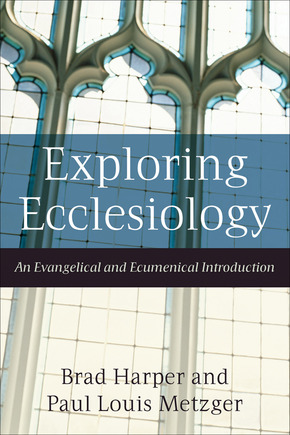
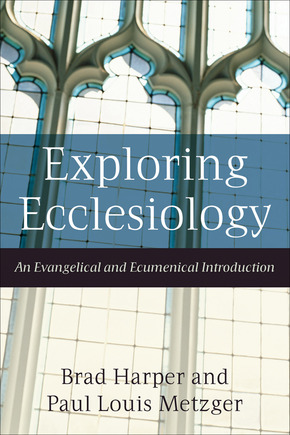
 Brad Harper and Paul Louis Metzger, Exploring Ecclesiology: An Evangelical and Ecumenical Introduction (Grand Rapids: Brazos, 2009), 336 pages, ISBN 9781587431739.
Exploring Ecclesiology promises “an evangelical and ecumenical introduction” to the doctrine of the church. This subtitle to the otherwise aptly entitled book is multi-faceted and, judging from the nature of the book, intentionally so. On the one hand, the book is an introduction for evangelicals to the discipline of ecclesiology and the ecumenical discussions on the nature and purpose of the church. On the other hand, the book is an introduction for non-evangelicals to the problems and concerns of the church as they are perceived and discussed in the evangelical community. The authors define their use of “evangelical” with reference “to that post-World War II movement in Protestant American Christianity that prized the ‘fundamentals of the faith’” (p. 13). With that in mind, the combination of “evangelical” and “ecclesiology” is a welcome contribution to the growing debate about ecumenical ecclesiology.
The church is a trinitarian, eschatological, worshipping, sacramental, serving, ordered, cultural, and missional community.
The layout of the book, at first glance, is reminiscent of Avery Dulles’ classic
Models of the Church. Writing from an evangelical perspective, Harper and Metzger seem to portray eight “models” of understanding the nature and purpose of the Christian community, each in a separate chapter: the church as trinitarian community, eschatological community, worshipping community, sacramental community, serving community, ordered community, cultural community, and missional community. However, this is precisely where the book differs from Dulles’ work in two significant areas: First, the trinitarian and eschatological chapters form the theoretical underpinnings for the rest of the book. With that intention, the book ceases its model function. The foundational considerations of the triune God and the eternal Kingdom shape the remaining discussion of various themes that are mostly practical in orientation. Second, these eight chapters are interspersed with eight additional chapters that extend the thought of their counterpart and carry it into discussions of culture, fleshing out the cultural significance of the theological concepts. The result are 16 chapters alternating between theological and cultural considerations of the church. This layout reveals the substantive argument that underlying all ecclesiological proposals must be the idea that the church exists only in concrete cultural settings. In light of the author’s definition of “evangelical,” these discussions are dominated by American cultural concerns. Furthermore, in light of the continuing transitions of cultural settings, there cannot emerge from this book a “once-and-for-all” proposal on the doctrine of the church.
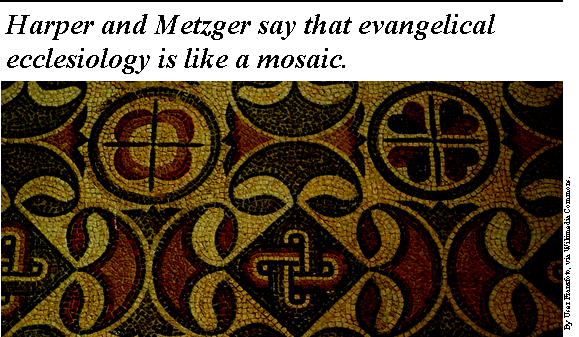 The history of evangelicalism in America shapes the ecclesiological perspective of the authors. Emerging from the modernist-fundamentalist controversy of the early twentieth century, and shaped by the development of fundamentalism after World War II, evangelical ecclesiology exhibits a considerable diversity. While this diversity makes it difficult to speak of an evangelical ecclesiology, in a doctrinal sense, the authors lament the neglect of ecclesiology among evangelicals and reject the common perception that evangelicals have no ecclesiology at all. Instead, Harper and Metzger intend to make this diversity their advantage and propose that the image of a mosaic is perhaps the best metaphor for ecclesiology from a contemporary evangelical perspective.
The church is someplace: The idea that the church exists only in concrete cultural settings must underlie all ecclesiological proposals.
The book’s emphasis on culture is significant, since it promises an ecclesiology that is concrete, relevant, and critical. When it comes to the once-and-for-all elements that the church possesses, despite the authors’ hesitation, Harper and Metzger offer a valuable ecclesiological discussion that does not shy away from concerns about American individualism, ecology, enculturation, race and class barriers, church discipline, or the role of women. These discussions are absent from many classics and standard works of ecclesiology. The combination of church and culture is a precarious one because it touches the Christian community at its core, questioning the authenticity of its doctrines and practices in light of the demands and needs of particular cultural contexts. Theological texts have discussed these challenges since the 1970s under the headings “contextualization” and “inculturation.” Surprisingly, however, the nature of the church is rarely the subject of such debates. On the contrary, church and culture are often seen as two distinct realms, and it is their association and integration that remains the chief problem. Ecclesiology is the subject but not the object of consideration. Culture, in turn, is often seen as ambiguous and in need of redemption or, at least, purification. In this view, culture is not part of the church—it is part of the mission of the church. In contrast,
Exploring Ecclesiology integrates the various dimensions of culture into the quest for an evangelical ecclesiology. This approach allows for, often necessary, critical assessments of the ecclesial landscape in American evangelicalism and beyond. From that perspective, the book opens up an important direction and blazes a path for the future of evangelical ecclesiology.
At the same time, the book suffers some significant shortcomings that cannot be attributed to the pluralistic landscape of evangelicalism. The doctrine of the church presented in this work is framed in the first chapter by the argument that the church as a trinitarian community is a being-driven church and in the last chapter by the proposal that the church as a missional community is a being-driven church. This nuanced argument separates the missional nature of the church artificially from its divine nature. The presentation of the church as a trinitarian community appears like an abstract, detached theory, while the missional character of the Christian community is displayed as a consequence of the church’s worship, service, discipline, and other practical dimensions. If this portrayal of a separation of the nature (trinitarian essence) and purpose (mission) of the church is a correct assessment, then evangelical ecclesiology is going to be hard-pressed to find any theological justification for its diverse cultural identities. Culture and theology are then pushed apart in an attempt to describe the church that sandwiches all that the church does between what the church is and the purpose for which it exists. At least methodologically, the choice should have been made to speak of the church as a missional community in the same breath it is proclaimed as a trinitarian community. This would allow for a fruitful discussion with existing proposals beyond the evangelical community and with theological considerations beyond the confines of ecclesiality. In this sense, the book is less ecumenical in nature than it is intended to be.
Exploring Ecclesiology integrates the various dimensions of culture into the quest for an evangelical ecclesiology.
For a Pentecostal audience, the relegation of the missional character of the church to the end of the discussion is also apparent in the position of discussions about spiritual gifts. Surprisingly, neither the trinitarian nor the eschatological theory of the first chapters contains any consideration of the essential relation between the church and the Spirit of God. The biblical image of the church as the temple of the Holy Spirit is notably absent. Neither is the eschatological nature of the church interpreted pneumatologically in any significant way. The question if culture can be seen as a playground for the divine Spirit is only marginally pursued. As a result, the topic of spiritual gifts is not broached until the discussion of the church as a serving community (chapter 9) and more notably in practical questions of church order and discipline. Such a restriction in scope is surprising considering the cultural emphasis of the authors and the general surge of charismatic ecclesiologies. Pentecostals, who themselves are struggling to formulate an ecclesiology, have generally equated the church with the mission of God instead of making mission one aspect of church practice among others. A pneumatological orientation and emphasis on spiritual gifts are a hallmark of this endeavor. The neglect of these dimensions in the portrayal of evangelical ecclesiology suggests strongly that Pentecostals are well advised not to pattern their ideas after this proposal. At least in their understanding of the church, Pentecostals in North America cannot consider themselves to be evangelicals.
Reviewed by Wolfgang Vondey
Preview this book online: christianbook.com/reader/?item_no=431739
Publisher’s page: bakerpublishinggroup.com/books/exploring-ecclesiology/269590
-
Wolfgang Vondey, Ph.D. (Marquette University) and M.Div. (Church of God Theological Seminary), is Professor of Christian Theology and Pentecostal Studies at the University of Birmingham, UK. He is an ordained minister with the Church of God (Cleveland, TN). His research focuses on ecclesiology, pneumatology, theological method, and the intersection of theology and science.