
The Global Christian Mission: The Maritime Global Expansion


Christian historian Woodrow Walton takes another look at the causes and effects of global navigation by ships sailing from Europe and how the mission and message of Jesus was carried throughout the world.
The Maritime Global Expansion: End of the Fifteenth Century to the Present
A few year prior to the fall of Constantinople in 1452 to the military prowess of the Ottoman Turks, a Norwegian long boat arrived back in Norway after a lengthy voyage across the north Atlantic from the Davis Strait separating the southwestern shoreline of Greenland from northeastern Canada. It was the first known crossing of the North Atlantic. The long boat carried marketable goods for Norway and its neighbors as Denmark and Sweden and other countries facing both the North Sea and is neighboring Baltic Sea.

Image: Wikimedia Commons.
Unlike the expansive Atlantic Ocean, the North Sea is squeezed between Great Britain and Denmark and the Baltic flowing between the shorelines of Sweden, Poland, Prussia the Slavic lands and northeastward along the shorelines of Finland.
In a way, it was not an extraordinary feat of seamanship because the voyage to Greenland involved landfalls at the Shetland and Faero Islands and Iceland, making the distance between that Scandinavian settlement and Greenland feasible. By the late 1400s, there were settlements on those islands, and an occasional influx of Christians. Nonetheless, the voyage was an important one as far as negotiating an extremely wide expanse of ocean.
Before 1452, Europeans confined their sea voyages to the Mediterranean squeezed between the shorelines of southern Europe and North Africa, the Arabian Sea between the horn of Africa and the shorelines of Iran and northeastern India. There were also smaller bodies of water that were navigated such as the Adriatic and the Aegean, both inlet extensions of the Mediterranean. The Adriatic separates the eastern shorelines of the Italian peninsula, from the western shorelines of Illyria and Greece. The Aegean Sea flows between the eastern shorelines of Greece and Macedonia from the shorelines of what we know now as Turkey. The tiny and narrow Sea of Marmara is actually not a sea as it is squeezed in by Macedonia and northwestern Turkey and becomes the Bosporus, a strait that almost trickles into the Black Sea. Where the Marmara flows into the Black Sea is the City of Byzantium, later re-named Constantinople, and after 1453, became known as Istanbul.

Image: The Books of Kells by way of Wikimedia Commons.
The Black Sea, also called the Euxine Sea, was as important in New Testament times as it is in our present time. On its north shore was the Crimea and the Ukraine. It eastern extension is part of western Asia and its western shorelines are those of eastern Europe. The Crimea was one of the Roman Empire’s food baskets. Egypt and Sardinia were the other two.
These seas were the ones most familiar to the Apostles. The southern shorelines of the Black Sea were shorelines of Pontus, Cappadocia, and Galatia, well known to the Apostles Peter, Paul, and others. One other body of water that was well known as it is now, the Red Sea separating northeastern Africa from the Arabian peninsula to enter into the Arabian Sea. Last of all was the Sea of Galilee, actually a large lake, also known as Lake Tiberias.
The point of these descriptions is that these various bodies of water were not broad oceans as the Atlantic, the Indian, and the Pacific. The ships that carried the apostle Paul, other apostles, and later evangelists were not built for ocean travel. Ships during Biblical days kept principally in sight of shorelines. Even the ships of the adventuresome seamen of Tyre and Sidon did not strike out across the middle of the Mediterranean during the spring and winter seasons when strong winds blew out of the northeast. The Carthaginians who were masters of maritime voyages and the first to round Africa’s Cape of Good Hope stayed in sight of the western coastline of Africa and then veered northward along Africa’s shorelines toward where the Red Sea emptied into the Arabian Sea. The confluence of the Red Sea and the Arabian were in close proximity with the Persian Gulf. This area was well traveled in Biblical days, serving as a maritime highway for the peoples of the Ancient Near East and as a link between the eastern Mediterranean and the coastal shores of Persia.
Along with the Silk roads connecting Eastern Europe and the Palestinian-Syrian Mediterranean world with Central Asia and beyond, the waterways just described furnished the sea-lanes for travel between East and West. The Red Sea, which runs from northwest to southeast and vice versa, was a much-used passage between Alexandria, Egypt and the Indus River delta separating southeastern Persia (modern Iran) from India. In fact, Roman coins have been found along that coastline and down the Malabar Coast of India. This find lends credence to the apocryphal story of St. Thomas, a tradition which says this apostle gave witness to Jesus in that part of southern Asia.
It was, however, the exploratory voyages of Pero de Covilha of Portugal in the late 1480s which led to the most extraordinary period in maritime missionary journeys. One of the objectives was to reach the Christian king of Ethiopia and to ascertain the possibility of reaching the Indian Ocean by sea. He did visit Aden at the tip of the Arabian Peninsula and also Cannanore, Calicut, Goa, and the coast of East Africa. It was, however, Bartolomeu Dias who led three ships on a voyage into the Indian Ocean for the first time. He would eventually dock in Mossel Bay, 160 miles east of the southern tip of Africa, on February 3, 1488. Vasco De Gama, in 1492/3, reached the Malabar Coast of India and then docked at Goa along the Gujarat coast of India. Catholic priests from Portugal that came with De Gama reported having met Christians who identified themselves as Mar Thomas Christians, speaking a language akin to Syriac. This was a critical moment in the history of global Christianity.
Even with this Spanish incursion, the South American country of Brazil came under Portuguese oversight, as did Angola on the west coast of Africa, Mozambique on Africa’s southeast coast, and eventually the island of Macao, just east of Canton, where the waters of the South China Sea and the Pacific intermingle north of the Philippines.
It was the Portuguese, the Spanish, the Netherlanders, the Genoese of Italy, and the English who set the pace for the maritime expansion of the Gospel. The Netherlanders, the English, and the growing cities in northern France were, nevertheless, latecomers compared to the Portuguese and Castilians who ruled the waves from 1483 to 1496. These ventures were primarily for commerce, but the fleets that went out had not only chaplains but also potential settlers who were of the Christian laity.
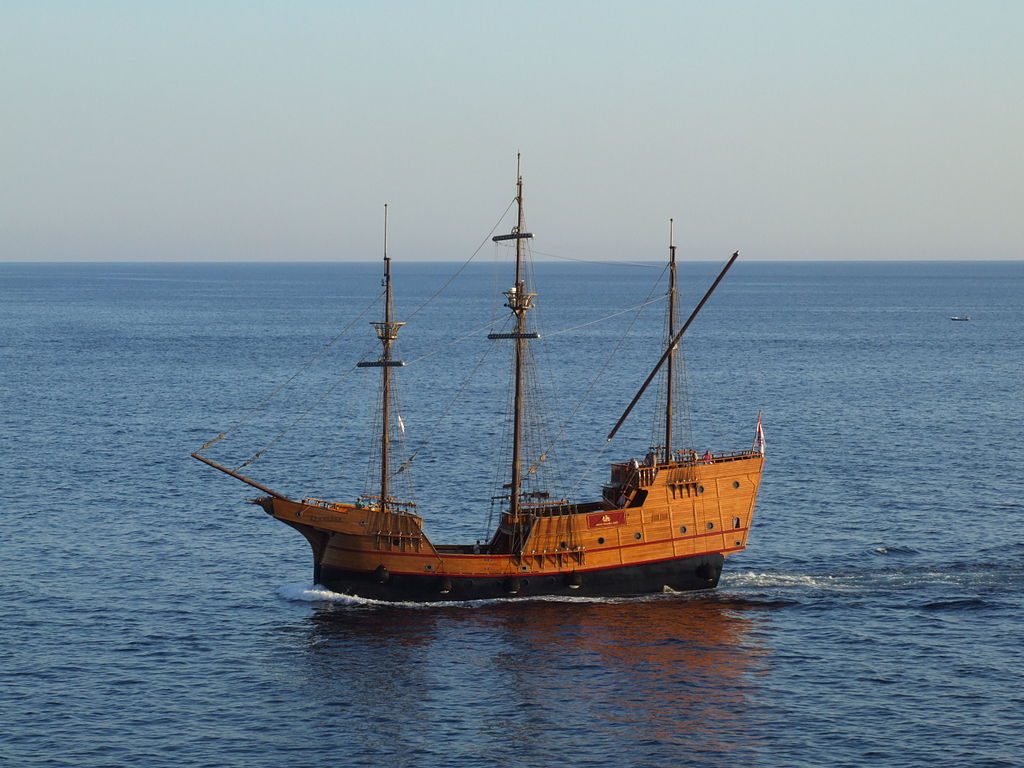
Image: Marcin Szala/Wikimedia Commons.
Of the previously mentioned, it was Portugal who led the way in the maritime expansion of the gospel. The island of Goa just off the northwestern coast of India became the site of the first Portuguese Roman Catholic bishopric. It was from Goa that Roman Catholic believers spread over into India. Similarly, it was from the Portuguese settlement of Rio de Janiero that Jesuit missions were carried out within the vast hinterlands of Brazil.
Santo Domingo is the oldest city in North America, settled by Spanish settlers who were on board the Spanish flotilla captained by Christopher Columbus. Santo Domingo became the staging point for Spanish missions among the Native Americans. It was a slow start for the Spanish mission as the first settlers who shared Columbus’ devotion to the Christian Scriptures were few. Most wanted to use the Native Americans as forced labor. Conspicuous among these few contrarians was Bartolomé de las Casas. In 1493, as a youth, Las Casas witnessed the return of Columbus from his first voyage. After traveling to Hispaniola on a later voyage into the Caribbean, Las Casas returned to Spain where he studied for the ministry and was afterward ordained as a deacon. In 1507, he was accepted as priest within the Spanish Roman Catholic Church. In 1522, he identified with the Dominican order, and as a firebrand for Native rights, fair treatment, and dignity. In his publication, The History of the Indies, and in later publications, and then direct appeals to the Pope in Rome, the Spanish Cortes [Spanish Parliament], and Spanish officials in the Americas, he got his wish. The Pope came down on the side of the Native Americans.
In 1534, Las Casas wrote his famous De Unico Vocationes Modo (“The Only Way to Draw All People to a Living Faith”) which drew attention not only in Spanish and Portuguese America but also in Europe. It was expanded in 1537 and submitted to King Charles I of Spain who soon thereafter became Holy Roman Emperor Charles V. Las Casas drew upon Matthew 28:19-20 and Romans 10:17 and made a distinction between “True evangelization” and “false evangelization.”
By that time, the Protestant Reformation was well underway and the work of Las Casas, Ignatius Loyola, and Francis Xavier did not escape notice as the news circulated fast throughout Europe. Furthermore, these initial missionaries joined with Girolamo Savonarola, John Colet, and Desidarius Erasmus to pave the road for Martin Luther and the Protestant Reformation. Indeed, Erasmus has been characterized as having “laid the egg that Luther hatched.”
While Las Casas, Loyola, and Xavier did not split from the Roman Catholic Church, they were critical of the existing Roman Catholic administration and accretions to both Christian praxis and theology. Ignatius Loyola and Francis Xavier were responsible for forming of the Society of Jesus, better known as the Jesuit Order. The Jesuit Order was both late in gaining approval from the Vatican and was long a thorn in its side because of its preaching and teaching that remained critical of Roman Catholic leadership and its unwillingness to be answerable to anyone except the Lord Jesus Christ. Xavier, born on April 7, 1506, near Saguesa in Navarre, he worked with the Portuguese Catholic missionaries, like Loyola did, and was himself the most far-reaching of the missionaries. He traveled by ship to India and on to China, preaching and teaching the Gospel of Jesus and establishing Christian fellowships everywhere he went.
In 1525, Xavier matriculated at the University of Paris. It was there he met Ignatius of Loyola who also studied there. Both men were also contemporaries of another University of Paris student who would figure in the world Christian movement, John Calvin, though their paths diverged greatly in the unfolding Protestant Reformation. The Jesuit Order and the Reformation led by Luther, Calvin, and Zwingli were contemporaneous, each of which would have lasting effects upon the Christian world mission. The evangelical fervor generated by Luther, the push for reform by Calvin and Zwingli, combined with the Catholic Reformation spearheaded by Loyola and Xavier would have a lasting effect.
Impressed by the Jesuits, John III, ruler of Portugal, petitioned the Jesuits to function within the growing Portuguese empire. Xavier chose to work within that sphere. Xavier left Rome in March of 1540. Two years later on May 6, 1542, arrived at the port of Goa, India, where he ministered among the poor. Over a period of seven years, his missionary endeavors covered not only southern India but extended into Ceylon (today known now as Sri Lanka), the Molucca Islands, the Banda Islands, and the Malay Peninsula.
In 1549, Xavier boarded a Portuguese ship which eventually took him to Kagoshima, Japan, and adapted to the local Nipponese culture. There he arranged for the translation of Christian writings, enabling him to reach more converts in the eighteen months he spent in Japan.
In 1552, Xavier left the Japanese islands and traveled to Shangchuan island, near Canton. He was unable to proceed into mainland China as the borders were closed to foreigners. He also suffered an illness which would bring about his death at the age of 46, on December 3, 1552. By 1540, Pope Paul III, officially recognized the Order of the Jesuits, and by the time of Xavier’s death, it was estimated that Xavier had baptized 30,000 individuals over his lifetime.

Image: Wikimedia Commons.
Simultaneously, changes were taking place in Europe between 1517 and 1552. The Mediterranean world was fast becoming a Moslem lake with the Turks taking control in much of Northern Africa and some of the Mediterranean islands as Cyprus and threatening the Slavic lands. This created a stir throughout Europe, particularly in the Austro-Hungarian lands. The impact on Europe was great and shifted the center of economic activity northwestward toward northern France, northern Germany, Denmark, and into the Netherlands, England, and
Scotland, away from the former commercial powerhouses. This shift also strengthened the outreach of Protestant churches as it was in central and northern Europe that the Reformation initiated by Luther and furthered by Calvin, Zwingli, and Oecolampadius gained considerable strength. Before the Ottoman Turkic conquest, international commerce had been dominated by Florence, Genoa, and Venice along the Italian coast of the Adriatic.
The three cities of Florence, Genoa, and Venice, nonetheless, retained their prominence while withstanding the incursion of the Ottoman ships upon the waters of the Mediterranean. They strengthened their position by shifting their sights toward the development of Europe, particularly inland Europe. The many princedoms of Germany benefitted as did the newly formed nation of Spain, forged by the merger of Castile and Navarre, as well as France, and northwestern Europe all the way to the Baltic. The same circumstances sent Cristobal Columbo of Genoa to France and from there to the court of Ferdinand and Isabella in Spain. Giovanni Caboto, also an Italian, found his way to England and offered his services to the English.
The story of Columbus is familiar; the impact of Caboto, better known by the English rendition of his name as John Cabot, was also of signal importance. By his service to the English crown, his maritime venture across the north Atlantic brought him to the shores of Newfoundland and New England. The opening voyage of John Cabot opened the way to North America not only for commerce but for the movement of peoples from northern Europe to the new found lands. The countries at the forefront of this movement, beside that of England and Scotland, were France, the Netherlands, Denmark, and the Baltic countries. More important was the growth of population in western and northern Europe and the increase of demand for goods and food. The population growth had much to do with migration in response to the advance of the Ottoman Turks into Eastern Europe and central Mediterranean. By 1540, northern France, England, and the Netherlands had forged a triangle of commerce with hundreds of Dutch ships sailing eastward through the Danish straits carrying altar pieces carved in Antwerp, tapestries, and other high value products, bringing back west amber, wax, grains from the Vistula river country, timber and wax.
These new hubs of trade were directly affected by the Protestant Reformation erupting in Central Europe. Northern France and the Netherlands were greatly influenced by the reformers John Calvin and Menno Simons, as much as Germany and Denmark were affected by Martin Luther. These sea-side countries also felt the effects of the Portuguese and Spanish ventures into the Atlantic and the Pacific and the flood of goods coming back from the Indian and Pacific Oceans and from the Caribbean.
The significance of these ventures is greater than what first meets the eye. The Pacific and its subsidiary seas, islands, islets, peninsulas, and archipelagos threw out a vast mission field for Protestant Evangelical missions. In 1619, the Dutch mariners made landfall on Java, the largest island of Indonesia, in the area of modern Jakarta. Reformed missionaries set out from the Netherlands as well as from bordering Germany and Denmark. The islands of Indonesia, at the time referred to as the Spice islands, were known for their coffee. It was the Netherlands, also known as Holland, that may be credited with initiating the modern global mission. Its antagonism toward Spain and the Holy Roman Empire, and to an extent, Anglican England, attracted persecuted and harassed Christians. Reformed Christians, Anabaptists, Mennonites, Lutherans, and even Jewish believers found Holland to be a haven. It was from the Netherlands that the English “Separatists” (Congregationalists) took flight to North America and established the settlement of Plymouth.
Near the same time, England made landfall at the island of Singapore, just three miles off the tip of Malaysia. The Malay peoples and the English related well, and a brisk trade in tea, teakwood, and other natural products arose from the interchange. Singapore was transformed into a prosperous island city and became, along with Hong Kong, off the coast of China, a major entrepôt of maritime commerce. It was not long before the Scottish Covenantal Presbyterians and the English Evangelicals, both Broad Church Anglican, Baptists, and Wesleyans formed the SPCK, the Society for the Propagation of Christian Knowledge. Whatever the problem areas in evangelical Christianity, the British succeeded in the area of the establishment of Christian schools.
Even then, Holland was the leading nation in the global Christian mission. It was Holland which stressed religious freedom for all Christian persuasions. No other nation in Europe rivaled the Netherlands in the spread of the gospel from Jakarta in Indonesia, South Africa, Guyana in Northeast South America, and New Amsterdam, now known as New York City.
By the time of the Protestant Reformation between 1517 and 1550, the outward spread of Evangelical, Reformed, and then Waldensian, Pietist, Moravian and Anabaptist Christians was underway, first a trickle and then a flow of emigrants.
In the period of the late 1500s, both England and the Netherlands took the lead. By the 1600s, the Netherlands took the lead in the global spread of the Christian Gospel.
These oceanic ventures had a global impact for the church and especially for those directly affected by the Protestant Reformation: The Lutheran, the Reformed, the Anabaptist, and the Catholic.
In the midst of this, there emerged out of the Roman Catholic Reformation an organization which became known as the Sacred Congregation for the Propagation of the Faith, formulated by Pope Gregory XV in 1622.
This was the forerunner of both the Lausanne Covenant of 1974, the Manila Manifesto, Affirmation 21 (1989), and the Cape Town Commitment Preamble of 2010, in the promotion of indigenous congregations of believers.
Three hundred fifty-two years before the Lausanne gathering promoted by Billy Graham, John R.W. Stott, and other prominent Christian leaders from around the world, the Sacred Congregation for the Propagation of the Faith, expressed the mission dei (mission of God). It instructed missionaries not to regard it as their task to change the manners, customs, and uses of the people they served except where such usages were “evidently contrary to religion and sound morals. What could be more absurd, than to transport France, Spain, Italy, or some other European country to China? Do not introduce all of that to them, but only the faith.”
PR