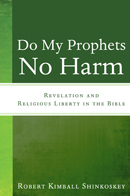
Robert Shinkoskey: Do My Prophets No Harm

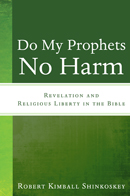 Robert Kimball Shinkoskey, Do My Prophets No Harm: Revelation and Religious Liberty in the Bible (Eugene, Oregon: Resource Publications, 2011), 206 pages, ISBN 9781608998456.
Robert Shinkoskey has two main proposals in Do My Prophets No Harm. The first proposal is that the Ten Commandments provide ancient Israel’s constitutional government. In theory, the Ten Commandments are “purely secular law, rather than a mixture of cultic and civic law” (p. 81). The first five commandments serve two purposes: the preservation of “freedom of religion for prophets and other dissidents who work to restore worship of the God of their ancestors” (back cover summary); and an adversarial purpose: to stand separate from the civic government. The role of the prophet is to call into question any policy or personal power that negates or abuses the last five of the commandments.
Shinkoskey’s second proposal is to challenge the notion of the cessation of prophecy. God always reveals Himself to those who are sensitive to Him, namely the prophets. This is necessary in order to preserve not only the first five commandments but also the second five. The prophets urge Israel to repent and return to their calling. Israel’s call is to honor and keep the second five commandments and to be a light to the nations: how to treat one’s neighbor in love and mercy and the stranger or alien among them.
This reviewer finds Shinkoskey’s analysis intriguing. He seems to suggest that the observance of the second five of the Decalogue promotes the worship of the God of the Exodus, the one who brought them out from slavery to Egypt. New revelation from God restores the people of Israel to their calling to be light to the nations. The prophets are those receptive to that revelation and must prophesy; hence, “Do my prophets no harm.” It is Shinkoskey’s contention that when a government exceeds its bounds whatever its form, monarchy, democratic republic, theocratic, those in governance seek to silence the prophets. It also occurs when complacency or satisfaction occurs in a nation. This is where religious liberty is threatened.
This reviewer also challenges Shinkoskey’s contention that the compilation of both the Old and New Testaments was “politically motivated” (p. 74). This counters the record of Jerome’s work, of the Council of Carthage, of Athanasius’ Paschal Letter, and of the scattered codices” such as the Byzantine, Alexandrian, the Old Syriac, and Caesarean. Pages 76-77 are interesting reading. This is where Shinkoskey notes that neither Judaism nor Christianity recognizes any further revelation from God other than what is recorded either in the Mikra Qodesh (Hebrew Scriptures) or the Kaine Diatheke (New Testament). Consider page 77 of Shinkoskey’s work and compare it with Hebrews 1:2 which strongly contends no further revelation than that of Christ Jesus is needed.
This is no criticism of Shinkoskey’s work as it is interesting reading and worth examining. Let the reader read the second paragraph on page 86 and determine whether there is a stretch of Shinkoskey’s imagination as to the function of the great commandment as given in both Exodus 20:3 and Deuteronomy 5:7. This reviewer does not wish to criticize Shinkoskey’s work and thus cast a doubt upon its credibility. It is heavily documented and has a three-page bibliography attached to its work and an index which goes from page 185 to page 205.
One other thing can be noted. It is clear that Shinkoskey holds to the documentary theory of the Old Testament’s compilation as he frequently refers to the J, E, P, and D documents. For the reader “J” stands for those places in the Old Testament where God is addressed as Jehovah while “E” refers to God as Elohim. “P” refers to the Priestly Code found most pronouncedly in Leviticus while “D” refers to the “Deuteronomic” writing. Readers unfamiliar with this approach may wish seek another introduction to the writings of those biblical scholars who specialize in literary aspects of the Scriptures. There are differing views as to the literary aspects. Lastly, there are comments in the later chapters with respect to Islam and its “prophetic” stance in relationship to Judaism and Christianity.
Reviewed by Woodrow E. Walton
Originally published on the Pneuma Foundation (parent organization of PneumaReview.com) website. Later included in the Winter 2022 issue.