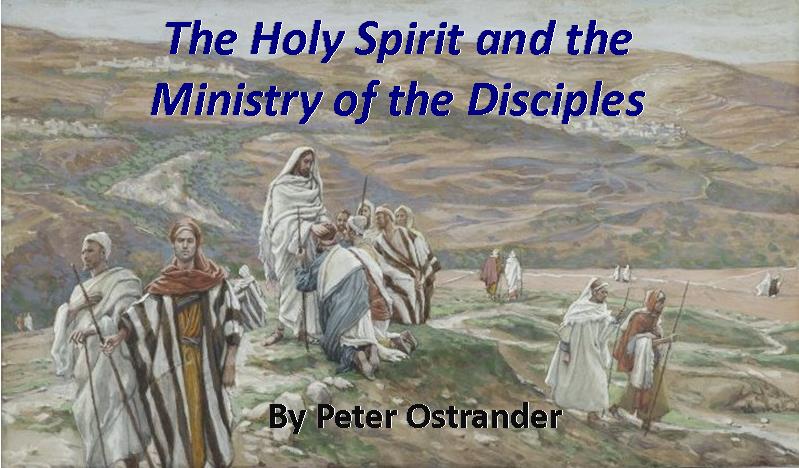
The Holy Spirit and the Ministry of the Disciples
Part 2 of an excerpt from Peter Ostrander’s book, New Testament Healing. Read Part 1 in the Winter 2016 issue: “The Holy Spirit and the Ministries of Jesus.”

The Holy Spirit and the Ministry of the Disciples
I am personally interested in finding out whether healings that are carried out by believers follow a pattern similar to that of healings carried out by Jesus, including those associated with the activity of the Holy Spirit. This is not to limit God’s healing activity through Christians who might not identify themselves as Spirit-filled, or as God uses the healing pattern of James 5:14–16 with established elders. I will attempt to use the New Testament to answer these questions.

In our world of advanced western medicine, complementary or alternate therapies, twelve-step groups, and self-help programs, many people have sought to maintain or improve their health in this life Have you considered another possibility: Christian healing ministry according to the patterns found in the New Testament? If you read the Gospel according to Mark, about 32% of this wonderful narrative up to Jesus’ final week upon earth, is about healing and miracles! Jesus and his first disciples were quite successful. How did they heal the sick? Would a contemporary expression of this ministry be of interest to you? As the good news about Jesus is preached and ordinary Christians pray and minister, people have been healed physically, emotionally, and spiritually, then experience abundant life with Jesus Christ. This book will help you learn more about Christian healing, encourage you to receive ministry, and prepare you to reach out to others.
Purchase New Testament Healing by Peter Ostrander
According to Mark, the earliest Gospel, Jesus sent the twelve apostles into ministry sometime before Peter’s confession of faith at Caesarea Philippi and the transfiguration of Jesus, which is recounted near the midpoint of the Gospel account. The accounts of Jesus sending out the twelve apostles are found in Matthew 10, Mark 6, and Luke 9. Additionally, there is an account of Jesus sending out seventy-two individuals. When I was teaching physics, I always gave my students instructions before they began their experiments, hoping they would pay attention. Likewise, Jesus prepared his twelve apostles before sending them out in advance of his visiting many towns in Israel. Clearly, our relationship with God through his Son Jesus Christ, in truth and spirit, is the basis for any possible Christian ministry.
Before he gives either group practical instructions for the way they are to travel, minister, find accommodations, and deal with the reactions of townspeople, Jesus gives them authority to drive out unclean spirits (demons) and to heal diseases and sickness. Luke indicates that the twelve also received power for this ministry.) They are to go only to the lost sheep of Israel (Matt. 10:6), preach the good news of the kingdom (reign) of God and call people to repentance as they heal the sick, cleanse lepers, drive out demons, and even raise the dead. They are to go out as Jesus’ commissioned representatives or ambassadors, then do the things that Jesus had been doing since his baptism. They go in pairs, without baggage, without money to purchase their own lodging or meals. They rely on the goodwill hospitality of townspeople. While obeying Jesus, they discover that God actually works through them in wonderful ways. Jesus’ own authority, or right to minister, had somehow been transmitted to them, and God’s power is evident as people are healed or set free. This takes place despite their incomplete understanding of who Jesus is or of God’s plan that his Son would die on the cross for their and our sins. One would betray Jesus and then commit suicide, another would deny Jesus, and the rest would flee before being surprised by the Resurrection. Jesus had not yet breathed on them, telling them to “Receive the Holy Spirit” (John 20:22). They had not yet experienced the baptism with the Holy Spirit at Pentecost or the subsequent infillings. Nevertheless, their ministry is successful, and they report to Jesus what they had done (Luke 9:12).
Somewhat later, Jesus appoints seventy-two other people to be sent out (apostled, sent with a mission) two by two as his advance agents to every place and town where he is preparing to go (Luke 10:1). Jesus states that the harvest had been abundant but that the workers are few. He tells them to ask the lord of the harvest to send out workers, then Jesus makes his hearers part of the answer to their own prayers. They are to travel light, accept the first offer of hospitality, proclaim peace (shalom) to the house, and stay there. They are to proclaim the near presence of God’s reign and to heal the sick. If they are not welcomed, they are to wipe the dust from their sandals as a testimony against those who do not welcome them and to warn the unreceptive again of the proximity of God’s kingdom, which requires a response. Rejecting his workers and representatives is equivalent to rejecting Jesus himself.

I am intrigued by the fact that these workers are completely unknown to us. Were they part of a larger group of disciples who had been following Jesus since John the Baptist’s imprisonment, or were they individuals who had been healed recently? Were members of the various religious parties or local officials among them? Were they all unmarried men, or could there have been married couples among them?
When the seventy-two return with joy, they tell Jesus that even the demons had submitted to them in Jesus’ name. The name of Jesus did and still does carry significant authority when used by Christians. Jesus states that he has given them authority to trample on snakes and scorpions in the wilderness and to overcome the power of their spiritual enemies (see Ephesians 6), and nothing will harm them. Indeed, he sees Satan falling like lightning during their mission. Yet, they should rejoice more over the fact that their names have been written in Heaven, in the book of salvation, than about their successes. Jesus, full of joy in the Holy Spirit, rejoices that God has gladly revealed these things to spiritual babes, or young children, while hiding them from the wise and learned of his day. The Father has committed everything to his Son, so that we cannot know God unless the Son reveals him to us! The disciples, through these missions, begin to realize that they might actually be able to do the same works of healing and deliverance that are the hallmark of Jesus’ ministry. Indeed, according to the Gospel of John, Jesus tells his disciples, “I tell you the truth, anyone who has faith in me will do what I have been doing. He will do even greater things than these, because I am going to the Father. And I will do whatever you ask in my name, so that the Son may bring glory to the Father” (John 14:12–13).
They need a new counselor, comforter, advocate, helper, and teacher resident within them. This Holy Spirit and his anointing are evident in the life and ministry of Jesus, but before his death, Jesus tells them: “Unless I go away, the Counselor will not come to you; but if I go, I will send him to you” (John 16:7). Instead of the Spirit being within a few leaders in the history of Israel, God wants his Spirit to be actively involved in the life of every member of his new people, the Church, the Body of Christ. Before his ascension, Jesus tells his followers to wait in the city of Jerusalem, for they will soon be baptized with the Holy Spirit and receive the personal power of God for mission and ministry throughout the world.
When Peter and John see the man who had been lame from birth at the temple gate, they tell him they have no money and command him “In the name of Jesus Christ of Nazareth, walk” (Acts 3:6). The man’s entrance into the temple courts causes such a reaction that Peter takes the opportunity to boldly preach about Jesus and his resurrection. Alarmed officials bring Peter and John before the Sanhedrin, who wants to find out “By what power or name did you do this?” (Acts 23). Luke tells us that Peter is filled with the Holy Spirit as he confidently answers this question. These disciples are clearly different after Pentecost! When the council members “say the courage of Peter and John and realized that they were unschooled, ordinary men, they were astonished and took note that these men had been with Jesus. We should recognize that the patterns of ministry that the apostles and other disciples had learned during their approximately three years with the Lord, as well as their whole direction, outlook, and views about God and his relationship with humankind, had been transformed. They have certainly learned much by watching, hearing, interacting, and participating with Jesus, but now they are empowered by the Spirit. In a short time, the apostles are performing miraculous signs and wonders among God’s people near the temple (Acts 5:12). Even Peter’s shadow heals the sick. When a group of Spirit-filled “deacons” are chosen, Stephen and Philip do great wonders and signs. Opposition, from a group of Jews outside Palestine infuriated by Stephen’s message, leads to his early martyrdom.
We can see the same pattern repeated as God not only expands the Church geographically but also sovereignly includes Samaritans and Gentiles among those who call Jesus Lord. When the Church is scattered after Stephen’s death, Phillip visits the Samaritans. He preaches about the kingdom and about Jesus, and then he heals the sick and sets demoniacs free, leading many to believe and then receive water baptism. When the apostles hear about this early fulfillment of Jesus’ words, which are recorded in Acts 1:8, Peter and John visit them. “When they arrived, they prayed for them that they might receive the Holy Spirit, because the Holy Spirit had not yet come upon any of them; they had simply been baptized into the name of the Lord Jesus. Then Peter and John placed their hands on them, and they received the Holy Spirit” (Acts 8:15–16). It is likely that the presence and power of the Spirit have been manifested through various gifts. Later, when Peter is staying in Joppa with Simon the Tanner, he experiences a vision that teaches him to never call any person unclean. He is then told to go with the men who were just arriving to take him to Cornelius, a Roman centurion! When Peter begins to preach to these Gentiles, he tells them that God does not show favoritism and that Jesus had been anointed by the Holy Spirit, then healed people and set them free of the devil. God sovereignly interrupts Peter’s sermon by baptizing the group in the Holy Spirit with various manifestations of the Spirit, including speaking in tongues. The Jewish believers, with Peter, are amazed that even Gentiles, like us, had received the Holy Spirit. These new believers receive water baptism in the name of Jesus after God’s action. The elders of the Jerusalem Church have difficulty accepting this new reality but move toward acceptance by the conclusion of the Jerusalem council (Acts 15). Through God’s sovereign action, a Jewish sect became a worldwide religion.
The book of Acts continues to record healings and deliverances that are similar to the work of Jesus yet individually different. Paul tells a man in Lystra, who had been lame from birth, to get up—and he does! This results in Paul and Barnabas almost being worshiped, until Jewish opponents arrive. In other cities, a fortune-telling slave girl is set free, two people are raised from the dead, and a shipwrecked apostle heals every sick person on an island after he himself had been bitten by a viper yet did not swell up or die.
A List of Scriptures About the Holy Spirit in the Christian Life
- “If you then, though you are evil, know how to give good gifts to your children, how much more will your Father in Heaven give the Holy Spirit to those who ask him!” (Luke 11:13)
- “[ Jesus answered,] I tell you the truth, no one can enter the kingdom of God unless he is born of water and the Spirit. Flesh gives birth to flesh, but the Spirit gives birth to spirit. The wind blows wherever it pleases. You hear its sound, but you cannot tell where it comes from or where it is going. So it is with everyone born of the Spirit.” (John 3:5–6:8)
- “But the Counselor, the Holy Spirit, whom the Father will send in my name, will teach you all things and remind you of everything I have said to you.” (John 14:26)
- “And with that he breathed on them and said, ‘Receive the Holy Spirit.’” (John 20:22)
- “For John baptized with water, but in a few days you will be baptized with the Holy Spirit. You will receive power when the Holy Spirit comes on you; and you will be my witnesses . . .” (Acts 1:5, 8)
- “The disciples were filled with joy and with the Holy Spirit.” (Acts 13:52)
- “And hope does not disappoint us, because God has poured out his love into our hearts by the Holy Spirit, whom he has given us.” (Rom. 5:5)
- “The mind of sinful man is death, but the mind controlled by the Spirit is life and peace. . . . The Spirit himself testifies with our spirit that we are God’s children.” (Rom. 8:6, 16)
- “Do you not know that your body is a temple of the Holy Spirit, who is in you, whom you have received from God? You are not your own.” (1 Cor. 6:19)
- “Now to each one the manifestation of the Spirit is given for the common good. To one there is given through the Spirit the message of wisdom, to another the message of knowledge by means of the same Spirit, to another faith by the same Spirit, to another gifts of healing by that one Spirit, to another miraculous powers, to another prophecy, to another distinguishing between spirits, to another speaking in different kinds of tongues, and to still another the interpretation of tongues. All these are the work of one and the same Spirit, and he gives them to each one, just as he determines.” (1Cor. 12:7–11)
- “So I say, live by the Spirit, and you will not gratify the desires of the sinful nature. . . . The fruit of the Spirit is love, joy, peace, patience, kindness, goodness, faithfulness, gentleness, and self-control.” (Gal. 5:16, 22)
- “Do not get drunk on wine, which leads to debauchery. Instead, be filled with the Spirit.” (Eph. 5:18)
- “The Spirit and the bride say, Come! . . . Whoever is thirsty, let him come; and whoever wishes, and let him take the free gift of the water of life.” (Rev. 22:17)
PR

Read Part 1 in the Winter 2016 issue: “The Holy Spirit and the Ministries of Jesus“
This chapter is reprinted with permission from New Testament Healing by Peter E. Ostrander (Xulon, 2011).