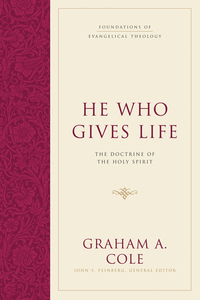
Graham A. Cole: He Who Gives Life

 Graham A. Cole, He Who Gives Life: The Doctrine of the Holy Spirit, Foundations of Evangelical Theology (Wheaton, IL: Crossway, 2007).
Graham A. Cole is professor of biblical and systematic theology at Trinity Evangelical Divinity School in Deerfield, IL. He is an ordained Anglican minister, and has written several other books regarding Evangelical theology. This book is an addition to Crossway’s Foundations of Evangelical Theology series, and discusses the role of the Holy Spirit within Evangelical doctrine. Cole is an ardent Trinitarian theologian and offers here one of the most definitive treatments of pneumatology available today. Cole approaches this from a solidly Reformed theology, but he is notably ecumenical in his treatments of contentious issues regarding pneumatology. Authors from both the Eastern and Western traditions are covered, and at the end of each chapter many questions for our generation are raised and various implications to pneumatology are highlighted. So then, the book is practical and well-written. Taking this ecumenical approach allows the reader to gain a better understanding of the differences for him/herself, and thus enables them to become better theologians. The book is thoroughly biblically-based (Cole admits to a high view of Scripture in the introduction, calling it the “norming norm,” whereas tradition, experience and reason are “ruled norms”), and is illuminated by theological reflections on the doctrine of the Holy Spirit. In engaging theology, Cole brings Basil of Caesarea, Augustine, Aquinas, Calvin, Barth and Moltmann to bear on issues of pneumatology.
Cole demonstrates an evidence-based approach to theology within this book in that he engages information bearing on the truth of falsity of a proposition. Cole invokes Bonhoeffer in stating that we must learn to know the Scriptures once again, for they are the basis of our evidence for forming a doctrine of the Spirit. Cole acknowledges four distinct periods of Pneumatological discussion, to which I would a fifth. First, Cole recognizes the Patristic era, which was concerned with the ontology (derivation of, i.e.) the Spirit. Second, Cole recognizes the Medieval period, which saw the schism between the Eastern and Western branches of the church in due part to the doctrine of the Spirit’s ontology. Third, Cole recognizes the Reformation period, in which more emphasis was given to the works of the Spirit over the ontology of the Spirit. Fourth, Cole notes that the Modern period, characterized by Whitefield and Wesley, highlighted the Spirit’s role in regeneration and sanctification. The fifth period, which Cole does not directly indicate but does peripherally allude to, is what I refer to as the Post-modern period, in which pneumatology is beginning to be seen as the avenue to engage a theology of religions (reference Amos Yong’s groundbreaking work in Beyond The Impasse).
In the first part of Cole’s book, he addresses the mystery of the Spirit. Also within this first part of the book, Cole examines the personhood of the Spirit, the deity of the Spirit, and the relation of the Spirit to the Godhead. In the second part of this book, Cole turns from the person of the Spirit to the works of the Spirit, for, as Cole indicates, operation follows being. So then, Cole agrees with the notion that what can be said of the work of the Spirit is predicated on what can be said of the person of the Spirit. In this second part, Cole explicitly interacts with the Old Testament, and derives from it what can be predicated to the Spirit (though he acknowledges that the writers of the OT were not “Trinitarian” per se). In the third part of this book, Cole turns his attention to the New Testament, and continues to explore the work(s) of the Spirit. In this third part, Cole highlights the Spirit’s empowering Jesus as Messiah, the role of the Spirit in the life of God’s people, and the role of the Spirit in fostering community amongst God’s people.
Many debated questions of pneumatology are covered within this book, including whether all of the gifts of the Spirit are applicable today, whether there is such a thing as subsequence, and whether the third article of the Creed should become the starting point for theology today. Whereas the views of Cole may not be representative of the readers of The Pneuma Review at all times, Cole nonetheless does adequately argue for his viewpoint and interpretation, and as such the results of it have to be reckoned with by all. Indeed, though I do not agree with Cole’s interpretation at all points, this book has sharpened my own defense of the theological positions that I hold dear. Notably, this book shows the ultimate selflessness of the Holy Spirit as the member of the Trinity who always works for the glory of God the Father and God the Son and for the good of the saints called by Christ’s name. In conclusion, this book is ideal for readers of The Pneuma Review, including pastors and teachers, as well as students of theology.
Reviewed by Bradford McCall.
Preview He Who Gives Life: http://books.google.com/books/about/He_Who_Gives_Life.html?id=rU9Ulp4Jo_UC
Originally published on the Pneuma Foundation (parent organization of PneumaReview.com) website. Later included in the Spring 2025 issue.