
The Resurgence of the Gospel, Part Two: Recharting the Christian World Mission


The Resurgence of the Gospel and the Flowering of the Global Christian Message
Part Two: Recharting the Christian World Mission
Church councils, a changing geo-political landscape, invasion and upheavals had a radical impact on how followers of Jesus participated in the Christian mission.

Image: The Books of Kells by way of Wikimedia Commons.
It may seem strange but it is from Ephesus that the re-charting of the Christian world mission takes place. It is, however, not as strange when one considers the fact that Ephesus, situated in Asia province of the Graeco-Roman world and facing the Aegean Sea and looking westward is the western entrepot of a vast East-to-West commerce where goods from oriental sources were readied for trans-shipment either into Europe or into Africa. There had a been long history of commercial intercourse between East and West.
The other factor is that Ephesus, like Antioch-on-the Orontes, is an important Christian Center where Paul the Apostle once preached. Ephesus lies south of Nicaea and of Troas, also crossroads, between East and West. From Troas, Paul and Silas took voyage toward Philippi and Thessalonica. On the other side of the Aegean from Ephesus stood Athens and Corinth.
As a result, Ephesus became an eminent Christian Center and by the late 300’s and early 400’s, and became the host for conciliar meetings of Christian leaders from places in Europe, North Africa, and the Near East. In A.D. 431, a council was held in Ephesus to clarify, for the sake of evangelism and Christian instruction, the meaning of the Trinity particularly with attention on the Person of Christ Jesus. There were three eminent Christians who differed over what to stress. One was Cyril of Alexandria who was strong on the redeeming work of Jesus and on the divinity of Jesus. The second was Theodore of Mopsuestia who was as strong on the humanity of Jesus as Cyril on the divinity of Jesus as Son of God. The third part was Nestorius from Antioch who was made Patriarch in Constantinople. Nestorius differed on referring to Mary, the mother of Jesus, as a theotokos, mother of God.

Image: Jordan Klein / Wikimedia Commons
The Council of Ephesus in A.D. 431 came out in Cyril’s favor putting both Theodore and Nestorius in an unfavorable light. A second Council was held in A.D. 449 which amended the verdict but did not exonerate either Theodore or Nestorius. The controversy simmered for twelve long years. Then in A.D. 461, a greater number of Christian leaders gathered from all over the then Christian world, from York in Roman Britain, to John, a Bishop in western Persia. The Council at Chalcedon came down hard on the Second Council of Ephesus and called it a “Robber” Council. It was a partial victory for both Nestorius and Cyril and for the Apostle Paul’s statement found in his second letter to the Corinthians: “God was in Christ” reconciling the world to himself (II Corinthians 5:18-19ff). Though neither Cyril nor Nestorius was fully satisfied, it did free both of them to go back to Egypt and to Antioch to do that which was most important, to preach the gospel as each understood the gospel. In the years between A.D. 431 and A.D. 461, Nestorius wrote a defense, first done in Greek, then translated into Syriac between A.D. 525 and 533. The Bazaar of Heracleides must have been written between A.D. 451 or 452, as he mentions the death of Emperor Theodosius in A.D. 450.
The early Christian writer Evagrius lived at the time referred to in the book. For many years, from 533 till the nineteenth century, The Syriac translation lay in state in a library in Kotchanes in Kurdistan. Travelers in the 1500’s told about seeing it. Luther himself had seen it and read it in a German translation. The point of mentioning it is that the Bazaar of Heracleides, in its Syriac rendition, portends the importance of Nestorius and the Bazaar of Heracleides for the advance of the gospel across the whole face of Asia from Damascus to Mongol China.
On the other side of the controversy between Nestorius and Cyril of Alexandria, Cyril was freed from debating Nestorius to return to Alexandria in Egypt and furthering the extension of the gospel into the upper Nile into Nubia, now known as the Sudan and into Abyssinia, an area known to the Romans as Ethiopia. Two major missionary efforts were spawned by the results of the decisions of the two councils of Ephesus and then of the Council of Chalcedon in A.D. 461.
In effect, the controversies and the decision at Chalcedon re-chartered the entire missionary enterprise. Armenia fell within Rome and Constantinople’s sphere of influence, and the Patriarch of Constantinople sent workers into what is now eastern Europe. The most notable missionaries were a pair of brothers who went north into the Slavic countries and into the Ukraine. The Western Church concentrated its efforts in Italy, Gaul (France), northern and northwestern Africa, Hispania (Spain), Lusitania (Portugal), the Netherlands (Holland, Belgium), Brittania (England), northern Europe, and into the Celtic world (Ireland, Scotland, Breton).
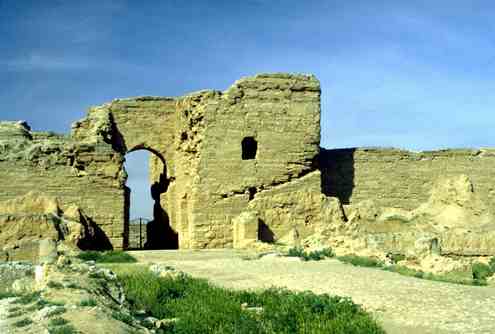
Image: Wikimedia Commons
As impressive as this may seem, it did not compare as to what took place in Africa east of Cyrene (Libya) and in Asia east of Antioch, Damascus, and Dura-Europos. When Cyril went back to Alexandria, he concentrated on the extension of the Gospel toward the upper Nile all the way toward the source of the Nile and toward the lands of Ethiopia and Abysinnia and what now is referred to as Somalia toward the horn of Africa and to some extent across the Sinai peninsula and down the east side of the Arab Peninsula.
As for Nestorius, after the controversies and Chalcedon’s decision, he started writing out his thoughts, which included his famous Bazaar, and sharing the gospel of Christ in the countryside east northeast of Antioch, southward into Arabia southeast of Damascus in what was once known as Nabataea, then southeastward going toward the Chaldees. While Egypt’s mission converted the Himyarite Arabs, the Nestorian mission influenced the Ghassinid Arabs just east of what was known as the Decapolis and formerly known as Gilead, Ammon, Moab, and Edom.
What really makes this two-prong advance of interest is that later, down through the years, the two forces of Cyril and Nestorius would occasionally bump into each other, each stressing their differences but eventually learning how to work together toward the conversion of Kereite Mongols in central Asia. How that occurred is a story in and of itself.
By way of hindsight, the difference between Cyril’s Monophysite followers and Nestorius’ followers reminds this writer of present-day Evangelicals arguing over the relationship of the Father and the Son in Trinitarian theology. Both men were Trinitarians and adhered to the Nicean-Constantinopolitan Creed of A.D. 318.
In a strict sense of mission as evangelizing, the Nestorians outshone the Egyptians of Alexandria but in a broad sense of the missionary enterprise, the Egyptians lent an institution that was adopted by the western church and integrated into its missionary thrust. That institution was the Pachomian monastery named after a converted Roman soldier from Egypt. Pachomius envisioned not only a place of prayer and solitary devotion but a place also set apart for Christian growth and outreach. The monastery would have a scriptorium for writing and study of the Bible for Christian growth. It would have a place for a garden and a work-house where the crafts could be pursued.
It was a Byzantine Christian by the name of John Cassian, born about A.D. 360 in what is now known as Romania, who is responsible for the spread of the ideas of Pachomius and Christian monasticism into western Europe. Cassian, the son of wealthy parents, he had an excellent education. He was also bilingual and was able to converse in both Greek and Latin. At one point in his adult life, he not only visited Alexandria, Egypt, but went into the Egyptian desert and saw the operations of the monasteries there. In his first written work, the Institutes, he shared what he saw and experienced, and also wrote to his sister about the monasteries and their operation. After leaving Egypt, he traveled westward to Italy and after spending time there went on to Marseilles around A.D. 415. At Marseilles, he founded the Abbey of St. Victor, a complex of monasteries for both men and women, one of the first such institutions in the West. It served as the model for later monasteries throughout Europe. It was the model for the monastery of Armagh in Ireland, which traces its origin to Patrick. During his lifetime, John Cassian got to know Benedict. Benedict incorporated many of Cassian’s insights into his own monastic rule and encouraged the adoption of Pachomian ideas as relayed by Cassian.
What Cassian accomplished for the development of the monastery in the west caught the attention of the Eastern Church, Byzantine, Coptic, and Syriac. It caught the attention of Nestorius and the monastic model out of Egypt was adopted for the Eastern Christian churches. Cassion, who died in Massilia, Gaul (modern Marseilles, France) in 435, is today venerated by the Eastern Orthodox Church, the Roman Catholic Church, The Church of the East, the Oriental Catholic Church, and the protestant Anglican Communion.
What we have here is a very interesting re-charting of the routes taken in the propagation of the gospel through the years and facilitated by the monastic movement. What now merits attention is the way east, but the way east was not a straight path. The way east was like a misshapen pitch fork. One fork pushed north from Damascus to bend eastward toward Edessa and Nisibis in Capppadocia into the Caucasus mountains east of Armenia and Georgia.
At an undisclosed point north by northeast, one fork went toward the river which drains into the Euxine [Black] sea and crossed it at a point northeast of the Ukraine. The other fork bent northeast toward the Volga and continued in a more easterly direction, crossing over the Ural river where the upper reaches of the Karakum desert blend into the steppes northwest of the Aral Sea.

Image: Wikimedia Commons
The other fork took off in an easterly direction in the upper reaches of the Tigris-Euphrates valley close to the area of present-day Mosul and southeast of Nisibis and Gaugamela. The home base was undoubtedly Nisibis where an important Nestorian monastery was located. Originally a monastery for prayer and contemplation of the Scriptures, it quickly took on the appearance of the monasteries in Egypt while retaining its focus upon the whole of Asia and the retention of the Syriac language for the whole Syrian-Aramaic speaking sector of Asia east of Antioch, Caesarea, and Damascus. The Old Testament retained its Hebrew but the Targums or Commentaries on the Old Testament were written in Syriac. There was already a Syriac translation of the koinē Greek of the Gospels, the letters, Acts of the Apostles, and the Revelation [apocalypsis] to John. Belonging to the end of the second century, the Old Syriac, was replaced by the Peshitta which retains the Syriac of the 5th century A.D. and which is still today the authorized Old Testament and New Testament of the Church of the East. This is the time of Nestorius and Cyril of Alexandria, the middle and late 400’s.
Like the Coptic Church of Egypt and the Byzantine Orthodox Church of Constantinople, and unlike the Roman Catholic which favored the Latin Vulgate as the language of all European Christians, the Church of the East did favor the indigenous languages so that all peoples could read the Bible in their own tongues and learn of the Son of God who died on a Roman Cross and yet resurrected to give all who received his love to know the forgiveness of sins and a new resurrected way of living. It took the Roman or Western Church nearly 1450 years and a Protestant Reformation to get around to favoring the indigenous languages of the Europeans.

Image: Wikimedia Commons
When the Eastern Christians of greater Syria and Armenia got underway toward central Asia they took a torturous route, a tradesman’s route which went through mountain passes. The Silk Road, they were called. Although they offered the best way through, the roads were still physical challenges, they had obstacles and natural barriers. These included the Pamir mountains where passes were heavily protected, such as Tashkurgan’s Stone Fort near Kashgar in the west of the Taklamakan Desert. The Silk Road traversed the Oxus River and went toward Bukhara. Bukhara had forbidding defensive walls. This was Mongol territory going toward Samarkand and Xinjiang in western China. The Nestorian Christian traders and occasional monastics, in the course of their travels and trade, established churches in Bukhara and Samarkand. Samarkand, in time, became the site of a Christian patriarchate as Baghdad also did back west in Iraq.
Over the course of time, after facing obstacles, opposition, and occasional persecution, the Christians of the Church of the East established themselves in every major settlement along the Silk Road, even Kashgar. In the sixth century, a Nestorian Christian named Abraham who lived from A.D. 491 to 586, initiated a revival in Kashgar and also established a monastery there.

Image: Wikimedia Commons
How has this record been retained over the course of time? By Christians who have kept records and whose records have been kept safe within monasteries. These include John of Ephesus who lived in the sixth century and wrote his Lives of the Eastern Saints and an unknown Christian who wrote The Chronicle of Seert. Records of the Nestorian mission into the East have been kept in every century in monastic establishments. Many have been photographed, restored, and long preserved in libraries like St. Catherine’s Monastery in the Sinai desert and other historic sites across the globe. The Church of the East, the Coptic Church, the Greek Orthodox Church, The Roman Catholic Church, and Protestant Churches all have repositories of ancient records of the early growth of the Christian mission and how that mission was carried out.
PR
Coming in the Winter 2019 issue:
Exploding myths about early Arab-Christian relationships while identifying the reality of a Turkic-Moslem curtain that triggered the oceanic global mission to the Americas and beyond.