Invading Secular Space: Strategies for Tomorrow’s Church

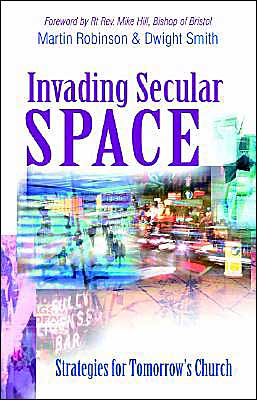
 Martin Robinson & Dwight Smith, Invading Secular Space: Strategies for Tomorrow’s Church (Grand Rapids: Monarch Books, 2003), 221 pages, ISBN 9780825460500.
This book assesses the crisis of the Western church and proposes strategies for recovering the missional character of the church. According to Robinson and Smith, the mission of the church in the apostolic period was spurred by its conviction in the Lord’s imminent return and the urgency of spreading the gospel. The people of God as a whole were engaged in mission. However, with the new social status gained in Constantine’s conversion, mission shifted from being the essential nature of the church, to being one of its many functions. Mission was now seen as preserving the institution through the new class of professional priests and tied to the agenda of the church. The institution began to define its mission, rather than God’s mission defining the church (p. 46). The crisis in the Western church today is once again rooted in its misplaced focus on declining numbers and its frantic quest to reverse this trend. Robinson and Smith call the church back to its core purpose and calling—mission.
The underlying conviction is that the church’s mission is sharing in God’s mission to the world, in giving the only begotten Son to the world for the sake of the world. Divine mission must be reflected in the church. The life and witness of the church is rooted in God’s mission, in which the church becomes the love of God manifested in the world.
Crucial to the church’s mission is Christian formation, argue Robinson and Smith. When the church defines itself according to its institutional priorities the focus becomes church growth and success, but when the church is shaped by mission priority is given to sustained personal transformation, relationship and intimacy with God and fellow human beings. The authors suggest that personal transformation takes place in the mentoring process of small group structures. In the small group, all the people of God are engaged in the church’s mission and witness. Unfortunately, however, lively worship acts as a substitute for personal transformation, creating a dependency in a consumer approach to worship (111). Also detrimental to mission is the culture of domineering leadership. “The abnormality of the ‘man at the top’ syndrome…is a cancer eating at the health of all human organization. It is this concern, extending through the expectations of younger leaders and reinforced by training institutions, that has created our present realities (p. 126). Robinson and Smith propose a missional style of leadership that empowers people to engage the cultures of this world for the sake of the kingdom. “Dynamic leadership does not think first of how to retain control but how to give away as much as possible (p. 153).” True New Testament leadership is always shared; dissension and opposition is viewed as Trinitarian diversity, not as a threat to a dominant leader.
The implications of this work for Pentecostal ministry are twofold: one positive and one negative. Positively, Pentecostalism at its best is missional, in that it believes that the Spirit empowers all believers to work actively in the world for the growth of the kingdom, in mission and witness, by encountering the cultures of this world in redemptive and prophetic ways. At their best, Pentecostals have been able to inculturate the gospel, creating truly indigenous expressions of biblical faith. The spontaneity of the Spirit so valued in Pentecostal structures creates space for new and innovative cultural expressions of the gospel. Negatively, Pentecostals today have been seduced by the institutional model of the megachurch structure, in which the growth of numbers and trappings of success become the priority of mission. Top down leadership with a professional class of ministers who administer the faith is becoming the norm in many so-called successful Pentecostal churches, but at the cost of a truly missional approach that sustains personal formation and empowers all the people of God to work in service to the King. The emphasis on performance in these churches, in which “professional” ministers, singers or administrators service the institution, has restricted the participation of the congregation in worship and world engagement. However, Robinson and Smith offer fresh possibilities for creating a more missional church.
Robinson and Smith’s book is helpful for pastors thinking about how to make the church more missional in orientation, though many of their concerns reflect the Episcopal context. Nevertheless, Pentecostals can learn from their wisdom and make the church more meaningful for today’s world.
Reviewed by Peter Althouse
Preview this book online: books.google.com/books?id=wJYBDrGonZUC