James K. A. Smith: Speech and Theology

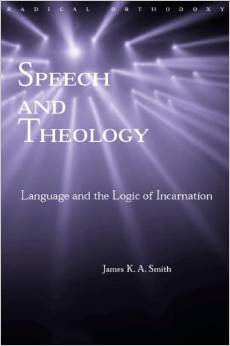
 James K. A. Smith, Speech and Theology: Language and the Logic of the Incarnation, Radical Orthodoxy Series (London and New York: Routledge, 2002), 186 pages, ISBN 9780415276962.
The book is more complex than its title suggests. Speech and theology is a splendid inquiry into the question: how we can speak about God. More precisely, it addresses the question of why we can speak about God at all. Smith’s answer is indicated in the subtitle: it is the logic of the incarnation that allows us, and even compels us, to speak of the ineffable mystery of God.
Speech and theology is directed primarily toward an academic audience. It is published as part of Routledge’s Radical Orthodoxy Series which offers writings of a contemporary theological movement that operates across many Christian and non-Christian traditions, and which works alongside other academic disciplines such as politics, economics, the natural sciences, social and cultural theory. The increasing interest in the central themes of Radical Orthodoxy should also direct attention to this author, who seeks to create a new Christian phenomenology which asserts the Incarnation as the condition of possibility for language generally and for speech about God in particular.
The dilemma of theological language is that every act of human speech about God, who is infinite and transcendent, must employ language and concepts that are finite and immanent. Smith proposes that this should not reduce us to silence. On the contrary, he argues that the transcendent God must appear in terms of immanence or, otherwise, cannot be revealed at all. Consequently, immanence and transcendence should not be viewed as opposites. In the Incarnation, the transcendent God entered into the finite world, not simply participating in it but being embodied by the immanent and thus allowing the finite and the infinite, the immanent and the transcendent, to exist side by side as the very possibility of finite language about an infinite God.
Smith illustrates his complex thesis by retrieving the theological language of Augustine. This section also contains a number of images which help illustrate the intricate subject matter. Augustine grappled with language as an expression of the divine mystery and of his own self. In order to articulate that which is incommensurate with language, he found a literary and aesthetic basis in his confessions. The language of “confession” became the linguistic vehicle that allowed him to indicate the ineffable mystery of his own soul to others yet without full disclosure of himself. What Smith proposes is a language that bears witness without divulging the secret—a speaking which neither compromises nor obliterates the incommensurate. He finds the solution to the problem of speaking about God in God’s own solution to the problem in the Incarnation, which functions as a paradigm for the operation of theological language. The radical nature of Smith’s thesis is the argument that a Christian theology is possible only on the basis of a radically incarnational philosophy. In turn, the Christian theology of the Incarnation can then form the basis for a general philosophy of language.
The reader may wonder if contemporary phenomenology does not introduce a problem that is unknown to the theology of the Scriptures. A closer examination of the biblical texts concerning the question of language comes remarkably short in Smith’s treatise. Such a biblical theology might reveal that despite the incommensurable difference between God and humankind, the latter is never reduced to silence, even when the words spoken have nothing other to say than that little can be said that does justice to the mystery of God. Furthermore, the disciples of Jesus are compelled to speak of what they saw and heard (see Acts 4:20) not only because of their experience of the incarnate Son of God but, more directly, as a result of the outpouring of the Holy Spirit at Pentecost. In this sense, Smith’s remarkable treatise could be supplemented by an examination of the relationship between the logic of the Incarnation and the dynamic of the Holy Spirit. This pneumatological perspective would open up an important area of theology not yet accessed by the Radical Orthodoxy project.
Reviewed by Wolfgang Vondey