
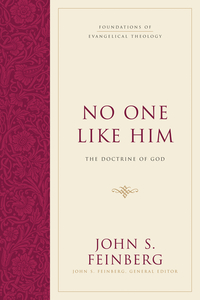
John Feinberg: No One Like Him

 John S. Feinberg, No One Like Him: The Doctrine of God (Wheaton, IL: Crossway Books, 2001), 879 pages, ISBN 9781581348118.
In the 1970s, Paul E. Little wrote an excellent book entitled, Know What and Why You Believe. In clear simple language, he presented various doctrines of the Bible in a way that could be easily understood by young Christians. It was in many ways a practical guide in apologetics. Now there is a book that takes the doctrines of the Bible to a new level.
No One Like Him: The Doctrine of God by John S. Feinberg presents an in-depth look at the teachings of God while providing readers with an indispensable tool for defending their faith. On one level, it challenges Christians to think critically and even philosophically; on another level, it inspires them see God as He is revealed in Scripture.
Feinberg is the general editor of Crossway’s Foundations of Evangelical Theology series. He is the author of a number of books, including The Many Faces of Evil, and Ethics for a Brave New World (with Paul D. Feinberg). John S. Feinberg is Professor of Biblical and Systematic Theology and chairman of that department at Trinity Evangelical Divinity School.

Concerned about the changes in today’s society and the rise of postmodern thought, Feinberg felt the need for a book that would answer current questions about God. Process theology and openness theology are just two of the many issues he tackles. He writes:
The advent and growing entrenchment of the postmodern mindset, not only in our universities but also in culture more broadly, have had dramatic implications for our very understanding of who and what God is. Theologians and non-theologians alike are clamoring for a God who is engaged in our lives and responsive to our needs (p. xxv).
No One Like Him is a comprehensive work that consists of 16 chapters. It is divided into three parts. Part One deals with the concepts of God. It covers such topics as the idea of God, what happens to God in contemporary thought and process theology. Part Two covers the being and nature of God. It features chapters on the existence and being of God, the attributes of God, the non-moral divine attributes, the moral attributes of God, God as He relates to time and eternity, and the Trinity. Part Three addresses the acts of God. It covers the decree of God, the doctrine of creation, divine providence and human freedom, the sovereignty of God, freedom and foreknowledge, and divine providence and evil.
The entire volume should be of interest to Pentecostals, as it goes beyond simple answers and weak illustrations about the nature of God. It also goes beyond Scripture, in a legitimate way, by analyzing modern concepts about God in the context of history. Included is a dissection and critical analysis of different viewpoints on controversial teachings. With the emphasis on prosperity in many churches today, the biblical view of God is often distorted. However, Feinberg offers an antidote to this distortion
One section that should prove especially relevant to Pentecostals is the chapter on the Trinity. Fienberg argues for the importance of the doctrine and notes the sad implications for those who dismiss it as insignificant. “This is a most significant doctrine theologically,” he writes. “If Father, Son, and Holy Spirit are not coequally God and not of the same essence, there are serious problems, for example, for the doctrine of salvation” (p. 440).
Fienberg makes a strong case for the traditional view of the Trinity, which is a uniquely Christian doctrine. The doctrine holds that God is one as to essence and three as to persons. As opposed to the “Oneness” or “Jesus Only” teachings, the doctrine of the Trinity claims that the Father, Son and Holy Spirit are one but three separate and distinct persons. “Any Christians who think it important to understand who and what their God is must recognize that the Christian God is triune,” Fienberg writes (p. 439).
As he does with other topics, Fienberg traces the doctrine to the Bible and through history. He presents the various positions held throughout history and makes a case for view that is typically held by conservative Evangelicals.
Feinberg’s book is especially useful to scholars, as it provides the depth and critical analysis expected for a book of this nature. It shows that some teachings, which may appear simple on the surface, are anything but simple to grasp. Still, because of the approach used and the topics covered, the book would also be good resource for young Christians and students of the Scriptures. Given the length of the book and the attention it requires to appreciate, it is not likely that one can merely skim its contents and become an authority over night. Still, if read slowly, where each section is absorbed over time, the concepts and arguments presented can result in a better understanding and appreciation of God and His mighty works toward humanity.
Feinberg set out to show that God is one and there is no one like Him. He aimed to show how a study about God could be relevant to practical living. In doing this, he argued for the importance of the subject and its relation to the issues of today. His effort was undoubtedly ambitious. However, he clearly achieved what he set out to do. As a result, the church has a volume that sheds critical light on the doctrine of God. It is a volume that helps one to see that the God of the Scriptures is indeed Who He claims to be—and there is no one like Him.
Reviewed by Roscoe Barnes III
Preview No One Like Him: http://books.google.com/books/about/No_One_Like_Him_Hardcover.html?id=A34hkDowhawC
Publisher’s page: http://www.crossway.org/books/no-one-like-him-case/