

John MacArthur’s Strange Fire, Reviewed by R. Loren Sandford

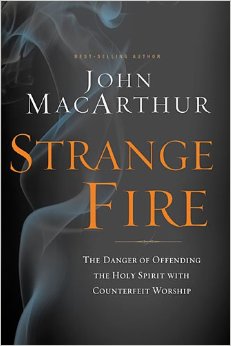 This is a pre-publication review of John MacArthur, Strange Fire: The Danger of Offending the Holy Spirit with Counterfeit Worship (Thomas Nelson, Nov 12, 2013) 9781400205172.
Strange Fire by John MacArthur is basically an attack on anything and everything related to the Charismatic Movement and the various movements descended from it, as if the whole of it were composed of one monolithic set of doctrines and practices that all of us espouse. It invalidates anything that smacks of the supernatural or of emotion freely expressed in God’s presence. MacArthur pours his vitriol – and I mean vitriol – through the filter of his own prejudices and theological presuppositions in a way that blinds him to the differences between the various movements within the charismatic stream and causes him to deny the existence of the majority of us who do not agree with or practice the abuses he objects to. In doing so he ignores or reinterprets, through very poor exegesis, the clear teaching of much of the Scripture as well.
Ironically, as he formulates his attack, he builds upon concerns that many of us in the movement share. I share his concern over abuses in prophetic ministry, aberrant doctrines, fallen leaders, manipulative fundraising, acting out in fleshly ways that are not of the Spirit and fakery on the part of some associated with the movement. As an insider, I confront these things as well, seeking what is genuine and calling for biblical grounding. MacArthur commits grievous error, however, in claiming that these abuses characterize the movement as a whole. They do not.
For example, I am a charismatic and have been from my childhood in the 1950s. I am also a graduate of Fuller Theological Seminary, 1976. Consequently, I have been steeped in exegetical principle and the doctrines of the historic faith from a time when Fuller described itself as “reformed” in its theology. Consequently, I do not embrace aberrant theologies. Reading MacArthur, you’d think that all charismatics espouse prosperity teaching. We do not. You’d think that we are all Word of Faith adherents when, in fact, they constitute a small minority and promote a doctrine many of us oppose. I actually wrote a rebuttal of those two doctrines in my own book, Purifying the Prophetic.
On a side note, in his introduction MacArthur asserts that Fuller Theological Seminary abandoned the doctrine of biblical inerrancy in the early 1970s. I was there from 1973 until my graduation in 1976 and I can state categorically that Fuller at that time held to inerrancy. MacArthur is wrong on many fronts and should be held accountable for what is either blatant intellectual dishonesty or just inexcusably sloppy research.
In reading MacArthur uncritically, you’d think that we all focus in unbalanced ways on manifestations and behavioral aberrations like barking and animal sounds. We do not. Over the years, I’ve spent at least a cumulative 5 months in meetings at the Toronto Airport Christian Fellowship, now known as Catch the Fire, serving for 14 years in leadership as a regional coordinator and international council member. Never in all that time did I hear an animal sound. I think he must be reacting to what he has heard from other revival critics, rather than his own eyewitness experience. This, again, constitutes intellectual dishonesty and sloppy research.
He states, “I’ll start believing that the truth prevails in the charismatic movement when I see the leaders, who are the people who are most exposed to its principles, looking more like Jesus Christ.” Yes, some very few of us have been guilty of seeking or walking in anointing without character. Our exercise of church discipline in response to their failings has often been deficient. Tragically, some of those failures have been seen in people with prominent ministries and as a result we have all had to wear the mud we didn’t deserve.
The truth is that the foundation of the Toronto Blessing, for instance, was and is the kind of transformation of character to conform to the image of Jesus (Romans 8:29) that has produced people like Rolland and Heidi Baker. In their ministry in Mozambique, not only are many thousands of orphans given homes and countless thousands of hungry fed, but thousands of churches are planted, hundreds of thousands come to Jesus, the dead are raised, the sick are healed and the lame walk. The vast majority of lesser known leaders in the renewal go quietly about the business of doing those same things in the places where they labor all over the world. The fallen leaders and those operating with less than the character of Jesus to whom John MacArthur actually objects are not my leaders and never were for a majority of us.
In bashing spiritual gifts, MacArthur characterizes the gift of tongues, for instance, as “babble”, relegating it to the flames of “strange fire”, seemingly ignoring the clear teaching of Scripture on the various uses of it. It was evangelistic on the day of Pentecost, but Paul in 1 Corinthians 14 clearly defines its use in corporate prayer (with interpretation) and for private personal edification, saying, “I wish that you all spoke in tongues.” The 120 did in fact speak in tongues on the day of Pentecost. Paul did in fact franchise its disciplined use in gatherings in Corinth and clearly described it as praying with an unfruitful mind for personal edification. Nowhere does the Scripture say that any of the supernatural gifts would cease.
MacArthur cries out against people falling into senseless trances but seems to miss that this very same thing happened to Daniel who broke into physical trembling when the angel touched him after he awakened from what was clearly a trance state. He seems to miss that the priests at the dedication of Solomon’s temple couldn’t stand up under the weight of the presence of the glory of God. And didn’t the disciples appear to be drunk on the Day of Pentecost? Speaking in foreign languages would have attracted little attention in a city where many thousands of Jews from different regions of the world had gathered for the feast, so it had to be their drunken behavior under the power of the Spirit that drew the comments. Through the filter of his cessationist theology, when these things happen today MacArthur calls them “strange fire”.
This book isn’t about strange fire. It’s about putting the fire out.
PR










Is MacArthur arguing that charismatics and Pentecostals are not Christians?
Is MacArthur arguing that charismatics and Pentecostals are not Christians?
A friend of the ministry sent this in response to R. Loren Sandford’s review:
_______________
While I appreciate R. Loren Sandford’s passion, and clearly buttons have been pushed, vitriol on top of vitriol usually only produces more vitriol.
I do not have a copy of *Strange Fire* by John MacArthur so can only respond to Sandford’s response, and while I have no reason to doubt the veracity of any of the statements in the review above, let us consider a calmer approach.
If for a moment MacArthur thinks his suppositions are true, then what he is saying by default is that Charismatics are demon-possessed. And if that is true, Pastor MacArthur, then you have quite a conundrum on your hands because of the millions upon millions of Charismatics worldwide. By your own admission, you can offer them no hope because you disavow exorcism. Now that is a problem, is it not?
By extending that “logic” further, Pastor MacArthur must be confessing, in a round-about way, that the Dark One has more power and influence than the Father, Son, and Holy Spirit. This would also pose quite a theological puzzle.
And by using the worst of the worst examples as a means of pointing out the flaws in any human institution, then it is no wonder the world-at-large has such a dim view of Evangelicals, who have myriad examples of failed faith, broken morality, and the stain of sin on their hands. Pointing fingers can be a telltale sign of grasping for straw-man arguments.
I hope that I am wrong, Pastor MacArthur, and before I write more, I shall wait and make an attempt to read *Strange Fire*. In the meantime, let our calm and mature faith prevail. Let us not call down fire from heaven but rather, let grace-filled prayers for truth be raised for Pastor MacArthur’s edification, and may this ultimately be transformed into good and glory for our Father in Heaven!
KMW
MUST READ FACT CHECK:
Given the fact that the reviewer, R. Loren Sandford used MacArthur's comment about "Fuller Theological Seminary abandoned the doctrine of biblical inerrancy in the early 1970s," as a stepping stone to say, "MacArthur is wrong on many fronts and should be held accountable for what is either blatant intellectual dishonesty or just inexcusably sloppy research," I decided to look into when Fuller "abandoned the doctrine of biblical inerrancy."
The June 1998 issue of Theology, News and Notes, the official magazine of Fuller Theological Seminary contains the installation address of Donald A. Hanger as the "George Eldon Ladd Professor of New Testament," which he delivered on Oct. 4, 1993. He says,
"There are those for whom it is not enough to affirm the inspiration and authority of the Scriptures. One must also assert their inerrancy. It is hard to imagine anything more debilitating to the work of the Biblical scholar than the a-priori insistence on inerrancy. The faculty of this seminary, we may be thankful, saw how unreasonable, unnecessary and misleading this doctrine is, and in 1972 changed the seminary's statement of faith" (p. 7).
http://www.epm.org/resources/2009/Dec/10/biblical-inerrancy-and-fuller-seminary/
To back this up, I have provided comments from Dr. Harold Lindsell, one of the four founding faculty members of Fuller Theological Seminary, where he speaks of how this decline started ten years before the 1972 change in the seminary's statement of faith.
http://www.biblical-data.org/Fuller_seminary.pdf
Seems to me Mr. Sandford, before you challenge MacArthur's honesty or research abilities, you should make sure you have the facts straight about your own school! Talk about "inexcusably sloppy research."
[…] John MacArthur’s Strange Fire, Reviewed by R. Loren Sandford […]
[…] John MacArthur’s Strange Fire, Reviewed by R. Loren Sandford […]
Invitation to readers: develop a TL;DR summary of this review.
Invitation to readers: develop a TL;DR summary of this review.
MUST READ FACT CHECK:
Given the fact that the reviewer, R. Loren Sandford used MacArthur’s comment about “Fuller Theological Seminary abandoned the doctrine of biblical inerrancy in the early 1970s,” as a stepping stone to say, “MacArthur is wrong on many fronts and should be held accountable for what is either blatant intellectual dishonesty or just inexcusably sloppy research,” I decided to look into when Fuller “abandoned the doctrine of biblical inerrancy.”
The June 1998 issue of Theology, News and Notes, the official magazine of Fuller Theological Seminary contains the installation address of Donald A. Hanger as the “George Eldon Ladd Professor of New Testament,” which he delivered on Oct. 4, 1993. He says,
“There are those for whom it is not enough to affirm the inspiration and authority of the Scriptures. One must also assert their inerrancy. It is hard to imagine anything more debilitating to the work of the Biblical scholar than the a-priori insistence on inerrancy. The faculty of this seminary, we may be thankful, saw how unreasonable, unnecessary and misleading this doctrine is, and in 1972 changed the seminary’s statement of faith” (p. 7).
http://www.epm.org/resources/2009/Dec/10/biblical-inerrancy-and-fuller-seminary/
To back this up, I have provided comments from Dr. Harold Lindsell, one of the four founding faculty members of Fuller Theological Seminary, where he speaks of how this decline started ten years before the 1972 change in the seminary’s statement of faith.
http://www.biblical-data.org/Fuller_seminary.pdf
Seems to me Mr. Sandford, before you challenge MacArthur’s honesty or research abilities, you should make sure you have the facts straight about your own school! Talk about “inexcusably sloppy research.”
A friend of the ministry sent this in response to R. Loren Sandford’s review:
_______________
While I appreciate R. Loren Sandford’s passion, and clearly buttons have been pushed, vitriol on top of vitriol usually only produces more vitriol.
I do not have a copy of *Strange Fire* by John MacArthur so can only respond to Sandford’s response, and while I have no reason to doubt the veracity of any of the statements in the review above, let us consider a calmer approach.
If for a moment MacArthur thinks his suppositions are true, then what he is saying by default is that Charismatics are demon-possessed. And if that is true, Pastor MacArthur, then you have quite a conundrum on your hands because of the millions upon millions of Charismatics worldwide. By your own admission, you can offer them no hope because you disavow exorcism. Now that is a problem, is it not?
By extending that “logic” further, Pastor MacArthur must be confessing, in a round-about way, that the Dark One has more power and influence than the Father, Son, and Holy Spirit. This would also pose quite a theological puzzle.