John Stott: The Radical Disciple

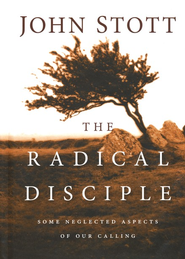
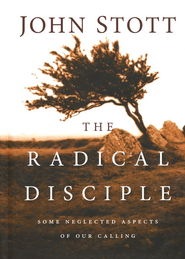 John Stott, The Radical Disciple: Some Neglected Aspects of Our Calling (Downers Grove, IL: InterVarsity, 2010), 144 pages, ISBN 9780830838479.
The name of John Stott is widely known in the evangelical world. He was one of the most respected leaders in Christianity. For many years he served as pastor of All Souls Church in London, England. The thing that made him well-known to the wider Christian world was his writing. Dr. Stott was certainly one of the most prolific evangelical writers prior to his death in July 2011. The Radical Disciple is his last published book.
This is one of Stott’s shorter books; however, while it is relatively short in length it is not short on substance. This book contains the words of a man who has thought much about what it means to be a Christian and what is important in the Christian life. In The Radical Disciple Stott addresses eight areas of discipleship that he feels are often neglected but need to be taken seriously (pg. 16). The topics that he covers are: nonconformity, Christlikeness, maturity, creation care, simplicity, balance, dependence, and death.
In chapter one, “Nonconformity,” Stott warns Christians about being like the world. Specifically, he addresses the challenges of pluralism, materialism, relativism, and narcissism. After telling us what we should not conform to the author tells us whom we should conform to: we are to be like Christ. In chapter two, “Christlikeness,” Stott tells us that we are to be like Jesus in His incarnation, service, love, patient endurance, and mission. In this chapter he also tells us that suffering helps us to be like Christ, that the effectiveness of our evangelism is related to how much like Christ we are, and that the ministry of the Holy Spirit is necessary in order for us to be like Christ. Chapter three, “Maturity,” deals with the need for the growth of the believer. Christians need to have some spiritual substance. One may be surprised to see chapter four, “Creation Care,” included in this book. While concern for the environment is not a subject we frequently hear in the church, it is a subject that the scriptures address. “Simplicity” is the subject of chapter five. In this chapter Stott reproduces a rather long document called “The Evangelical Commitment to Simple Lifestyle.” This document came out of The International Consultation on Simple Lifestyle and covers topics such as these: the church as the new community, the need for a simple personal lifestyle, international development, justice and politics, evangelism, and the Lord’s return. Chapter six is titled, “Balance” and here Stott looks at a number of images in Scripture that refer to believers: babies, living stones, holy priests, God’s own people, aliens and strangers, and servants. He tells us what can be learned from these images regarding the kind of people we are to be. Chapter seven is “Dependence” and in this chapter Stott tells us that dependence is the only appropriate attitude for the radical disciple (pg. 109). This is a very personal chapter in which the author shares a very difficult time in his own life. Chapter eight is “Death,” in this chapter Stott traces the themes of death and life as they relate to salvation, discipleship, mission, persecution, martyrdom, and mortality. In all of them, he says, death leads to life.
There are a number of things that impressed me about this book. First, was Stott’s assessment of the “Christian scene in the world today,” in chapter three (pg. 38). He described it as “growth without maturity” (pg. 38). Stott then cited other Christian leaders whose remarks supported his assessment of the situation. This lack of maturity manifests itself in doctrinal shallowness and aberrant behavior. Stott reminds us that the mission of the church is not just to make converts but rather to make disciples, who are mature in Christ.
The second thing that impressed me about this book was Stott’s vulnerability in chapter seven. In this chapter he recounts a fall that resulted in him receiving a hip replacement. He found himself helpless on the floor and dependent on others. The aftermath of the accident and his subsequent surgery took its toll on him. He experienced disorientation and hallucinations (pg. 103). He was also moved emotionally. His usual calm reserve gave way to times of weeping (pg. 103-104). I was impressed that a man of the spiritual stature of John Stott would publicly admit this. It is certainly nothing to be ashamed of but he did not have to volunteer this information. He did it to help teach us a lesson about dependence.
The last thing that I will say about this book is that John Stott knew that this one would be his last. The notes on the back cover describe it as “his farewell address to the worldwide church.” In chapter eight he states “the end is in sight” (pg. 128), and on page 130 he mentions “reflecting on death and seeking to prepare for it.” The postscript of the book is titled “Farewell.” Like Paul of old he knew that his pen would soon be stilled and so for one last time he writes to pass on some parting instructions to encourage and instruct succeeding generations of believers. The last line of the postscript is “Once again, farewell!” (pg. 137).
The apostle Paul wrote that God gave to the church apostles, prophets, evangelists, pastors and teachers (Eph. 4:11). John Stott was without question one of the teachers that the Lord gave to the body of Christ. Dr. Stott has gone to be with the Lord but he has left behind for us a rich legacy of biblical exposition. Read his final words in The Radical Disciple.
Reviewed by John P. Lathrop
Publisher’s page: www.ivpress.com/cgi-ivpress/book.pl/code=3847