Michael Brown’s Authentic Fire, reviewed by John King

Are Pentecostals offering Strange Fire? (Panel Discussion)
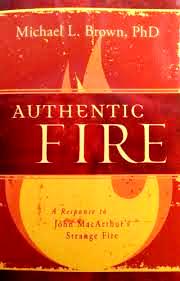
 Michael L. Brown, Authentic Fire: A Response to John MacArthur’s Strange Fire (Excel Publishers, Dec 12, 2013), 418 pages.
Dr. Michael Brown in his work Authentic Fire confronts the misinformation of Pastor John MacArthur’s outspoken zeal against all things charismatic in his book, Strange Fire. While Dr. Brown admits that on some points Dr. MacArthur is right on, his language is radically abusive in tone. And some of Pastor MacArthur’s comments are simply untrue. Brown carefully separates the message from the messenger in addressing charismatic abuse before proceeding to the good stuff: how to burn with authentic fire.
How successful Pentecostal movements have been at policing their own—or if they have just been policing their ammunition, cleaning up their own crime scene to mitigate the charges—is debated early. This is a must read section for persons like myself who miss the mourners bench and the witness from the unlearned that God is among us (1 Corinthians 14:16). Charismatic abuses are undeniable: the prosperity doctrine; slain in the ‘spirit’ but not healed; emotionalism without holiness; game-show hype and seeker-centric services instead of the message of the Cross; the superficial replacing the spiritual. Brown recognized that we are catering our gospel to carnality.
But as Brown shows, there is a true spirit of co-operation with God’s Spirit among a large segment of Pentecostal leadership to penitently admit the self-centric extremes visible in their midst and to confront it with biblical truth. Brown has been outspoken in past writings about what he called the “gospel” of self. Simply put: MacArthur has nothing constructive to add to the honest voices within Pentecost that call for repentance. MacArthur’s Strange Fire, which required a response in the writing of Authentic Fire, provides mere background static that drives Pentecostals to go on the defense—something Brown cautions against and wants to prevent from happening.
Brown says that some of MacArthur’s ranting is a false attack akin to what England’s ministerium did in 1874 when they labeled the powerful outcomes of Ira Sankey’s singing as human conceit and not worship. But emotion is not emotionalism. A move of God’s Spirit often elicits a heartfelt response which is smothered in the name of propriety or order by well-meaning but misguided church leadership—who are afraid to express the full depth of their Christian experience [Luke 6:23; 10:20;19:37]. If there was abuse, it was in requiring a charismatic outburst—and not simply allowing a passionate response to happen.
MacArthur is a cessationist maintaining that tongues and prophecy have ceased based on his interpretation of 1 Corinthians 13:8. MacArthur called a Pentecostal revival service “craziness” and an “emotional orgy.” No wonder Brown had to respond in a gentle spirit while encouraging charismatic believers who only want a closer reality of their Savior and to be under His administration. In Brown’s words: “I embraced it with tears of joy while others mocked it. And that’s the great concern I have today.”
Brown speaks of MacArthur’s judgment of a move of the Holy Spirit as a faulty exegesis of Scripture and a flawed pneumatology. Brown provides scriptural insight to support this assertion. It is also noteworthy that MacArthur has been looking at a small percentage of American ministries that are not at all representative of the global move of God’s Spirit.
Chapter three is Brown’s cloud of witnesses and includes a registry of well-known and well-accepted Spirit-filled believers who embraced Pentecost, including A.W. Tozer, Oswald Chambers, Gordon Fee, Craig Keener, Ben Witherington, N. T. Wright. Brown rebuts MacArthur’s claim that charismatic theology has made no contribution to true biblical interpretation or that Pentecostal preaching is a deviant mutation of truth. A.W. Tozer, as Brown notes, called the Baptism in the Spirit our true Christian heritage. Brown addresses a number of MacArthur’s concerns: Where is the Pentecostal outreach to the sick and poor? How have Pentecostals enriched true worship? Are there any Christlike Pentecostal leaders?
Chapter four deals with the historical roots of Pentecostalism and speaking in tongues as its peculiarity. MacArthur focuses on the acts of a few leaders in the Pentecostal movement to discredit anything charismatic. Brown calls this a genetic fallacy. MacArthur’s claim is that from the beginning the entire movement was misleading and inaccurate. Brown points out that the Pentecostal movement has a far greater and older history of holy living and evangelism, thus exposing MacArthur’s fallacy.
Brown also points out the fallacy of guilt by association. The fact that any of us may only be a few degrees from heresy doesn’t make us a heretic. Brown uses MacArthur’s dispensational eschatology—something which Pentecostals also believe—to show that MacArthur criticizes himself. R.C. Sproul, also a dispensationalist, was mentored by Dr. John Gerstner who called dispensationalism a heresy. Brown calls this a ridiculous mess.
Brown went on to point out that Martin Luther, the great reformation leader, called peasants dogs and pigs and claimed responsibility for killing 100,000 of them. He called Jews devils and called for setting their synagogues on fire. Does this association discredit the Lutheran faith today? In John Calvin’s Geneva, where he administered justice, children who called their mother a devil were put to death. Church attendance was obligatory under threat of fines and floggings. In no short time could any Roman Catholic be found living in Geneva. What does this say about Presbyterians or Baptists who consider themselves Calvinists? Brown contends that it should say nothing, no more than Martin Luther’s anti-Semitism reflects on today’s Lutheran church or for Protestants in general.
MacArthur uses, according to Brown, unequal weights and measures when he discredits charismatics but embraces Calvinism. The principle to put to memory is don’t compare the best things about your religion to the worse things of someone else’s.
MacArthur attempts to enlist Jonathan Edwards’ nine signs to distinguish the work of the Spirit from other causes, human and demonic. However, Brown maintains these are negative positives or merely signs to exclude what was not from God. Edwards was more concerned with what contradicts Scripture rather than calling on the Word to confirm what is—freedom within limits. Brown correctly observes that “the Bible does not give us the right to …judge…based on … physical responses.” The heart of the matter for MacArthur is that displays of Pentecostalism appear recklessly out of order. But Brown correctly points out that crying, weeping, shouting, and the like are not outside the move of the Spirit.
What about sin in Pentecostal circles? Brown draws attention to the Corinthian church as an example of what Edwards refers to as “irregularities … in conduct.” Even disgraceful behavior does not mean the Spirit isn’t there. One clergyman’s indiscretions cannot discredit an entire work of God. Judas Iscariot’s betrayal does not make Jesus’ mission less Spirit-led. Brown quotes Edwards in saying: “This is not any argument that the work in general is not of the Spirit.”
There are, however, five signs that positively indicate a move of the Spirit. Does the move exalt Jesus, lead to Truth, result in increase love for God, turn the recipient from Satan and sin, and produce a hunger for The Word of God? Brown debates these points with incontrovertible logic. Brown refers to: “mountains of data that flatly contradict [MacArthur’s] conclusions.”
Back in 1977, Brown became disillusioned by the sham he observed in healing services—fake healings— which led him to investigate cessationism. He had a serious problem, though, in trying to prove from God’s Word that charismatic gifts had discontinued with the completion of our Bible. He became convinced that cessationism was exegetically impossible. He would return to a belief in continuationism.
In 1980, there was an outpouring of the Spirit in Brown’s church in which congregants, unlearned in Pentecostal phenomena, began to experience a move of God’s Spirit among them. Some began speaking in tongues. Brown continued to question his theology. He relates this personal side of his investigations into Pentecostalism. He was working on his doctoral dissertation at the time and changed his topic of research from “Idioms in the Hebrew Bible” to “I am the LORD your Healer” (Editor’s note: Michael Brown’s dissertation was later published by Zondervan in 1995 as Israel’s Divine Healer).
Not because of any experience but because of his research into God’s message on healing, Brown turned once again back to Pentecost—more persuaded than ever—that regardless of personal observation or the testimony of others, divine healing is part of God’s work for His people according to His Word. Brown, then, proceeds to define charismatic phenomena—not in observational terms but—in Scriptural terms: Sola Scriptura. Brown referred to this as “bow[ing] to the testimony of the Word.”
Brown, at this point in writing Authentic Fire,was careful to check his guns at the door. Church history is strewn with the bodies of the saints killed by “saints.” At many times in church history, flaming rhetoric exploded into physical confrontation. In the name of Christ, Christians have killed each other with a zeal which is as inexplicable as it is not of God.
Chapter 6 cautions the reader against any brand of abuse against another believer. “We need each other,” says Brown. Even though Brown is talking about Baptists needing charismatics and Pentecostals needing the Reformed, Brown recognizes he needs MacArthur. Avoid calling any believer a false teacher. None of us are 100% correct in what we say or believe.
Seek to understand each other and major on the majors. Brown urges us to: “Let the exaltation of the Lord Jesus be our ultimate passion.” Yes, Brown broke out into sermon in the middle of a theological discourse, but it was profoundly necessary and timely. Brown reiterates that cessationism is a false and unbiblical teaching, but cessationists are not false teachers. Brown urges his senior brother, Pastor MacArthur, not to paint other believers with such a broad brush to see all charismatics as evil doers—condemning the good with the bad.
In the chapter: Spirit and Truth, Right Brain and Left Brain, Brown remarks: “I, for my part, am convinced that my cessationist friends have much to offer to us charismatics.” Brown sees a balance between prayer and Bible study, seeking and studying, the display of God’s empowerment and searching Scripture to stay grounded in the truth. He views this as a right brain-left brain unity—a Cessationist-charismatic symbiosis. Brown calls it a cross-pollination which accordingly should produce a spiritual approach that addresses “Baptist boredom” and “Charismatic chaos.” He proposes replacing fanaticism and formalism with dynamic service. He describes it as an effective union in the Lord.
Brown offers personal testimony to show that fellowship with God—essential for unity—is both relational and rational. Worship, as a characteristic of that relationship, to charismatics is not “superficial hysteria” as MacArthur maintains. MacArthur sees true worship as a “rich theology” preferring thought over sensation—limited to organ arrangements. Brown shares that worship may employ the use of an orchestra of harmonious sounds accompanying all solidly biblical forms of praise including: singing, dancing, jumping, and even shouting.
MacArthur sees loud music that is youth-centric as manipulative—getting them drunk on the sound rather than addressing life—a sensual experience disconnected from reality. Brown sees such music, if Spirit-led, as enhancing worship and making youth more receptive to truth and the sick more open to anticipating God’s healing touch. Brown proceeds to use a number of Scriptures and comments from well-known church leaders from the past in support of his position.
Going forward, Brown believes Strange Fire will backfire. As Pentecostals clean house and show an increased interest in evangelism and holiness, and as a true effusion of the Spirit leads charismatics more to repentance and a genuine passion for truth not just a ceremonial excitement, cessationists will approach less cautiously and less skeptically. Inevitably, the non-hostile cessationists and the non-crazy charismatics will connect. Brown believes it is already beginning.
If you see yourself as a picked-on Pentecostal, reading Authentic Fire should help you hold your head high. But not too high.
Reviewed by John H. King