Michael Yount: A. B. Simpson

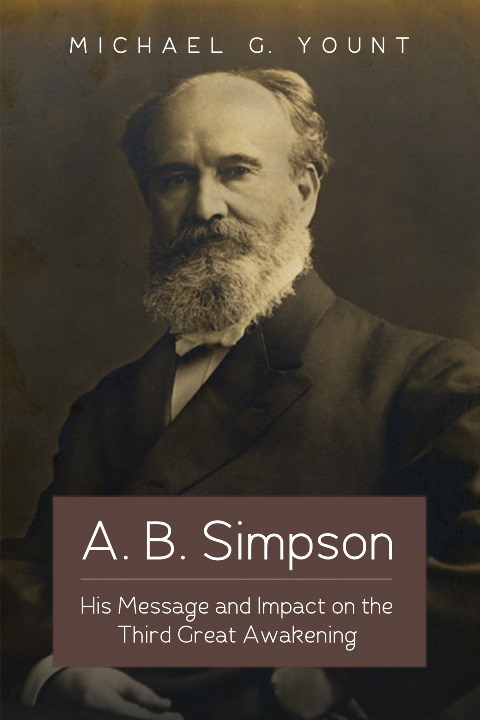
 Michael G. Yount, A. B. Simpson: His Message and Impact on the Third Great Awakening (Eugene, OR: Wipf and Stock, 2016), 232 pages, ISBN 9781498282802.
An appreciation for the role that A. B. Simpson (1843–1919), founder of The Christian and Missionary Alliance, played in the shaping of late nineteenth-century trans-Atlantic evangelicalism has been growing in recent years. While the impact that he had on the denomination that he founded is obvious, the impression that he left on early Pentecostalism seems now beyond academic dispute. Only more recently has Simpson’s contribution to a wider Evangelicalism been considered. Michael Yount’s A. B. Simpson: His Message and Impact on the Third Great Awakening will certainly contribute to that growing understanding and appreciation.
At the heart of Yount’s work is the assertion that Simpson played a significant role in shaping the Third Great Awakening, a movement of God that brought new life to the Church and emerged from, among other influences, the Layman’s Prayer Revival of 1857 and Phoebe Palmer’s Tuesday Meetings for the Promotion of Holiness. After providing a very helpful chapter that surveys the religious landscape that led to and marked this Awakening and after providing a chapter laying out an insightful biography of Simpson’s life, Yount moves on to describe those areas, both theological and practical, where Simpson’s contributions may be seen most clearly. These are 1) evangelism, 2) the Holiness Movement, 3) the Healing Movement, 4) the Premillennial Movement, and 5) Urban and Worldwide Evangelization. These, of course, align with Simpson’s “Fourfold Gospel” and his emphasis on mission. Each of these chapters is clearly laid out, starting with an examination of the theological and historical context of the topic at hand and then moving on to describe and analyze Simpson’s particular views and contribution in that field.
In spite of this book’s valuable, and perhaps even invaluable, contributions to an understanding of the contributions of A. B. Simpson to the shape of turn-of-the-century Evangelicalism, I would have liked to have seen Yount spend more time establishing the argument for the existence of an entity known as the “Third Great Awakening.” I am not convinced that it as readily recognized as a definable movement as this text assumes. While the various events that Yount identifies (e. g. the Laymen’s Revival, the Holiness Movement, and the missions movement) were highly significant, and while they certainly relate in some way to one another, it is less clear that they coalesce into a single movement. In addition, while each chapter clearly shows both that Simpson was a participant in each of these various movements and that he so ably stirred his followers to engage in them, not all chapters show equally or as ably Simpson’s actual contribution to each particular movement. For example, while no one would argue that Simpson was a dedicated evangelist, the chapter dedicated to that topic gives barely two pages to his efforts in this area. Furthermore, his “impact” on this particular movement is wholly absent. Finally, this book is in need of a good editing to address numerous typographical errors which, at times, lead to misinformation. These include the inaccurate dating of Simpson’s death, twice, with a different incorrect date given each time (p. xvii & 40.)
In spite of these relatively minor difficulties, there remains much to commend about this work. Those who read it carefully will come away both with a better understanding of the theology and practice of Albert Benjamin Simpson and, more important, with the possibility of a renewed vision for life and ministry.
Reviewed by Bernie Van De Walle
Publisher’s page: http://wipfandstock.com/a-b-simpson.html
Preview: https://books.google.com/books?id=xwJoDQAAQBAJ