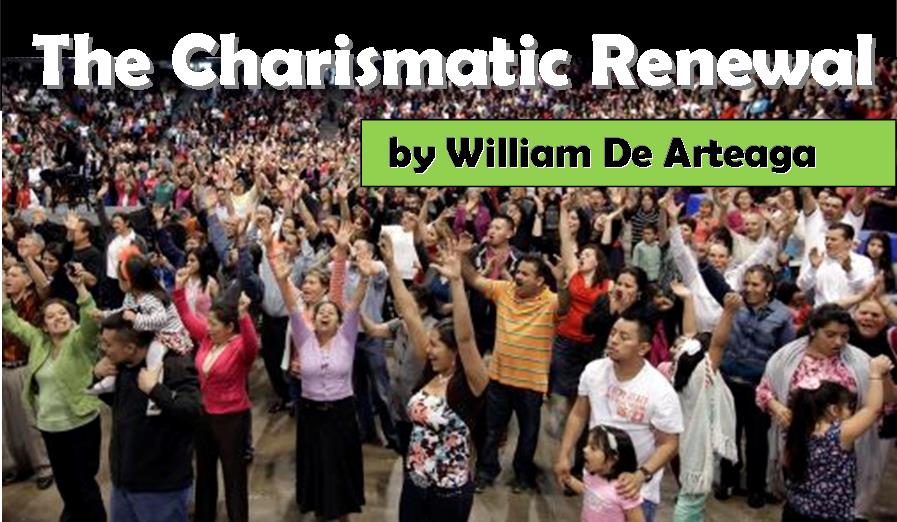
The Charismatic Renewal
Historian William De Arteaga introduces us to the beginning and early years of the Charismatic Movement, when Pentecostalism and the gifts of the Spirit publicly and dramatically entered into the mainline churches.
 Previous articles in this series covered the origins of Pentecostalism, and the Full Gospel Business Men’s Fellowship International. Both groups played important roles in bringing the gifts of the Spirit into the Church as normal events. This article traces the history of the Charismatic Movement, when Pentecostalism and the gifts of the Spirit publicly and dramatically entered into the mainline churches. Many Spirit-filled believers today—Pentecostal, charismatic, or non-denominational—have no memory of how the Charismatic Movement began,[1] but its history should not be forgotten.
The Coming of the Charismatic Renewal
By 1960, there were large numbers of mainline Christians in the United States who were “closet Pentecostals.” They received the Baptism of in the Spirit mostly from contact with such para-church groups as the Camps Furthest Out (CFO), the Full Gospel Business Men’s Fellowship International (FGBMFI), and Agnes Sanford’s Schools of Pastoral Care.[2] Others came into the fullness of the Spirit through direct prayer encounters with God, as in the case of Rufus Moseley[3]. Most had learned to be prudent in manifesting the gifts of the Spirit in their mainline churches lest they be thrown out, or ostracized as “weird.”
There was no specific name for that type of Spirit-filled believer – one who exercised the gifts of the Spirit but remained within a mainline congregation. Some of those who received the baptism of the Spirit during the 1930s to 1960 were ministers or pastors within the mainline churches, and this posed a special problem for them. They were often asked to resign their charges or leave their denominations if they persisted in their Pentecostal ways.
But some ministers were able to keep their positions in spite of their Pentecostalism. Among these was a Lutheran minister, Harald Bredesen, who had a long association the CFO. He had offered to resign his position after he received the Baptism of the Spirit, but his bishop refused to accept it. Then in 1957, the Rev Bredesen accepted the call as pastor of Mount Vernon Dutch Reformed Church in upper New York. That church soon became the focus of local charismatic activity and worship.[4] A handful of other pastors succeeded in openly operating as Spirit-filled ministers within their denominations, among these were Fr. Richard Winkler (Episcopal, in Wheaton, Illinois) and the Rev. James Brown (Presbyterian in Parkesburg, Pennsylvania). All of this was low key and unnoticed on a national level. After the renewal became public in 1960, these men came into leadership positions of the general movement. For example, the Rev. Bredesen had a special anointing as a publicist. He seemed to be at the right place and time, and know the important media people. He was quoted and cited many times in the national press and was often on TV.
From Closet Pentecostalism to the Mainline
The years of “closet Pentecostalism” came to an end when the Episcopal rector of a church in California decided to inform his congregation that he had received the gift of tongues. The subsequent chaos and publicity was providentially molded into what became identified as the start of the “Charismatic Renewal.”

The rector, Fr. Dennis Bennett, had begun his church ministry as a Congregational minister before becoming an Episcopal priest in 1950. He was well versed in theology and solidly orthodox in belief.[5] He was called to St. Mark’s in Van Nuys, California, where he presided over a growing and affluent congregation.
In 1959 several members of nearby Episcopal parish received the baptism of Holy Spirit from Pentecostal friends and were holding “tongues” prayer meetings. The vicar of the church, Fr. Frank Maguire, asked Fr. Bennett to investigate and give his opinion. Fr. Bennett went to see the couple who led the prayer group and was intrigued. After weeks of conversations with them, and of reviewing church doctrine of the Holy Spirit, re-reading the Book of Acts, as well checking the Book of Common Prayer, he concluded that the Baptism of in the Spirit and tongues were legitimate. By November of 1959 both he and Fr. Maguire received the Baptism of in the Holy Spirit. The prayer group expanded to include members of St. Mark’s.
Fr. Bennett attempted to keep everything low-key as the renewal continued to spread in his parish. But rumors and exaggerations also began to spread. To clarify the situation, Fr. Bennett felt it was important to go public, and he did so on Sunday, August 3, 1960.
I set aside the preaching scheduled for the day, and went into the pulpit at the three morning services and simply shared what had happened to me. I appealed to the people to dismiss the ridiculous rumors.
The general reaction was open and tender – until the end of the second service. At that point my second assistant snatched off his vestments, threw them on the altar and stalked out of the church, crying, “I can no longer work with this man!”
That blew the lid off. After the service concluded, outside on the patio, those who had set themselves to get rid of the movement of the Holy Spirit began to harangue the arriving and departing parishioners. One man stood on a chair shouting, “throw out the damn tongue-speakers!”
…The contrast was amazing. On the one hand was the unreasoning fury of the “opposition,” while the people who had received the Baptism of the Holy Spirit were quietly moving around telling their story, faces shining with the love of God.[6]
The treasurer and one of his vestrymen joined the opposition and asked Fr. Bennett to resign. Fr. Bennett announced his resignation at the third service. He did not have to resign, but felt he needed time to sort out his wonderful but revolutionary experiences of the past months. Immediately, the Bishop of Los Angeles wrote a letter to the parishioners of St. Mark’s forbidding them to speak in tongues in any parish function. Those involved in the charismatic prayers left St. Mark’s but continued in two home prayer cells not under church auspices.
One of the lay leaders, Mrs. Jean Stone, had excellent social and press connections and managed to get national press coverage of Fr. Bennett’s dramatic Sunday in both Newsweek and Time. The Newsweek article headlined “Rector and a Rumpus” (July 4, 1960). Both articles presented the appearance of Pentecostalism at St. Mark’s in surprisingly positive terms. The Time article began:
The early Christians were much impressed by the phenomenon known as glossolalia (literally, “speaking with tongues”), which appeared at the first Pentecost: “And they were all filled with the Holy Ghost, and began to speak with other tongues, as the Spirit gave them utterance.” To the skeptical, the “other tongues” sounded like gibberish, but the faithful found special meanings in the spontaneous outpouring of sounds.
Peter saw the “gift of tongues” in a group of Gentiles as evidence that the Holy Ghost was present and they should be baptized forthwith. Paul cited it as a notable Christian gift, and though he had it himself (“I thank my God, I speak with tongues more than ye all”), he warned in his first letter to the Corinthians against letting it get out of hand. The general practice lasted into the 3rd century. Now glossolalia seems to be on its way back in U.S. churches—not only in the uninhibited Pentecostal sects but even among Episcopalians, who have been called “God’s frozen people.”[7]
Shortly thereafter, Mrs. Stone organized the Blessed Trinity Society to promote the Pentecostal experience among Episcopalians. The society published various pamphlets on Holy Spirit baptism and Trinity Magazine, and mailed it to extensive list of Episcopalians all over the country. When Dennis Bennett’s witness of how he received the Baptism in the Holy Spirit appeared in Voice Magazine (The FGBMFI journal) the society mailed a copy of the magazine to every Episcopal priest in the country. For five years Trinity and Voice magazines were the only non-Pentecostal magazines that advocated practicing of the Gifts of the Spirit. The Blessed Trinity Society organized meetings and conferences on the Holy Spirit which attracted persons from many denominations. It disbanded in 1964 due to the scandal that ensued when Mrs. Stone divorced (how times have changed!) but not before the society did its providential work of publicizing that one can practice the Gifts of the Spirit and still live within a mainline church.
St. Luke’s of Seattle
After Fr. Bennett resigned from St. Mark’s, the Episcopal bishop of Olympia (Washington State) invited Fr. Bennett to take over a small parish in Seattle that was on the verge of closing, St. Luke’s. Bennett accepted the charge and in a year increased the membership from seventy-five to over three hundred. More importantly, St. Luke’s became the center of the new Pentecostalism for much of the West Coast. Visitors came to see what tongues were about, or to attend the conferences Fr. Bennett organized on the Gifts of the Sprit. Fr. Bennett also received invitations from all over the country, including many FGBMFI chapters and conventions, to share his testimony and experiences as an Episcopalian openly living the Spirit-filled life. At first, these new Pentecostals in the mainline churches, like Bennett, were called “neo-Pentecostals” – an accurate if clumsy name. “Charismatic” was suggested by the Rev. Harald Bredesen in Trinity Magazine and this word soon gained acceptance.

A factor for the wide success of the charismatic movement was Fr. Dennis Bennett himself. He was the Episcopal rector out of Hollywood central casting: handsome, dignified, theologically well educated, and a great speaker. He could explain how the Baptism of the Holy Spirit was not only good theology, but how it could help every congregation and denomination of the mainline churches.
Significantly, he also reassured his fellow Episcopalians that there was no conflict between being filled with the Spirit and the great liturgies of the church. In fact, one complimented the other. He related that one Sunday, when his assistant was celebrating the liturgy at St. Luke’s, he sat in the congregation with his family:
“As I listened to the familiar words of the Book of Common Prayer, and the readings of the Scripture lessons, I was suddenly overwhelmed by the beauty and significance of it. For the first time in my life, to my remembrance, I was moved to tears by a church service!”[8]
In 1973, Bennett and several others initiated Episcopal Renewal Ministries (ERM), an organization dedicated to spreading the charismatic renewal among Episcopal churches.[9] It did this through conferences, literature and through it journal, Acts 29. ERM met with a good degree of success, and by the 1980s over 500 Episcopal parishes were renewed—their clergy and member were predominantly charismatic.
Unfortunately, the number of renewed parishes was insufficient to turn around a denomination that numbered over 8,000 parishes and was becoming among the most theologically liberal and apostate of the mainline churches. This was mostly due to the fact that the ERM did not make major headway in altering the various Sadducean, anti-supernatural theologies that were rampant in Episcopal seminaries.[10]
By the mid 1960’s the example of the charismatic renewal in the Episcopal Church had helped rally the closet charismatics in other denominations to form alliances and organizations within their own denominations. Larry Christenson led the Lutherans, Tommy Tyson the Methodists, Harold Brown the Presbyterians. Even some Baptists, generally the most strongly cessationist of Protestants, began coming into the renewal.[11]
Surprised By the Spirit
The Pentecostals were genuinely surprised by the outpouring of the Spirit on the mainline churches. Pentecostal leaders had long written off these churches as hopelessly mired in liberal theology and apostasy. They considered them beyond the reach of God’s redemptive grace and renewal. That the renewal began among Episcopalians was especially shocking, as the Episcopal Church was notorious for its theologians who pioneered the trendy, Sadducean, and utterly faithless “death of God” theology of the times.[12] Further, the Episcopal Church, with its vestments, liturgy and strongly sacramental theology, was very close to the Roman Catholic Church – and any Pentecostal preacher would tell you, that church was the “whore of Babylon” and “Church of the anti-Christ.”[13]
There was another element of surprise, perhaps chagrin, among Pentecostals at the charismatic renewal. This dealt with the fact that the Pentecostal movement had originated and grown mostly among churches that were descended from, and subscribed to the old Holiness moral and dress codes. Good Pentecostals did not smoke, drink alcoholic beverages, go to movies, or do anything “worldly.” Pentecostal women wore no makeup and dressed with great modesty. They assumed their lifestyle was necessary for one to be a sincere Christian and to receive and maintain empowering presence of the Spirit.[14]
The Holiness code of how a Christian should behave, look like and dress was ignored by these new charismatics, especially the Episcopalians. They still liked their martinis or cup of wine, and worse, the Holy Spirit did not seem to mind! Their women wore lipstick and makeup, and wore fashionable dresses or pantsuits, yet they spoke in tongues and seemed to love the Lord! In other words, the Holiness behavior codes looked more and more like an unnecessary legalism. Pentecostals began to notice, especially their women and teens.[15]
Catholic Pentecostalism
For the Pentecostals another and bigger shock was yet to come. The Catholics started to get the Spirit too, and in huge numbers!
It began in 1967 among college students and their professors at two Catholic universities, Duquesne and Notre Dame.[16] Two lay Catholic theology instructors at Duquesne University, Ralf Keifer and Patrick Bourgeois, had read David Wilkerson’s The Cross and the Switchblade[17] and John Sherrill’s They Speak With Other Tongues,[18] two books which were best sellers at the time. Wanting to have the experiences of the Spirit described in these books, the two professors sought out a charismatic home group led by a Presbyterian laywoman and attended by others from a variety of Protestant churches. On the next meeting both received the Baptism of the Spirit. They began sharing their experience with their Catholic friends and students.
In February of 1967, Keifer and Bourgeois organized a prayer weekend for Catholic students at Duquesne, many of whom had also read The Cross and the Switchblade. They were determined to seek God’s will and meditate on first chapters of the book of Acts. By the time the weekend was over practically all of them had received the Baptism of the Siprit and had spoken in tongues. This group continued to meet, and visitors from Notre Dame came and were also baptized in the Holy Spirit.
A major milestone at Notre Dame happened on March 13th at the home of Ray Ballard. Ballard was the president of the South Bend chapter of the FGBMFI as well as a deacon of a local Assemblies of God church. He also hosted a mid-week pray meeting in the basement of his home. He was used to hosting persons from every Protestant denomination, but the telephone call asking permission for a group of Catholic students and faculty to visit was a bit intimidating. Ballard called several Pentecostal ministers to attend in order to answer any theological questions the Catholic visitors might have.
The Catholics who came included Kevin Ranaghan, a graduate student in theology, and six other students.[19] After a brief lesson on the Gifts of the Spirit by one of the Pentecostal ministers the Catholics asked for the Baptism of in the Spirit. They were encircled by the others and laid hands on for the Baptism. Within minutes, most were speaking in tongues, and all experienced a powerful impartation.

A retired Pentecostal missionary present asked the Catholics, “Now that you have received the Holy Spirit, when do you plan to leave the Catholic Church?” The astonished students insisted they would not leave their church. The missionary added, “Then you will lose the Gift of the Spirit.”[20] The missionary’s expectation was that this group of Catholics, like other Catholics he had seen before him, would leave the Catholic Church. Their affirmation to continue within the Catholic Church as Spirit-filled Catholics was the defining moment in launching the Catholic Charismatic Renewal.
This could not have happened a decade earlier. The Catholic council, Vatican II ended in 1965. It began by Pope John XXIII declaring he wished a new breath of freshness to come into the Church. The discussions and documents of Vatican II created an entirely new possibility of ecumenical exchange between Protestants and Catholics. The Catholic Church now called Protestants “separated brethren,” not heretics. Restrictions on Catholics attending Protestant services were eased. The documents of Vatican II, drafted by the Belgium’s Cardinal Suenens (later a major figure in the Catholic charismatic renewal) actually included several paragraphs urging the “charismas” be received by all Catholics. It also encouraged a stronger role of laity in Church life.[21] Thus, persons like Kevin Ranaghans and instructors Keifer and Bourgeois, who had followed the developments of the Council, understood what was happening to them and their students as within the new Catholic openness to the Holy Spirit.
During the weekend of April 7-9 of 1967, about one hundred students and faculty from Duquesne and Notre Dame met for a weekend of prayer and reflection on what had happened to them. All of this was reported favorable in two national Catholic journals, The National Catholic Reporter and Our Sunday Visitor. From then on, the Catholic Charismatic Renewal went on the “fast forward.” The Notre Dame campus became the center of yearly conferences of Catholic charismatics. The second yearly conference in March of 1968 attracted about 150 attendees. The third conference in 1969 brought 450, the forth 1,300, and the fifth in 1971 over 5,000. By then the movement had begun spreading to the Catholic Church in other countries. In 1976 the conference attracted 30,000 participants, and it was decided that this was unwieldy and henceforth the Catholics would attend regional conferences.
The Catholic charismatic renewal had two unique features. First is the absence of any form of anti-intellectualism or fundamentalism that characterized the original Pentecostal movement. The Catholic renewal was birthed amidst two Catholic universities and from the beginning attracted superb theologians and scholars to its ranks. Fr. Kilian McDonnell, who had from the early 1960s studied and dialogued with Protestants and Pentecostals, joined the ranks of the renewal early on. He served to present the case for an orthodox Catholic Pentecostalism to the American bishops, some of whom had some doubts about the movement.[22] Fr. Francis MacNutt, a Dominican priest who had received the baptism of the Spirit at a CFO, began writing about the gifts of healing.[23] Many others could be cited.
Another singular factor of the Catholic charismatics was that it was led by lay leadership that sprang out of Christian “covenant communities.” Two covenant communities in were particularly important for the beginning of the Catholic charismatic renewal: The People of Praise community at Notre Dame and Word of God at Ann Arbor Michigan.[24]
Covenant communities are an attempt to live out the picture given in the book of Acts of the Jewish/Christian community. In general, these communities developed as groups of families, often with attached singles, living in close proximity in order to better share as life of prayer, fellowship, accountability and the education of their children. The covenant communities gave the Catholic renewal a core of “shock troops” to organize, advertise and propagate the renewal with an effectiveness not seen before.
The advantages given to the lay leaders by these communities were not just spiritual encouragement and support, but practical things such as child care when a leader was called to a conference or ministry. The covenant communities supplied the leadership for the “Catholic Renewal Services,” which prepared conferences, including the huge national conferences at Notre Dame, recorded cassette tapes (the new medium of the times), booklets and position papers on the Charismatic renewal to be used by Catholic charismatics all over the nation – and the world. Out of these communities also came the staff of New Covenant magazine, the charismatic monthly for Catholics, and Servant Books, a major publishing house for books on the renewal.
A Publishing House for Charismatics: Logos International
For the first years of the renewal there was no national charismatic magazine other than Voice (FGBMFI) and Trinity (Episcopalism). This was remedied with the appearance of Logos Journal begun in 1971. It was published by a Christian businessman active in the FGBMFI, from Plainfield, New Jersey, Daniel Malachuk. Logos Journal carried articles from and about the whole spectrum of Spirit-filled authors and teachers including the “Word Faith” ministers such as Kenneth Hagin, but including more traditional Pentecostal leaders such as Kathryn Kuhlman.
 Even before, in 1966, Malachuk began the Logos International publishing house with the publication a book that was an expose of spiritualism written by an ex-medium, Raphael Gasson, The Challenging Counterfeit.[25] The book became a best seller. Malachuk’s next major success was the publication of Nicky Cruz’s book, Run, Baby Run, the exciting story of the conversion to the Spirit-led life of a gang leader in New York City.[26] That book sold eight million copies. Malachuck went full time into publishing and followed with a string of successful charismatic and Pentecostal works, including Fr. Dennis Bennett’s classic Nine O’clock in the Morning (1970).[27] Logos International books printed an incredible 45 million copies from 1966 to 1981.[28] In the mid-1970s it was publishing 50 titles of year from Pentecostal and charismatic authors.
Probably nothing else demonstrates the shift of spirituality away from other-worldly traditional Christianity, to the new this-worldly and Hebraic spirituality of the charismatic renewal than the books published by Logos International. Many of its authors incorporated the prosperity doctrine from E.W. Kenyon and Kenneth Hagin. The most salient example of this was the books by Harold Hill. Hill was a businessman and electrical engineer who had ruined his life with alcoholism until he cried out to God in desperation. He found himself led to AA meeting where he gave his life to Christ and began an amazing turnaround. His life became a Holy Spirit adventure of restoration and joy.
In his first and most influential book, How to Live Like a King’s Kid he described one incident after another in which amazing and miraculous outcomes result from calling on Jesus and the power of the Holy Ghost.[29] For example, a power company was having trouble debugging new equipment which was indispensable for its business. The manager called him and explained:
“We thought we could find the trouble. We had the technicians from General Electric and our own technicians working for two weeks, but we’re stumped. What are you going to do about it?’
Well, praise the Lord, I had a consultant, the best in the business, Jesus himself. …
I began to pray, and immediately while I was praying, I knew exactly what was wrong. I saw it as clearly as a picture on a TV screen. This was my first experience with diagnosing a serious and complicated electronic problem strictly by the Holy Spirit, and Satan said, “You crazy fool. You’re just imagining that. It’s too ridiculous.” But I was too dumb to doubt the Word of God.
I walked into the power station, directed entirely by the Holy Spirit. … And so I walked over to the spot that I had seen in the Spirit as being the trouble source and issued instructions to the technicians as to what to do to cure it….
One of them said, “Yes sir.” Although what I suggested seemed absurd, they had nothing else to try. So they did what I told them, pushed the button, threw the switches, and the thing took off like it was supposed to…”[30]
In Hill we see the optimism and an unbounded faith that the Holy Spirit will give the believer victorious answers to everyday, “earthy” problems. The Logos International also introduced the charismatic reader into the very this-worldly aspect of life in the body and marriage. Such works as Patricia Banta Kreml’s book, Slim for Him, with its concern for toned and attractive body, H. Page Williams, X-Rated Marriages, would not have been printed by a Christian press any century before the 20th.[31] Though the Puritans develop the first prosperity doctrine and had a high view of marriage, they were also reluctant to write about sexuality even within Christian marriage.[32]
The reality is that the Church as whole lacked a Biblically sound doctrine of sex and marriage – the product of its Hellenistic heritage. Christians claimed that only parental education was the proper venue for this matter – which were almost universally inadequate. All of which means that sexuality had no specifically Christian literature until the decades of the mid-20th Century – a horrible gap. Dan Malachuk‘s Logos International played an important role in ending this gap.
Logos International books covered the whole spectrum of Spirit-filled authors. Logos books included many titles from traditional Pentecostal authors such as Jack Hayford, Jimmy Swaggart and David Wilkerson. It published books by the new charismatic televangelists such Pat Robertson and Jim Bakker, and internationally known charismatics such as Dr. Paul Yonggi Cho of Korea. Logos also published books authored by CFO alumni such as, Harald Bredesen, Rufus Moseley, and especially Agnes Sanford. The Logos edition of The Healing Light (1972) was a key healing text of the early renewal. Logos also published most of Mrs. Sanford’s later works as well, such as her autobiography Sealed Orders, Twice Seven Words, and her prophetic classic, Creation Waits.[33]
Malachuk’s Logos International and his Logos Journal crashed into bankruptcy in 1981 in spite of excellent book sales. The problem stemmed from Malachuck’s unwise attempt to publish a weekly charismatic newspaper, the National Courier, for the Spirit-filled community. It was first class and very expensive, and, like most new ventures, lost money. Malachuk was soon transferring revenues that were rightfully authors’ royalties from Logos International to keep the newspaper going. Bankruptcy came in 1981 with dozens of Logos International writers losing much of their royalty earnings.[34]
By that time other Christian publishers were doing Pentecostal/charismatic writers regularly. Steve Strang picked up the mantle (and the readership) of Logos Journal with his magazine Charisma, which has remained the banner publication of American charismatics to this day. After bankruptcy, Logos eventually emerged under new management as “Bridge-Logos” and continued to publish charismatic titles, though at a much reduced rate.
With the Charismatic Renewal, and with such persons such as Dennis Bennett, Harald Bredesen and Francis MacNutt in leadership positions, it became difficult to consign tongues and the other gifts as delusions of the poor, fanatical and ignorant underclass. In an important sense, the Charismatic Renewal helped make Pentecostalism respectable to mainline Christians.[35] Partly because the Charismatic Renewal was a “middle class” Pentecostalism, and partly due also to the Charismatic Renewal’s separation from the classic Holiness/Pentecostal legalism, the growth of charismatic churches and influence during the 1970s was astounding.
Significantly, the doctrine that tongues was a necessary “initial evidence” for the Baptism of in the Spirit was challenged as many Christians began experiencing the Gifts of the Spirit during the Charismatic Renewal without tongues. They could turn to 1 Cor. 12: 7-11 which shows that Paul believed that individual believers experience some, but not all of the gifts of the Spirit. The focus of the Charismatic Renewal shifted from tongues to healing and worship as the main elements of Spirit-filled life. But at the end, the most important thing the Renewal accomplished was that it made Pentecostalism, and all the Gift of the Spirit respectable and an option for millions of Christians who would not directly go to a Pentecostal, “Holy Roller” church.
PR
Further study:
This recording, from about 1985, shows the Rev. Bennett explaining his unexpected entrance into the Spirit-filled life. http://www.charismamag.com/anniversary/greetings-from-friends-of-charisma/24021-watch-charismatic-movement-finds-episcopalian-priest-dennis-bennett
Notes
[1] There are now fine studies of the Charismatic movement from various perspectives, among the best are Peter Hocken’s, The Glory and the Shame: Reflections on the 20th Century Outpouring of the Holy Spirit (Gilford: Eagle, 1994) and the more recent work by Vinson Synan, An Eyewitness Remembers the Century of the Holy Spirit (Grand Rapids: Chosen, 2101). Both authors played significant roles in the renewal, with Dr. Synan being perhaps one of most important facilitators of the renewal. [Editor’s note: Read William De Arteaga’s 2001 review of Hocken’s The Glory and the Shame. Read John Miller’s review of Synan’s An Eyewitness Remembers the Century of the Holy Spirit.]
[2] I have given details of both the CFO and Agnes Sanford’s Schools of pastoral Care in my work, Agnes Sanford and Her Companions: The Assault on Cessationism and the Coming of the Charismatic Renewal (Eugene: Wipf & Stock, 2015) chapters 14 and 18.
[3] On the pivotal importance of Rufus Moseley, see my Agnes Sanford, chapter 14.
[4] See his autobiography, Harald Bredesen (“With Pat King”), Yes, Lord! (Plainfield: Logos International, 1972).
[5]Bennett’s account of the beginnings of the charismatic renewal in his church is a classic of charismatic literature: Nine O’clock in the Morning (Plainsfield: Bridge-Logos, 1970). For an excellent overview of the Charismatic Renewal in the Episcopal Church see: Dr. William Faupel, “Touched by the Wind: The Charismatic Movement in the Episcopal Church,” Pneuma Review, posted 8/20/2000.
[6] Bennett, Nine O’clock, 75
[7] Time, August 15, 1960.
[8]Bennett, Nine O’clock, 59
[9] Initially called “Episcopal Charismatic Fellowship’ it changed its name to Episcopal Renewal Ministries to avoid complications with the word “charismatic” had in the eyes of many of the more traditional Episcopalians. In 2001 it changed its name again to “Act 29 Ministries” as the Episcopal Church imploded in heresy and apostasy.
[10] On this see my work, Agnes Sanford, chapter 5, “From Cessationism to Secularism,” and chapter 23, “The Villains in the Story.”
[11]For instance, Dr. Howard Irvin, one of the earliest charismatic theologians, was a Northern Baptist pastor.
[12] On this theological atrocity, which I identify by its acronym, “DOG theology,” see my work, Agnes Sanford, chapter 5.
[13] This opinion is not entirely dissipated even to this day. The influential charismatic televangelist and pastor of Cornerstone Church in San Antonio (19,000 members), John Hagee subscribes to this opinion. He is more widely known for his irregular idea that Jews are still under the Old Testament covenant of God and do not need to acknowledge Jesus as Messiah to be saved.
[14]On the strictness of this Pentecostal-Holiness code of life see the brief description in Synan, Eyewitness, chapter 1, “A child of Azusa.” For a week in the mid-1980s Carolyn and I were on vacation in the North Georgia section of Appalachia, and one Sunday we worshiped at a classical Pentecostal/Holiness church. The woman pastor welcomed us warmly enough, but some of the elder woman made it a point to tell Carolyn that they were very strict and did not wear pantsuits or makeup. It really was a nice church in spite of the fact that the music was from the 1930s (significantly, there were no youths attending). We went back the next week with Carolyn wearing a dress and only a bit of rouge. At this church everyone in the congregation is invited to come to the microphone and sing “unto the Lord.” In this they were in obedience to 1 Cor. 14:26, although I did not recognize that, and thought it was a peculiar local custom. We were invited to sing, and had a great time belting out one of the new charismatic praise songs.
[15] It is my opinion that the annoying, “overdone” makeup and hairdos famous with Tammy Faye Bakker and Jan Crouch, the wives and co-hosts of the Christian TV pioneers, stems from their Holiness Pentecostal upbringing. Once they observed that being gifted and filled with the Spirit did not depend on their long hair being bundled on top or wearing flat heels, they went full tilt into “glamour.” But they lacked having the moderating effects of a mother or elder sister saying “Dearie, that color rouge is too much…”
[16] A good description of the beginnings is found in René Laurentin’s book, Catholic Pentecostalism (Garden City: Doubleday and Co., 1977), chapter 1, “The Birth of Catholic Pentecostalism.”
[17] David Wilkerson, The Cross and the Switchblade (New York: Pyramid Books, 1970). This book is about a small town Pentecostal pastor who obeys God’s prompting to go to New York City and minister to the youth gangs. It is one of those books, like Agnes Sanford’s The Healing Light (St. Paul: Macalaster Park, 1947) that has a special anointing to it. It has made an impact on many persons throughout the world. For its impact on the charismatic movement in Great Britain see: Peter Hocken’s Streams of Renewal, 148-149.
[18] John Sherrill, They Speak With Other Tongues, (Old Tappen: Fleming H. Revell, 1964).
[19] Keven Ranaghan and his wife Dorothy became perhaps the single most influential lay Catholic charismatics of the renewal. They have written numerous books on the renewal, including Kevin’s seminal The Catholic Pentecostals (New York: Paulist Press, 1969). I am proud to call them my friends, and we meet yearly at the Charismatic Leaders’ Fellowship.
[20] Edward D. O’Connor, The Pentecostal Movement in the Catholic Church (Notre Dame: Ave Maria Press, 1971), 47.
[21] For Cardinal Suenens’ understanding of how the Council prepared for the Catholic charismatic renewal, see Léon Joseph Suenens, A New Pentecost? (New York: Seabury Press, 1975, Translated by Francis Martin) 40-41.
[22] He was the principal author of an important early booklet, Theological and Pastoral Orientations on the Catholic Charismatic Renewal (Notre Dame: Word of Life, 1974). Perhaps his masterpiece is a work he coauthored with George Montague, Christian Initiation and the Baptism of the Holy Spirit: Evidence from the First Eight Centuries (Collegeville: The Liturgical Press, 1991).
[23] On MacNutt’s long term influence, and the importance of his Christian Healing Ministries on Jacksonville, Florida, see my work, Agnes Sanford, chapter 20 “Two Ministries Carry On.” The web page for the still very active CHM is found at: https://www.christianhealingmin.org/
[24] Website for the Word of God community at Ann Arbor is: http://www.thewordofgodcommunity.org/index.html, and for People of Praise: http://www.peopleofpraise.org/ Another important and influential covenant community is the Alleluia community in Augusta, Georgia, http://www.yeslord.com/
[25] Raphael Gasson, The Challenging Counterfeit, (Plainfield: Logos International, 1966).
[26] Nicky Cruz, Run, Baby Run (Plainfield: Logos International, 1968).
[27] Dennis Bennett, Nine O’clock in the Morning, (Plainfield: Logos International, 1970).
[28] To glimpse this huge output, now mostly resident in used book stores, go to www.abebooks.com and under advanced search choose “publisher” and type in “Logos International” My recent search brought up over 3000 entries – many of course repeated, but certainly hundreds of titles.
[29] Harold Hill, How to Live Like a King’s Kid (Plainfield: Logos International, 1974), 157-159. This work was a best seller, and Hill proceeded to churn out a whole bevy of books for both Logos International, and from 1980, with Fleming H. Revell, which had begun publishing charismatic books. Hill’s Logos works included: How to Live in High Victory (1977), How to Filp Your Flab – Forever (1979) and Instant Answers for King’s Kids in Training (1978). His Revell books included: How to Live the Bible Like a King’s Kid (1980), God’s in Charge Here (1982), Bible Answers for King’s Kids (1984), The Money book for King’s Kids (1984), The Impossible Takes a Little Longer (1985).
[30] Harold Hill, How to Live Like a King’s Kid (Plainfield: Logos International, 1974) 157-159. It should be noted that there is reason to think that some of Mr. Hill’s stories are exaggerations or even inventions. Hill, who at one point was a consultant for NASA, is famous for claiming that computers in NASA did an astronomical regression and authenticated the “long day” when the earth stood still in the Bible (Jos. 10:12-14). He never offered documentation for this incredible story and died in 1986 still vouching for it. NASA spokesmen denied the story.
[31]Patricia Banta Kreml, Slim for Him (Plainsfield: Logos International, 1976) H. Page Williams, X-Rated Marriages (Logos International, 1977)
[32] On the Puritan’s biblically based (non-exaggerated) prosperity doctrine, see my Quenching the Spirit (Lake Mary: Creation House, 1996).
[33] Agnes Twice Seven Words (Plainfield, NJ: Logos International, 1971). Note also, Sealed Orders (Plainfield, NJ: Logos International, 1972), Route 1 (Plainfield, NJ: Logos International, 1975), Creation Waits (Plainfield, NJ: Logos International, 1978).
[34] Jamie Buckingham, “End of an Era, Final Chapter of the Logos Era,” Charisma (Dec. 1981), 48-55.
[35] For example, Ted Olsen, “Why the Oral Roberts Obituaries are Wrong,” Christianity Today, posted 12/16/2009.