

Just Politics, Moral Deficit, Killing and Following Jesus: Amos Yong reviews four Ron Sider books




Ronald J. Sider, Just Politics: A Guide for Christian Engagement (Grand Rapids: Brazos Press, 2012), xvii + 249 pages, ISBN 9781587433269.
Ronald J. Sider, Fixing the Moral Deficit: A Balanced Way to Balance the Budget (Downers Grove: IVP Books, 2012), 171 pages, ISBN 9780830837953.
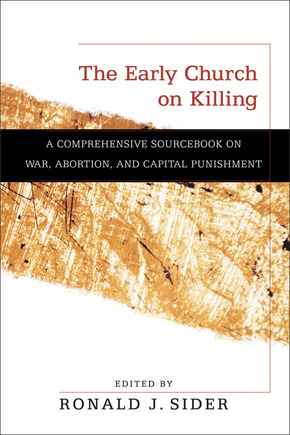
Ronald J. Sider, ed., The Early Church and Killing: A Comprehensive Sourcebook on War, Abortion, and Capital Punishment (Grand Rapids: Baker Academic, 2012), 216 pages, ISBN 9780801036309.
Paul Alexander and Al Tizon, eds., Following Jesus: Journeys in Radical Discipleship – Essays in Honor of Ronald J. Sider (Oxford: Regnum Books International, 2013), xiv + 235 pages, ISBN 9781908355270.
Some readers of this journal will think of Ron Sider, founder of Evangelicals for Social Action, as being on the left side of the Christian theological and political spectrum. Many others will recognize this longtime Distinguished Professor of Theology, Holistic Ministry and Public Policy at Palmer Theological Seminary – now related to Eastern University in Philadelphia, Pennsylvania – as being centrally evangelical in his commitments to biblical and Christ-centered engagements with the important social issues of the present age like poverty, war, and public policy. Over his career, he has published over thirty books and hundreds of scholarly and lay-accessible articles devoted to mobilizing evangelical believers, especially, to not only think but also live faithfully as Christ-followers in the public square.

Image: Danielbannoura / Wikimedia Commons
This review focuses on three of Sider’s most recent books (all from 2012), and a festschrift published in his honor. The three volumes are of different types but each one engages perennial Siderian themes. Just Politics is actually a second edition of The Scandal of Evangelical Politics published by Baker Books in 2008. It includes a new preface that comments critically on literature published too late to be considered in the first edition plus what has appeared between 2008-2011 at the intersection of evangelical studies and the political. The hallmarks of Sider’s approach are evident: extended reflections on the Bible in order to discern a faithful Christian understanding of the polis and, from this scriptural framework, proposals for evangelical engagements with the political. Part three presents an overarching evangelical political theology and philosophy addressing nine themes, topics, and issues (in nine chapters): the state, justice, human rights (including democracy and capitalism), the sanctity of human life, marriage and family, religious freedom in connection to the church-state relationship, peacemaking in relationship to just war and nonviolence, creation care, and nation-states and international affairs. Each chapter undertakes historical, political, and social analysis and includes recommendations for faithful evangelical political praxis with an eye towards shaping public policy in these domains.
Fixing the Moral Deficit can be read as a complementary sequel to Just Politics. The “moral deficit” refers to the combination of the “deficit crisis” (related to the federal budget), the “poverty crisis” (including the tremendous and growing gap between the rich and the poor in the USA), and the “justice crisis” (how the ever-deepening federal debt unjustly saddles future generations of Americans with the consequences of their ancestors’ spending). Three chapters of critical analysis and assessment – of the economic data, of scriptural principles related to the defined crises, and of recent economic proposals, both President Obama’s and GOP Congressman Pat Ryan’s for the 2011-2012 fiscal year – are a prelude to Sider’s “a better way” (the title of chapter 5), which major planks include the assisting and empowering of poor Americans through focused support of viable and successful programs, carefully considered proposals for taxation adjustments, strategic plans for saving social security and managing health care costs, and suggestions for the defense budget. In all cases, scriptural principles are brought to bear on the arguments and the various issues.
In the Sourcebook, Sider returns to his primary discipline as a Christian historian and historical theologian. Having earned his PhD from Yale University in the early 1970s (writing a thesis on the Reformation theologian Andreas von Karlstadt), here he takes up the question of violence by drawing together resources from the early Christian centuries. The focus on war, abortion, and capital punishment in the early church fills in the gaps between his many discussions of Christian pacifism, violence and nonviolence, and nuclear armament, among other related matters. While Sider’s Mennonite commitments are clear, this does not undermine the goal of producing a “comprehensive” collection of ancient Christian writings on these topics so readers will find selections about Christians also serving in the military especially in the third and fourth centuries and later. Yet by and large, Sider utilizes the data collected in these pages to at least interrogate, if not overturn, the arguments of others particularly about the Just War tradition extending back into the post-apostolic period. Beyond this, Sider documents the various reasons why early Christians were opposed to killing and military service.
Evangelical Christians seeking to understand the issues will come away well informed at every turn. Those who agree will have something to work for given the concrete suggestions presented urging civic and political responsibility. Sider argues normatively along each of these fronts – the political, the economic, and the question of violence – from the scriptural horizon rather than from any partisan platform, so his critics will at the very least have to proffer a reasoned and integrated biblical world- and life-view that is more convincing for evangelical Christian understanding and practice.

The preceding overview is indicative of why Ronald Sider is considered a “Christian giant” – from John DiIulio’s chapter in Following Jesus – in the realm of evangelical social and political theology. Journeys in Radical Discipleship gathers twenty-two colleagues and former students in honor of Sider’s wide-ranging and ground-breaking contributions in these arenas. Many of the essayists are themselves well-recognized scholars, including Vinay Samuel and Chris Sugden, Craig Keener, Samuel Escobar, John Perkins, Shane Claiborne, Glen Stassen, David Gushee, and others. The three parts of the festschrift organize the honoree’s evangelical commitments, holistic ministry initiatives, and public policy proposals. Many provide historical perspective and personal and anecdotal insight into Sider’s approaches, influence, and relationships. The book’s two co-editors, colleagues of Sider’s at Palmer Seminary, have done a great service, especially to those new to the Siderian corpus, since readers can begin here to appreciate why, although controversial from certain angles, Sider’s legacy will remain to substantively shape evangelical thought and action vis-à-vis the public domain well into the middle of the present century.
Reviewed by Amos Yong
Publisher’s page for Just Politics: http://bakerpublishinggroup.com/books/just-politics/340470
Publisher’s page for Fixing the Moral Deficit: http://www.ivpress.com/cgi-ivpress/book.pl/code=3795
Preview Fixing the Moral Deficit: http://books.google.com/books?id=LWGS_fWi80EC
Publisher’s page on The Early Church and Killing: http://bakerpublishinggroup.com/books/the-early-church-on-killing/288640
Preview The Early Church and Killing: http://books.google.com/books?id=HtjsH7pPaegC
Publisher’s page for Following Jesus: http://www.ocms.ac.uk/regnum/detail.php?book_id=108
USA distributor: https://wipfandstock.com/store/Following_Jesus_Journeys_in_Discipleship_Essays_in_Honor_of_Ronald_J_Sider