In the updated version of The Third Force in Missions: A Pentecostal Contribution to Contemporary Mission Theology (Hendrickson Publishers, 2016), Paul A. Pomerville offers an amplified reiteration of the major premises of his earlier work (Hendrickson, 1985), namely, that Pentecostalism is enacting a biblical reading which challenges theologies skewed by the claims of dispensationalism on mission theory and praxis, and that indigenous Christianity of the Southern Hemisphere offers viable examples of authentic engagement with the Bible. In fact, that engagement is unhampered by Western assumptions that threaten to contradict inherent Southern sensibilities regarding the existence of the spiritual realm. In regard to the vigor of the contemporary Pentecostal missions phenomenon, Pomerville offers that setting the movement apart as distinctive is in order. Not only does Pentecostalism don well its appellation as “The Third Force” of Christian expression after Roman Catholicism and Protestantism, Pomerville posits the justification of the term “first force” in twenty-first century missions as a possible descriptor pointing to the undisputed vigor of Southern missions today. That “force” manifests an impressive record of strides made within and emanating from that zone out to the world—much of which has been underreported. Its efficacy is also found in its potential to engage sensitively with the growing Islamic population. Pomerville sees the church of the South, rather than the church of the North, as the hope for Islam.
Paul A. Pomerville
In other words, what Pomerville does this second time around is to point to the undeniable vigor of the Pentecostal phenomenon in the Southern Hemisphere, and coming out of the South these past 30 years, where the movement is producing a contagious and enduring transcultural spirituality. Also, this time Pomerville reflects not just on the dangers of dispensational theology in terms of major blind spots counterproductive to sound hermeneutics (i.e., a hollow eschatology and an anemic ontology of the kingdom of God). As well, his concern targets the dangers to the ongoing mission of the Christian church that lay couched in an abiding silence on the role of the Holy Spirit and a suspicion of the concept of revelation as a dynamic activity.
Pentecostalism is undoubtedly at the forefront of the Christian global landscape.
Pomerville laments that Pentecostals have sought to accommodate incompatible elements of evangelicalism. One of the keys to correcting Western distortions is the realization that the Christ is the sign of triumph in ways that supersede the nationalism of Zionist dispensationalism, pointing rather to an eschatological fulfillment explicated in the faith and praxis of the disciples of the early church. Dispensationalist inclinations have made insidious inroads, impacting evangelicals and Pentecostals of the North, Pomerville offers, and the remedy is a robust Trinitarian use of missio Dei, an unapologetic appreciation for the agency of the Spirit in the New Testament church, and a biblical theology which can replace dispensational theology with an alternative that is moored to the “Christ-event” as the “mid-point” of the biblical meta-narrative. Herein is mission strategy also retrieved for honest engagement with all of the implications of Pentecostal life and expression; “theologizing” is freed from the ill-fitting yoke of scholasticism.
“Before Douglas Petersen, Allan Anderson, Veli-Matti Karkkainen, Andy Lord, Julie Ma, et. al., Paul Pomerville was charting the contours of a distinctively Pentecostal missiology. This revised edition of the The Third Force in Missions is not only prophetic with a three-decade hindsight in terms of the relevance of Pentecostal-charismatic Christianity for global mission in the third millennium, but it may even be understated in the sense that the other two ‘forces’ intimated in the title may well be riding on the coattails of their Spirit-filled and empowered upstarts. Whether the reader is coming again or is new to this book, Pomerville is a sure guide for the task of Christian mission theology in the present context.”
—Amos Yong, Professor of Theology & Mission, Fuller Theological Seminary
Pomerville’s text leaves us with at least one correction and a challenge. In answer to the issue of the gaps in the reporting on Pentecostalism in the South, he supplies data to reflect a truer portrayal in numbers of the movement’s actual scope today. Pentecostalism is undoubtedly at the forefront of the Christian global landscape. As well, Pomerville is sending out a fresh challenge to Pentecostal scholarship, and if I am gauging the terrain accurately, “the water has been stirred” and the academy is experiencing an upsurge of voices saying the same thing, that Pentecostal-Charismatic spirituality is poised for the presentation of articulate constructs which more adequately explain Pentecostal engagement with the Spirit, the Word, and the world.
Anna M. Droll, M. Div. (Fuller Theological Seminary), is ordained with the Assemblies of God and is a district-appointed missionary, having founded Kairos Global Missions in 2012 with her husband Raymond. Her ministry is focused in Africa where she also served as Communications Coordinator for Global Teen Challenge Africa. She is adjunct professor of Evangelism and Missions at Southeastern University and adjunct professor of Old Testament at Northwest University. She is finishing her PhD work with advisor, Amos Yong, exploring dreams and visions in African Pentecostal spirituality. A forthcoming publication will be articles to be presented in the Encyclopedia of Christianity in the Global South on Christianity in the West African countries of Togo and Benin. Facebook
James R. Edwards, “A Unity Not of Our Making” Christianity Today (Vol 45, No 10, August 6, 2001), pp. 48-50. “Unity in Diversity” has become one of the most popular ecumenical catchphrases. Especially among Pentecostal churches, the phrase seems to open up ways to engage in ecumenical dialogue without threatening the ecclesial independence or…
C. Peter Wagner, Churchquake!: How the New Apostolic Reformation Is Shaking Up the Church As We Know It (Ventura, CA: Regal Publishers), 274 pages, ISBN 9780830719181. I started reading Peter Wagner’s books soon after he began to be published, and I took his class on ‘Signs and Wonders’ at Fuller Seminary. I recall some…
Marty E. Stevens, Temples, Tithes, and Taxes: The Temple and the Economic Life of Ancient Israel (Peabody, MA: Hendrickson, 2006), 209 pages, ISBN 9781565639348. Marty Stevens’s Temples, Tithes, and Taxes is a wonderful book on a subject that can be really difficult. We all owe a tremendous debt to those who wade through the…
In 1987, on the 250th Anniversary of its founding, I visited New Herrnhut Moravian Church on the island of St. Thomas in the Virgin Islands. Visiting this mountain-side shrine and the jungle overhanging its cemetery impacted my life in a way I will carry to my grave. There are churches in the Western Hemisphere much…
In this review essay, missionary-scholar Jim Harries challenges Western assumptions used to decry the prosperity gospel as it is taught and believed in Africa. Hermen Kroesbergen, ed., In Search of Health and Wealth: The Prosperity Gospel in African, Reformed Perspective (Eugene, Oregon: Wipf and Stock, 2014). In reviewing a book about Africa written in English,…
Suggestions for Further Reading Although there are numerous scholarly papers that have been written on the subject of the church and postmodernism, here are some that readers have suggested. ♦ Stanley J. Grenz, “Beyond Foundationalism: Is a Nonfoundationalist Evangelical Theology Possible?” http://www.luthersem.edu/ctrf/Papers/1998_grenz.pdf [as of Oct 14, 2014] ♦ D. Lyle Dabney, “The…
To provide the best experiences, we use technologies like cookies to store and/or access device information. Consenting to these technologies will allow us to process data such as browsing behavior or unique IDs on this site. Not consenting or withdrawing consent, may adversely affect certain features and functions.
Functional
Always active
The technical storage or access is strictly necessary for the legitimate purpose of enabling the use of a specific service explicitly requested by the subscriber or user, or for the sole purpose of carrying out the transmission of a communication over an electronic communications network.
Preferences
The technical storage or access is necessary for the legitimate purpose of storing preferences that are not requested by the subscriber or user.
Statistics
The technical storage or access that is used exclusively for statistical purposes.The technical storage or access that is used exclusively for anonymous statistical purposes. Without a subpoena, voluntary compliance on the part of your Internet Service Provider, or additional records from a third party, information stored or retrieved for this purpose alone cannot usually be used to identify you.
Marketing
The technical storage or access is required to create user profiles to send advertising, or to track the user on a website or across several websites for similar marketing purposes.


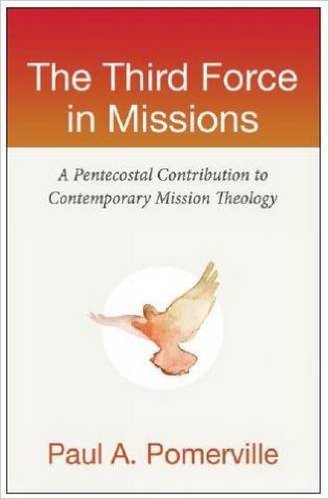 Paul A. Pomerville, The Third Force in Missions: A Pentecostal Contribution to Contemporary Mission Theology (Hendrickson Publishers, 2016), 276 pages, ISBN 9781619707689.