
Spreading from the Frontiers: Another Look at the Gospel in the Medieval Church

Wars without end, daily terror, displacement of entire populations: Can the medieval Church help us understand how to respond to our troubles today? What relationship should there be between the Church and political power? What should we make of how monks lived out their understanding of the good news of Jesus on the margins of society? How can we come to grips with how crusaders often acted nothing like Christ whom they claimed to be fighting for? Christian historian Woodrow Walton shows how the Gospel spread from the frontiers in this re-appraisal of the years A.D. 400-1452.

Image: The Books of Kells by way of Wikimedia Commons.
What transpired from the time of the Gothic and Vandal invasions of Eastern and Western Europe between A.D. 400 and 1452 is little different from what is occurring in our 21st century world. We complain about the threat of ISIS and the troubles of our global society, including the troubles of the United States of America. Yet those basic troubles are the same as what was experienced for a thousand years between A.D. 400 and 1452. Christians were as troubled then as we are today, but the Church survived then and it will survive this.
As the invasions forced Christians to flee from the Mediterranean world, which included all of North Africa and the Near East, into the frontiers of northern Europe, the British Isles, the Sahel belt, the northern mountains of Africa, and the further northeastern and eastern extremities of Eurasia, so are we witnessing the extension of the Church in southern and central Africa, South America, and the Far East by way of exiles. Orthodox Christians native to western and central Asia are coming into the United States of America and are welcomed in by such organizations as Solidarity with the Persecuted Church, BarnabasAid, and the Lutheran Immigration and Refugee Service. As renewal arose from the frontiers so are we finding renewal by displacements of populations.
The Church in those years, between A.D. 400 and 1452, went through a restructuring process with both positive and negative effects upon the life of the Church. One of the most puzzling features was the relationship between the Christian community and the political order. The Roman system of government in western Europe crumbled under the Gothic tribes, the Vandals, and Lombards but the Church had the structure to withstand the onslaughts. When the Arabs spread throughout northern Africa, the churches re-located themselves in the British Isles. There were two after-effects. Since the Church had the organization it re-read Augustine’s magnum opus, De Civitate Dei (The City of God), written at the time of the Vandal Invasions of Mauritius, Lybia, and the African coast and took a triumphalist approach where the Church had a hand in influencing the political order. The Church in the East suffering from the over-reaching powers of the emperors at Constantinople saw in Augustine’s City of God, a spiritual authority apart from the political order. There were positive results from both approaches but there were negative ones as one. The West institutionalized the Church alongside that of the new political orders which took the place of Rome. Even when the Reformation took place in the 1500’s, Church and State stood side by side insuring the safety of each. Not so in Greece, Eastern Europe, and Western Asia. The Orthodox had no central structure. In each country, the Orthodox conducted their concerns through conciliar means but within the context of patriarch who had a pastoral oversight within each individual country. Rather than a pope, the patriarchs had to contend with the new political entities as best they could. Those in the Near East, Western Asia, and the West Coast of India maintained their identities but had a dhimmi status and were considered as second-class citizens within the Moslem and Indian worlds.

Image: Wikimedia Commons
Two other re-appraisals are in order. The first of these is the Monastic movement which arose in the first half of the fourth century under Antony and Pachomius and came into its own in the fifth and sixth centuries. The other appraisal relates to the so-called Crusades. The Monastic movement has occasionally been criticized for moving away from the missionary imperative of the Church for a purer Christian life unspotted by the world’s temptations. Nothing could further from the truth as the monasteries became training grounds for the mission field. No one had a greater impact upon the outreach of the monasteries of the Western Church than John Cassian. The monasteries of Armagh in Ireland and Iona in Scotland trained those who re-evangelized Europe after the Gothic and Vandal invasions and the names of those evangelists are well-known, men as Patrick and Boniface and Augustine of Canterbury. Though the monasteries of the Orthodox Churches in the East were more of a contemplative nature, men as Basil the Great turned many of the monasteries into hospitals for the sick and infirmed, homes for the aged, and hostels for travelers. Both in the East and in the West, the monasteries also had their scriptorium in which the Bible was laboriously translated out of the Hebrew, Aramaic, and Greek into Latin and into the indigenous languages of eastern Europe and of Africa. It was the Latin language which made the Western Church catholic. The Church in the West encouraged a catholic language, that is a language that was universally spoken throughout western Europe. The Church in the East encouraged translating the Bible into the indigenous languages of the peoples of eastern Europe, Egypt, Ethiopia, and of Asia. The labor of the monks, East and West, brought the Word of God into the languages of the peoples.
By the time of the Crusades, the Arab themselves were on the defensive against the invading Seljuk Turks, and by 1070 the Seljuks already took over the Holy Land from the Fatimid caliph of Egypt. In A.D. 1095 Pope Urban II decided that it was time to end the Arab-Turkic Moslem dominance of the Middle-East and of the Holy Land in particular. The Council of Claremont gave their stamp of approval. In 1096 the enrollment of armies began all across western Europe to throw back the menace of the Moslems, be they Turks or Arabs. By 1098 both Edessa and Antioch had fallen to the crusaders. The following year Jerusalem fell under the Christian rule of Godfrey of Bouillon. Not all crusade leaders through the years acted like “Christians.” Several were barbaric in their actions but no more so than were the Moslems. Between 1099 and 1281, there were sparks of hope and many more sparks and flames of horrible actions. Several of the leaders of the crusading western armies were but nominal and “window-dressing” Christians in their actions which not only tarnished but soiled the Christian faith in the eyes of the conquered peoples and especially in the eyes of the Christians in the Balkan countries of Greece, Bulgaria, Serbia, Macedonia, when the fourth crusade decided to steer away from the Near East and attacked Constantinople, the capital of Orthodox Christianity. The action rocked the Christian world and drove a wedge between the Christian West and the Christian East because of the lust of the leaders to steal the wealth of the Byzantine capital. Constantinople was the wealthiest and most ornate capital city in all of Europe by virtue of its site as the entrepot of all the trade routes, maritime and overland which ended and began from there.
Lastly, the question is sometimes raised about the quality and vitality of the Christian faith during the medieval period extending from A.D. 400 to 1400. One of the interesting sidelights of the Visigothic and Ostrogothic takeover of Rome was that these Germanic peoples left the Christians pretty much alone and during their “rule” Cassiodorus and Lactanctius retained their Christian schools and libraries. Those who, like Patrick, went into Ireland about A.D. 390, not only evangelized the country but also initiated a long-term program which led to the creation of The Book of Kells, an illuminated presentation of the Four Gospels of the New Testament. Also living into the 400’s was Augustine, the Bishop of Hippo, who during the years of the Vandal invasions, completed his massive Civitate Dei which portrayed the Christian community as a transcendent reality far beyond the decaying Roman political reality, God’s colony in man’s world. In succeeding years his work was interpreted as concurrent with man’s political order or as a progressive interpretation of a coming order supplanting man’s. Augustine’s reputation far exceeds that of his magnum opus. His Confessions, De Trinitate, and other writings are read today. He is highly regarded by the scientific world today for his philosophy of time, eternity, and infinity.

Out of the Christian East, stands the figures of John Chrysostom, the preacher of Antioch, who went on to become prominent in Constantinople, and to challenge the emperors with his sermons. His eloquence earned him the sobriquet, Chrysostomas, “Golden Mouth.” In the 700’s stands the figure of John the Damascene, more often known as John of Damascus, whose The Orthodox Faith, defined the Christian faith of the Orthodox Churches to the very present. These were the giants of the defenders of the faith East and West. There were other eminent figures as John Climacus of the East, the Venerable Bede who wrote of the English people and the English Church. Soon after the crusades, stood the foremost figure of the entire Medieval period, Thomas Aquinas (1225-1274), whose Summa Theologica and Contra Gentiles stand as monumental works of Christian theology. Aquinas’ works were partially influenced by John of Damascus five centuries earlier but also with a partiality toward Aristotelian inductive logic. One cannot overlook such other figures of Gregory of Tours who recorded the conversions of the Franks and St. Francis of Assisi. Neither can one overlook the figures of Gregory the Great, whose Pastoral Rule is still read and who encouraged a later Augustine, better known as Augustine of Canterbury, who led a mission team into England proper. Two other significant individuals are Cyril and Methodius, the apostles to the Slavic people and who created the Cyrillic alphabet so that Slavic peoples could read the Bible. Another person not to miss is Dominic, the originator of the Dominican order. The list can go on and on.
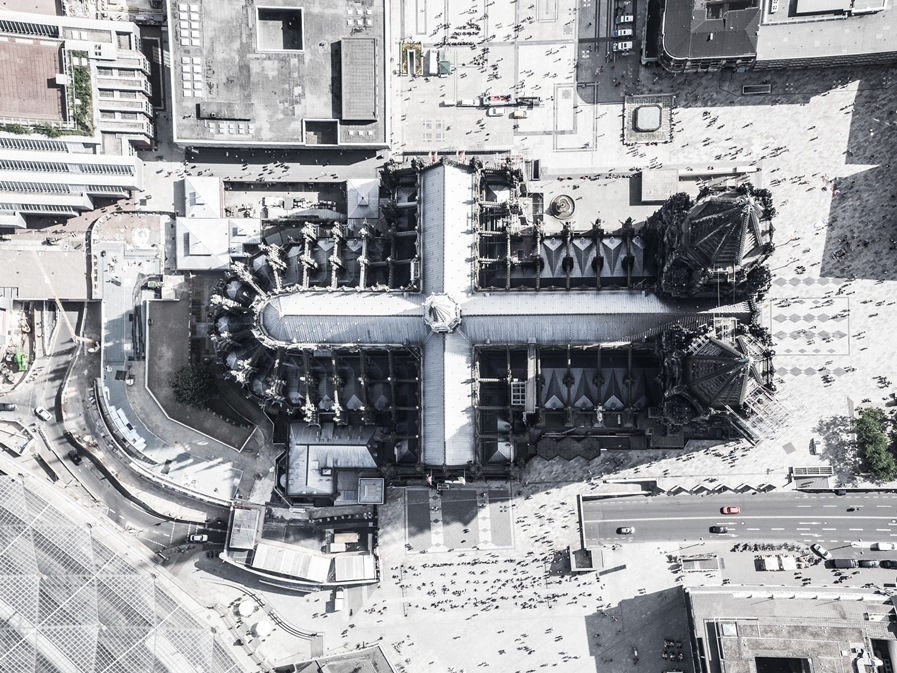
There are edifices worth noting which characterize in architecture the Medieval Christian world: the Gothic cathedral, the floor plan of which is that of the cross done by one long aisle, and the transepts forming the cross-beam, and which floor plan is obvious when the sun at its zenith shines down upon by highly placed windows. Eastern Christianity’s major edifice is that of The Church of Holy Wisdom, the dome of which portrays the resurrected Christ with his arms outstretched to embrace the universe, The Christos Pantokrator, the Christ Over All, before whom, all knees should bow.

The real character of Medieval Christianity is conundrum, a puzzle which appears unsolvable. It was indeed an era of conflicting character, a 2000 piece puzzle, amazingly complex yet vibrant. While it is true that the medieval Church was resilient to purification and renewal, it did survive intact into the time of the Renaissance and the Modern world when little else did. Understanding how the Church navigated the medieval millennium will help us see how to navigate ours.
PR
Read the other articles in The Gospel in History series.