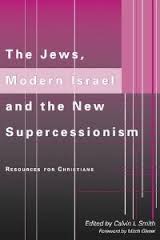
The Jews, Modern Israel and the New Supercessionism, reviewed by Kevin Williams

 Calvin L. Smith, ed., The Jews, Modern Israel and the New Supercessionism: Resources for Christians (King’s Divinity Press), 164 pages, ISBN 9780956200600.
Finally—a single book that treats Replacement Theology, Israel, and the Jewish people with respect, reason, and biblical integrity. Over many years working with Christians I have encountered too many who will ardently profess that they are not anti-Semitic, yet continue to hold to the premise that the universal Church supplants biblical Israel. Consider for a moment how that must make the average Jewish man or woman feel to be told that God is done with them, that their role in God’s plan has ceased, that the blessings in the Bible proclaimed for Israel have been transferred to the church, and you begin to realize how thoroughly anti-Semitic this theology is.
The Jews, Modern Israel and the New Supercessionism (American spelling: Supersessionism) takes a multi-faceted approach to Replacement Theology to help set the record straight. Editor Calvin L. Smith has collected works from a number of scholars, all of which were submitted for a weekend conference at the King’s Evangelical Divinity School in England. As Smith writes, “A series of papers were presented which, while academic in nature, were designed to be accessible to everyday Christians.”
That goal was achieved. In chapters such as “Who is the ‘Israel’ of Romans 11:26?,” “Apostolic Jewish-Christian Hermeneutics,” and “Israel and the Purposes of God”—to name a few—readers are given a well-rounded background in how Protestants derived their supersessionistic doctrines. These doctrines are then graciously dissected, discussed, and debunked.

There is a great deal of common sense as well. In Smith’s contributions in chapters two and seven: obvious, and not-so-obvious facts about the nation of Israel are brought to light, giving the reader new concepts to consider. He also handles “multiple fulfillments of prophecy” nicely, helping readers understand that prophecy does not have to be locked into an either this/or that dimension.
I was grateful for Andy Cheung’s chapter on “Who is the ‘Israel’ of Romans 11:26?” His examination of how Paul uses the word “Israel” to help us grasp the underpinnings of this epistle is well presented. I do, however, wish some time had been given in the book to verse 11:25 as well with a presentation on the implications of, “until the fullness of the Gentiles has come in.”
Jacob Prasch’s chapter on “Apostolic Jewish-Christian Hermeneutics and Supercessionism” is one of the finest arguments in favor of Jewish roots studies I have ever read. Prasch does an excellent job helping the reader grasp the depths of Scripture yet to be plumed by “gentilized” Christianity: to grasp and yearn for more.
Stephen Vantassel’s chapter, “A Calvinist Considers Israel’s Right to the Land” certainly captured my attention, by virtue of the title’s cognitive dissonance alone. No stranger to The Pneuma Review, Vantassel’s biblical approach to the hotbed of modern Israeli politics should convict every reader, regardless of whether they have a positive or negative view of the Knesset. As he writes, “we must be sure that our tone is moderated and our statements endeavor to assume the best of those of which we disagree.” (p. 82). On the whole, the book’s approach to the Jews and modern Israel is well balanced and informed. A must read for anyone navigating the labyrinth of the Israeli national, religious, and ethnic landscape.
Author Howard Taylor’s chapter on “Israel and the Purposes of God,” is punctuated with a very Jewish form of Gemara (literally “to study” in the Aramaic), a pattern well used by the Messiah and the apostle Paul: “if this is true, then how much more so this?” (ref: Matthew 7:11, 10:25, 12:12, Romans 5:9, 2 Corinthians 3:9, and others). For instance, “If one believes that Christ fulfills Israel’s destiny from Abraham to the end of time, then one will see Israel’s continuing history as ‘in Christ’…” (p. 95). At times Taylor’s if-this-then-that approach can feel confrontational, but once you understand the pattern, the pill goes down easier.
Paul Wilkinson’s “Jealous for Zion: Evangelicals, Zionism and the Restoration of Israel,” clearly demonstrates how Christian involvement in the 19th Century began paving the road toward a restored Jewish nation. In 21 short pages, readers are exposed to the history behind Israel’s rebirth as a nation, as well as the hope and prayer for her rebirth into the death and resurrection of her Messiah.
As the subtitle promises, this book contains Resources for Christians in convenient, bite-sized bits that both challenge and encourage. It presents materials for both academicians and laity alike in a well thought out format. I heartily endorse The Jews, Modern Israel and the New Supercessionism and hope that Calvin Smith will compile even more titles such as this. The body of Christ needs them.
Reviewed by Kevin M. Williams