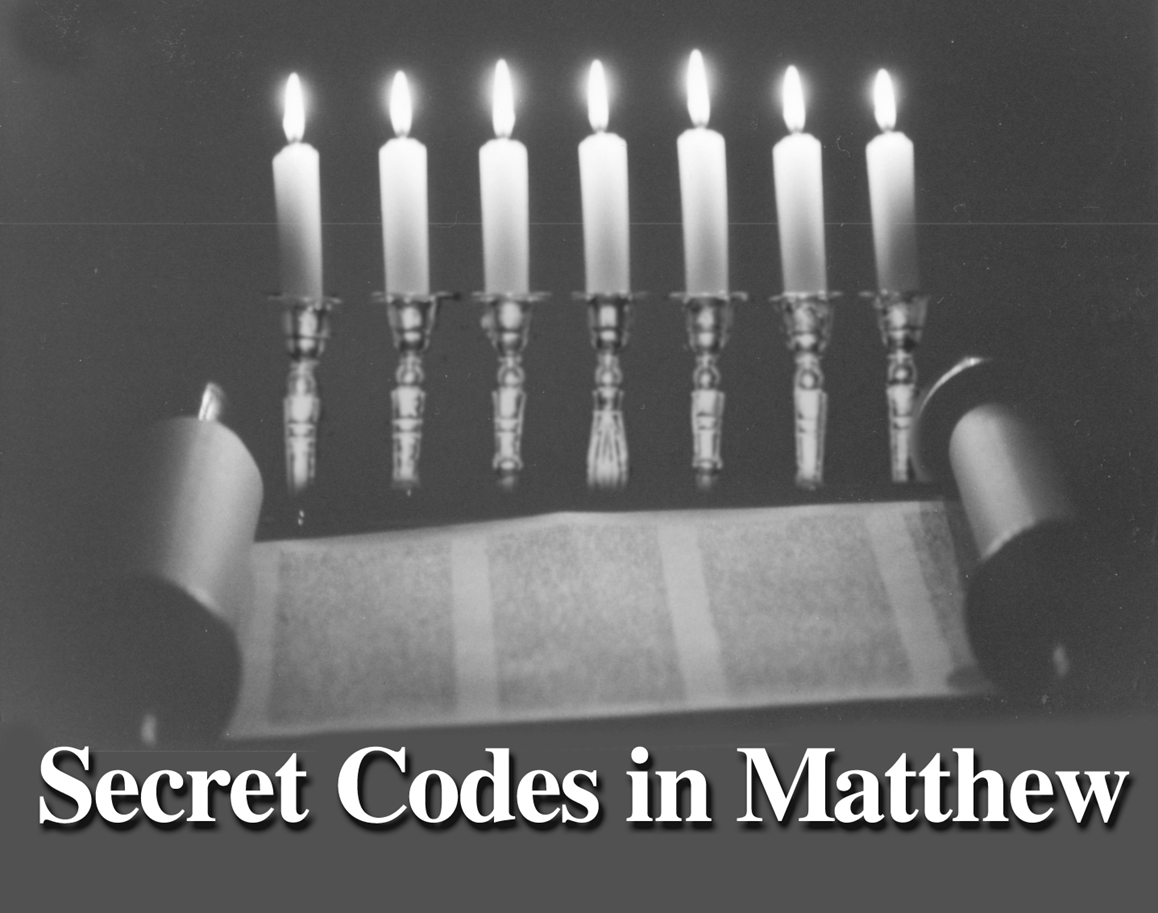
The Secret Codes in Matthew: Examining Israel’s Messiah, Part 6: Matthew 5:21-7:29, by Kevin M. Williams

From Pneuma Review Summer 2002
Part Five of the series examined Yeshua’s1 proclamation, “Do not think that I came to abolish the Law or the Prophets; I did not come to abolish, but to fulfill” (Matthew 5:17). We examined that this statement has, over the centuries, given many believers the impression that Yeshua did away with or annulled the Torah. Many have come to believe that its instructions and commandments are “inoperative” for today’s believer.
Christians have always been amazed and irritated by these words. Marcion, a theologian from the second century who rejected both the Old and a large portion of the New Testament as being too Jewish, was of the opinion that Jesus only could have said the opposite: that he had not come to fulfill the law but to annul it. Likewise, Rudolf Bultmann, one of the most influential exegetes of the twentieth century, thought that the statement could not possibly have been made by Jesus but that it had been ascribed to him by Judaizing Christians. Both of these theologians assumed that Jesus fundamentally rejected the Jewish law.2
Before we look into the ancient Hebrew perspective and potential understanding of Yeshua’s words and teachings—and join the “amazed and irritated”—it is important to keep one reality at the forefront. What you are about to read cannot at any time be separated from the crucial reality of God’s grace found through the shed blood of the Messiah. As we shall explore in the next issue of Pneuma Review, the form and function of some of the Torah began to take a new shape. The application of many of the biblical commandments—particularly in relationship to worship and sacrifice—took on a reality far beyond anything anyone in Israel had likely considered up to that age.
Lest anyone think that the following discourse discounts grace—far be it! If anything, Yeshua’s instructions throughout Matthew chapters 5-7 demonstrate quite clearly how totally depraved even the most conscientious and religiously observant human was or is, and how woefully insufficient works alone are.
___
In Part Five, we discovered that the phrase “I did not come to abolish but to fulfill” was a common euphemism used both in the first century and today in synagogues and yeshivas. A person who “abolished” the Torah was essentially teaching heresy.
“Annulling” a text from Scripture is also a rabbinic term, indicating that someone goes too far in interpreting a text and thereby actually decommissions it.3
On the other hand, a person who “fulfilled” the Torah had confirmed the Word in such a way that brought clarity and depth to its meaning. It blessed the assembly and helped them understand God’s Word in more relevant and applicable ways.
Yet another way of looking at this word “fulfill” is to find Old Testament parallels. The text Matthew uses is the Greek word pleroo (πλεροο, #4137 in the Strong’s). While it certainly can be translated as “fulfill,” it also means, “cause to abound, supply liberally, or bring to realization.”
But good exegesis demands that the Bible interpret itself. One apologist suggests that the Septuagint equivalent may have been the Hebrew word kum (םוק), meaning “to establish” or “confirm” based on its usage in both the Old Testament and the Mishnah. This same author writes, “If Yeshua used the word kum when He made His famous statement about ‘fulfilling’ the Torah and the Prophets, then He clearly meant that He came not to set the Torah aside but to establish the Torah, to confirm it, to see that it was carried out or obeyed the way God intended.”4
He is quick to point out that pleroo in the Greek Septuagint however, is not always translated not as kum, but as malei (אלמ). Malei is almost universally used as finishing something as far as it can be completed. If Yeshua was using the Hebrew parallel malei, rather than kum, new understanding may begin to take shape.
1 Kings 1:14 reads, “Behold, while you are still there speaking with the king, I will come in after you and confirm [malei] your words.” Jeremiah 44:25 reads similarly, “Thus says the Lord of hosts, the God of Israel, as follows: ‘As for you and your wives, you have spoken with your mouths and fulfilled [malei] it with your hands, saying, “We will certainly perform our vows that we have vowed, to burn sacrifices to the queen of heaven and pour out libations to her.” Go ahead and confirm [kum] your vows, and certainly perform your vows!’”
While on the one hand the word malei may mean complete as in “finish and be done with,” it is also used to “establish” or “confirm” a word or a vow. In this context, drawing parallels from the Greek pleroo to its potential Hebrew counterparts, kum or malei, we can equally and accurately derive the understanding, “to establish” or “confirm.”
As stated at the outset of this study, the book of Matthew is the good news written for a Jewish audience—proclaiming the reality of the Promised Jewish Messiah. This matter of Matthew’s intended audience is rarely, if ever, challenged in Christian circles. Therefore, if you can put yourself into the sandals of a Hebrew sitting near Yeshua 2,000 years ago, listening to Him speak, would you assume He was casting the Torah aside as annulled and completely finished? Or, would you think differently if you were a Jewish man or woman interested in spiritual matters? If you had been reared in the temple ritual, the synagogue, and the teaching of your local rabbi what would you think? Would you understand the Messiah to be “confirming” and “establishing” the Torah?
A gentile may easily read these words and come to understand that the Torah is “fulfilled” in such a way as to have become obsolete. But the text was written for Jewish readers in an entirely different historical, biblical, and cultural context that should just as easily lead the reader to believe that Yeshua was confirming the Torah and bringing it to its fullest revelation.
One must wonder how Marcion or Bultmann would have evaluated Yeshua’s view of Torah if they had known more about the world in which He lived. Between them, the Torah was either “too Jewish” or the phrase was attributed to Jesus by “Judaizing Christians.”
The Torah did not originate with “Jews” or from legalistically bent “Judaizing Christians.” The Torah was handed down to man by God Most High. If it has been warped in some way it was not a fault of the perfect Word of Yahweh but the insufficiency of mankind. Legalism came to be because of the flaws of man, not flaws in the Torah of God.
In most criticism of Torah, the Jewish people are the focus of attention. Of course, the Bible had not been given to any other society—so it stands to reason that the Israelites are the focus. But what about today? We have myriad Christian denominations and church splits because someone, somewhere, disagreed with how the Bible was being interpreted or applied. Do we therefore—with similar logic—accuse these denominations of using the Bible in too “Christian” a manner? Is it possible that over the centuries our attitudes toward the Jewish people have been hardened when in fact, we share culpability? What if the Bible used labels like “Baptists,” “Methodists,” “Reformed,” or “Assemblies of God” in its rebukes for mishandling the Word? Has the Church been too quick to judge the Jews? Can the Torah then be judged as being “too Jewish”?
Rather the Bible tells us, “we know that the Law is good, if one uses it properly” (1 Timothy 1:8, NIV). Paul goes on to tell our generation, “Scripture is inspired by God and profitable for teaching, for reproof, for correction, for training in righteousness; that the man of God may be adequate, equipped for every good work” (2 Timothy 3:16-17). It would be centuries before the New Testament would be compiled. The only Scripture Paul had—and could be referencing here—were the very books Yeshua refers to: the Law and the Prophets.
Day of Discovery Television host and author Jimmy DeYoung claims that one-third of the bible is prophetic.5 He feels this warrants a believer’s attention. One does not need to shop in a Christian bookstore long to find copious tomes devoted—at no small expense—to explaining Bible prophecy. Shelf after shelf has been set apart to illuminate this third of the Word.
In fact, you can easily find sections set aside for women’s issues, men’s issues, family living, leadership, and the fastest growing segment—fiction. Yet it is nearly impossible to find a grace-based examination of God’s Torah. Even though it was the national constitution of God’s community of the redeemed; is the foundation of what we say we believe; is God’s first revelation of Himself to mankind; and is referenced directly or quoted in approximately 40% of the New Testament text, there is very little examination of the Pentateuch that does not use a gentile “fulfilled” perspective as an interpretive filter.
Does Yeshua’s statement, “Do not think that I came to abolish the Law or the Prophets; I did not come to abolish, but to fulfill” (Matthew 5:17) require that a modern believer be divorced from the Old Testament form of community life?
Rather than belabor the point further, let us look at what the gospel of Matthew has to say. Did Yeshua annul the Torah as some allege? Or did he, as the Hebrews hoped Messiah would, explain the true spiritual depth underlying the commandments? We could volley opinions back and forth quite easily. Perhaps Yeshua’s own words can either prove or disprove the point.
___
“For I say to you, that unless your righteousness surpasses that of the scribes and Pharisees, you shall not enter the kingdom of heaven” (Matthew 5:20).
This is a heady statement! The scribes and Pharisees were well known for their meticulous attention to righteous living, for adhering to every minutia real and imagined. We find this true with each religious debate Yeshua has with them in the gospel accounts. They all relate to what are referred to as the “weightier points of Torah.” Elsewhere, Yeshua admonishes:
“The scribes and the Pharisees have seated themselves in the chair of Moses; therefore all that they tell you, do and observe” (Matthew 23:2-3).
How can these last two quotations be reconciled? How can obeying the Pharisees and scribes on the one hand keep us from turning out like them on the other? How can we be more “spiritual” than they were and enter the kingdom of heaven?
Again, the promised Messiah has the answers:
“You have heard that the ancients were told, ‘You shall not commit murder’ and ‘Whoever commits murder shall be liable to the court.’ But I say to you that everyone who is angry with his brother shall be guilty before the court; and whoever shall say to his brother, ‘Raca,’ shall be guilty before the supreme court; and whoever shall say, ‘You fool,’ shall be guilty enough to go into the fiery hell” (Matthew 5:21-22).
What is Yeshua teaching? The Torah! In what may be the most concise exegesis on Exodus 20:14 ever written, He says that the flesh can keep the Law while the heart breaks it. Does Yeshua annul the Torah? Hardly. In fulfilling it He makes the Torah more challenging!
Most people can refrain from murdering someone, but we are capable of calling people “raca” (empty headed fools) on a routine basis, whether speaking of the President of the United States, the boss, a teacher, a neighbor, or a family member—and we think nothing of committing this type of “spiritual murder.” Our righteousness does not “surpass that of the scribes and Pharisees,” only our arrogant self-righteousness.
“You have heard that it was said, ‘You shall not commit adultery;’ but I say to you, that everyone who looks on a woman to lust for her has committed adultery with her already in his heart” (Matthew 5:27-28).
Again, avoiding adultery is an achievable task. It is achieved by millions of men and women on a daily basis. But Yeshua lifts this Torah above the carnal and into the cranial. To even look on a woman with desire is to break God’s teaching—the Torah—and be found guilty.
Perhaps the first time we see this principle at play is in the Garden of Eden in Genesis 3:6: “When the woman saw that the tree was good for food, and that it was a delight to the eyes, and that the tree was desirable to make one wise, she took from its fruit and ate . . .” It was not eating of the fruit that got her into trouble—it was looking at it that started her on the slippery slope. To this point she had been able to avoid eating what was forbidden. It was only when she set her gaze upon it with desire that she began to rationalize her thoughts and feelings.
God proclaims “Now what I am commanding you today is not too difficult for you or beyond your reach … The word is very near you; it is in your mouth and in your heart” (Deuteronomy 30:11-14). In other words, if used properly, the spirit of the Torah is easy to “do.” It is not so easy however, to incorporate into one’s “being.” This is where we find the friction between Law and grace. This is the difference between having the Law written on the heart or having it written on stone. This is where we find the instruction of Yeshua.
And it was said, ‘Whoever sends away his wife, let him give her a certificate of divorce;’ but I say to you that everyone who divorces his wife, except for the cause of unchastity, makes her commit adultery; and whoever marries a divorced woman commits adultery (Matthew 5:31-32).
Once again, Yeshua does what the Messiah was supposed to do—“fulfill the Law.” By Hebraic application, he adds to our understanding of the words on the tablets of stone and applies them to the tablets of our hearts.
In first century Israel, there may have been up to 80 different sects in Judaism, including the lawyers and the zealots. There were the liberal Hellenists who cared little for the Torah. There were the scribes who had to memorize every “jot and tittle” of the script in order to transcribe it exactly onto parchment. There were the Pharisees of whom we read in the gospels, who were fastidious about things like ritual purity and Sabbath-keeping. Within their ranks was the School of Hillel and the School of Shammai, with Hillel6 considered the more lenient and Shammai the more conservative. And of course there were the Essenes from the community at Qumran. They were reportedly deeply opposed to divorce except in cases of infidelity.
The Essenes were considered even more strictly conservative than the Pharisees of the School of Shammai. They were deeply concerned over the weightier issues of the Torah. There is a movement afoot that attempts to link both John the Baptist and Yeshua to the Essene community. If this claim is true, then John and Yeshua would have been reared and trained amidst the strictest Torah keepers of the era.
Even if they were not Essenes, Yeshua—the Word made flesh—in all integrity would have remained faithful and true to that Word.
“Again, you have heard that the ancients were told, ‘You shall not make false vows, but shall fulfill your vows to the Lord.’ But I say to you, make no oath at all, either by heaven, for it is the throne of God, or by the earth, for it is the footstool of His feet, or by Jerusalem, for it is the City of the Great King. Nor shall you make an oath by your head, for you cannot make one hair white or black. “But let your statement be, ‘Yes, yes’ or ‘No, no’; and anything beyond these is of evil” (Matthew 5:33-37).
In other words, keeping an oath or a vow is easier than letting your yes be yes and your no be no. Yeshua says that anything else is evil.
In a modern setting, if you look at your driver’s license (assuming you have one), it bears your likeness, your signature, your address, your unique and identifying number. It may even reveal your weight, eye and hair color. A simple thing really. You pass the test, pay your money, and get a license.
What if it is not merely a license, but a covenant? You made a promise to follow the laws of the road. There is a contract with your signature on it on file somewhere and you were rewarded with a “license” demonstrating your trustworthiness. You said “yes” but when you are on the road do you live “yes?” Yeshua says that anything less is “evil.” Does that mean that if you speed, or slide through that stop sign, race through a red light, or refrain from using your turn signal, you are participating in “evil?”
And so it goes on through chapter five. The Torah proclaims truths and Yeshua does anything but annul them. He does what was expected of the Messiah—He explains the heart of God’s will and the heart of God’s instructions—the Torah. Who can keep the spirit of Yeshua’s Law perfectly—let alone the Torah of Moses? His enlightenment makes it so obvious that even the most diligent and pious Israelite (or Christian) still needs a savior.
Does Yeshua’s revelation about the Torah in some way negate grace? In no way! It may make passages like John 1:17 more understandable and impressive, “The Law was given through Moses; grace and truth were realized through Jesus Christ.” The Torah under the Mosaic system was a list of do’s and don’ts—a revelation of sin and a path toward atonement—but it never promised eternal life. It was always supposed to draw people closer to God, understanding that it is only by His grace that they had any relationship with Him to begin with. They were chosen, freed from bondage, brought through the sea, and formed God’s first foreshadowing of the community of the redeemed well before reaching Mount Sinai and the giving of the Torah.
Through the Messiah, however, through His unprecedented teaching on the Torah and its application to our lives, we realize how pitifully we fall short of righteousness. Through Yeshua’s death and resurrection we realize more fully “grace and truth.”
This seems to be in accord with Paul’s statements: “And the Law came in that the transgression might increase; but where sin increased, grace abounded all the more” (Romans 5:12). After Yeshua’s teaching on Torah, listeners with a healthy conscience may have realized that even though they might keep the letter of the Law, they were still guilty of breaking its spirit, hence as Paul says, “transgression increased.” Because transgression increased, through Yeshua, “grace abounded all the more.”
This also seems compliant with Paul’s teaching, “You have been severed from Christ, you who are seeking to be justified by law; you have fallen from grace” (Galatians 5:4). Anyone seeking justification through acts of the Torah or the traditions of man fail to understand what Yeshua was teaching in Matthew 5, 6, and 7. Torah, the Bible, is less about what we do and far more about what we are.
An interesting exercise might be to examine what a traditional, Orthodox Jewish rabbi might have to say about the fifth chapter of Matthew. Fortunately, we have such a rabbi upon which to draw. Jacob Neusner is a rabbi of distinguished acclaim with over 500 books on Judaism bearing his name. He is one of a handful of rabbis within Orthodox Judaism permitted to read the New Testament. His goal is not to accept or refute the messianic claims of Yeshua, but to use the New Testament as a tool to understand Judaism in the 1st and 2nd Centuries. Here are just a few examples of how this modern sage—a man outside the Christian faith—reads and understands Yeshua’s words:
Here is where he tells people how things are, what they should do, how God wants us to live. And Jesus’ torah is substantial and, by his own word, controversial too. So he invites arguments and opens the way to contention, as every teacher does who wants to change people’s minds—not to say, their lives too.
When we first hear from Jesus, rather than merely about him, he is telling people about God’s kingdom. This is for me a homely concern, one that the Torah has made mine too. When I accept the yoke of commandments of the Torah and do them, I accept God’s rule. I live in the kingdom of God, which is to say, in the dominion of Heaven, here on earth. That is what it means to live a holy life: to live by the will of God in the here and now.
By way of assurance, I hear, “Think not that I have come to abolish the Torah and the prophets; I have come not to abolish them but to fulfill them.” And what this must mean is that if there is rejection or persecution it is not because anything I hear from him conflicts with what I hear from Sinai.
It is right and proper, therefore, for this sage both to receive but also to hand on meaning, to take over the heritage of Sinai, and also to hand over to the next generation something that this sage has added to the heritage of Sinai.
We have to distinguish the substance of what Jesus is saying from the form that he gives to his statements. The message justifies my confidence but, of course, leaves me more puzzled than ever about what can be controversial in what are wise and deep readings of Torah-statements: a torah—the teaching of a master—that finds a comfortable place in the Torah—the revelation of God to Moses and Mount Sinai, a revelation that makes a place for the teaching of acknowledged sages through all of time. For what Jesus accomplishes in these saying is to point at the center and heart of the Torah’s message.7
One of contemporary Judaism’s most prolific and respected teachers does not realize any conflict with what Yeshua taught about the Law and what his own faith professes.8 For him, there is no conflict. For him, he brings the Torah to fulfillment in a Hebraic context.
Yet many Christians today feel the Torah’s instructions are incompatible with a faith in Yeshua. If Rabbi Neusner is any example, the promised Messiah of Israel still speaks to the heart of Hebrews!
___
Chapter Six
Of the available English translations, the King James Version seems to get closer to the literal Greek as we enter chapter six.
“Take heed that ye do not your alms before men, to be seen of them: otherwise ye have no reward of your Father which is in heaven” (Matthew 6:1).
This reads slightly differently in the NASB, “Beware of practicing your righteousness before men.” The NIV renders this verse “Be careful not to do your acts of righteousness before men.”
Here, the Greek for “righteousness” is eleemosune, literally “alms.” By translating this word here as “righteousness,” the NASB and NIV translators/interpreters seem to have captured some of the Jewishness of this verse. This same word, eleemosune, is translated “alms” in verses 2, 3, and 4. Only in verse 1 have they chosen to translate it as “righteousness.” The Hebrew equivalent for eleemosune is tzedaka, which means both “charity” and “righteousness.” In the synagogues, giving alms is considered a righteous deed.
With that said however, any liberty they have taken with the literal Greek would appear to be consistent with the intent of Yeshua’s teaching. Already we have seen in chapter five that Yeshua was not anti-Torah, but rather was very concerned with its deeper spiritual principles. It was not merely keeping them in the physical realm that mattered, it was the intent of the heart that touched God Almighty.
This same theme carries through in chapter six. Anyone can give alms (vv. 1-4). Anyone can pray (vv. 5-8), and anyone can fast (vv. 16-18). One might even say, “Look at the Muslims, Hindus, or Buddhists—they give alms, they pray, and they fast. What makes their deeds any different from your own?”
We live in a world run amok with slogans and campaigns. Have they leaked into our ministries? My mailbox would say yes. Every week I am bombarded with letters talking about all the great things being done for the poor (and asking for money). There is a barrage of newsletters about prayer, to pray and to be prayed for (and asking for money). I get email and posted mail encouraging me to join others in fasting (and asking for money).
Are these men, women, and organizations doing good works? Without question. I imagine that was true in Matthew chapter six as well. But the fanfare trumpets (6:2) and street corners (6:5) have been replaced with television, slick four-color brochures, and interactive web sites. In every age and every season we need to examine our true motives and actions and ask ourselves, “Are we working from the flesh or from the heart?”
___
In Matthew 6:9-13 we have what has come to be known as “The Lord’s Prayer.” It is rich in Hebraic liturgical form. In fact, John Lightfoot’s A Commentary on the New Testament from the Talmud and Hebraica gives a lengthy verse by verse comparison between the lines of the Lord’s Prayer and traditional Jewish liturgy of the period. Does this mean that Yeshua’s exemplary prayer was not original material? Does it inculcate Yeshua as stealing his liturgy from Pharisees? Does this dilute the teaching of our Messiah?
Heaven forbid! Yeshua is applying a very rabbinic form of teaching—taking numerous Scriptural principles and contracting and condensing them into brief summary statements. The fact that Yeshua utilizes a contemporary form of teaching does not detract or dilute Yeshua’s prayer. Rather, it reinforces his own role as a rabbi—a teacher—communicating effectively with his audience. Further, it strengthens the premise of this whole series, that the gospel of Matthew was written for a Jewish audience proclaiming the Messiahship of Yeshua.
“Pray, then, in this way: ‘Our Father who art in heaven, Hallowed be Thy name. Thy kingdom come. Thy will be done, On earth as it is in heaven. Give us this day our daily bread. And forgive us our debts, as we also have forgiven our debtors. And do not lead us into temptation, but deliver us from evil’” (Matthew 6:9-13).
“Our Father” is Aveinu in the Hebrew liturgy. One such prayer among many in the synagogues is known as Aveinu Malcheinu—our Father and our King—and is recited every morning.
“Hallowed be Thy name,” was taken seriously by the Hebrew people. The “Name” was so hallowed that no one but the High Priest could utter it, and then only on Yom Kippur—the Day of Atonement.
“Thy will be done, on earth as it is in heaven” is the very point of Rabbi Neusner above. Everything Yeshua has taught to this point is about establishing God’s will in the hearts of mankind.
“Give us this day our daily bread,” is a part of the grace said in Jewish households after the evening meal. They pray for God’s blessing upon all flesh for food and sustenance—Jewish and Gentile (yes, the Jewish people give thanks on your behalf)—and thank Him for his profound goodness.
“Forgive us our debts, as we also have forgiven our debtors.” This is a petition that is discussed latter in chapter seven, that as we measure others, we are also measured. Holding a grudge after the offender has repented and asked forgiveness, perhaps even made recompense, is not biblical. According to Yeshua, if someone has petitioned for forgiveness, we do not have an option to extend it, but an obligation.
“And do not lead us into temptation, but deliver us from evil” Literally, to keep us from “bad things happening,” but it can also mean the “Evil One,” or the “Adversary.” Compare this with words of another ancient rabbi:
The Talmud (Kiddushin 81a) reports that “Whenever Rabbi Chiyya ben-Abba fell on his face [in prayer] he used to say, ‘May the Merciful one save us from the Tempter.’”9
The customary end of the prayer among Protestants is, “For thine is the kingdom, and the power, and the glory, for ever. Amen.” This follows the Temple liturgical style. Notice how closely it mirrors 1 Chronicles 29:11, “Thine, O Lord, is the greatness, and the power, and the glory, and the victory, and the majesty: for all that is in the heaven and in the earth is thine; thine is the kingdom, O Lord, and Thou art exalted as head above all.”
Before leaving the Lord’s Prayer, it should be noted that the rest of chapter six is about individual behavior and private attitudes regarding alms, prayer, fasting, and possessions. Yet this lauded prayer is communal, “Our Father … give us … forgive us … do not lead us into temptation … deliver us.” In Hebrew society, guilt and forgiveness are bestowed upon the whole. Yes, it takes the efforts of individuals, but their labors make contributions to the entire entity. The whole is only as good as the sum of its parts and God’s kingdom is made up of many citizens serving One King.
___
Chapter Seven
Chapter seven continues examining individual attitudes working within the community and beyond. Here Messiah is expounding on what the Torah says about how believers are to relate to the rest of the world.
“Therefore, however you want people to treat you, so treat them, for this is the Law and the Prophets” (Matthew 7:12).
This concept within Jewish theology pre-dates Yeshua’s incarnation.
The Golden Rule can be found in Jewish writings as early as the Apocryphal book of Tobit (third century BCE), “What you hate, do to no one” (Tobit 4:15) … Rabbi Hillel expressed it in the generation before Yeshua; a famous passage in the Talmud comparing Hillel with his contemporary, Shammai, tells the story:
“A pagan came before Shammai and said to him, ‘Make me a proselyte, but on condition that you teach me the entire Torah while I am standing on one foot!’ Shammai drove him off with the builder’s measuring rod which he had in his hand. When he appeared before Hillel, the latter told him, ‘What is hateful to you, do not do to your neighbor. That is the whole Torah. The rest is commentary. Go and learn it!’” (Shabbat 31a).10
Again, this does not detract from the weight of Yeshua’s words—even though it means the Messiah is in agreement on this point with one of Judaism’s most influential Pharisees. Rather, He is again seen being a Jewish rabbi, teaching as the rabbis taught—effectively communicating with his Jewish audience. He is also affirming His statement in Matthew 5:17 and his teaching to this point, “Do not think that I came to abolish the Law or the Prophets; I did not come to abolish, but to fulfill.”
“Enter by the narrow gate; for the gate is wide, and the way is broad that leads to destruction, and many are those who enter by it. For the gate is small, and the way is narrow that leads to life, and few are those who find it” (Matthew 7:13-14).
This is another poignant verse worth exploring from a Hebrew perspective. In the Hebrew aleph-bet (alphabet) is the letter hay (ה). In some of the more mystical writings the upper left-hand corner, a small opening, is called “the narrow gate.” At the bottom is a wide expanse called the “wide gate.” It is taught that this “wide gate” leads to destruction. It is a visible illustration referencing the Tabernacle in the wilderness.
The Tabernacle had only one gate.11 Anyone coming onto the holy ground and into God’s presence had to enter through this singular gate. If you tried to slip in any other way than God’s prescribed and ordained fashion, it meant immediate death (destruction). There was no hearing, no tribunal. The guards would run you through with a spear.
Throughout this series has been the assertion that Matthew is the gospel to the Jewish people, unveiling the promised Messiah of Israel. There was only one way to the Father, a type seen in the narrow gate of the Tabernacle and latter the Temple. Yet we will read, as Yeshua is a bit more blunt, “I say to you, that something greater than the temple is here” (Matthew 12:6). To a Jewish audience, Yeshua may be telling the one who has ears to hear that Messiah is the narrow gate.
Another notable verse drawing the attention of a Jewish reader is “And then I will declare to them, ‘I never knew you; depart from me, you who practice lawlessness’” (Matthew 7:23). Of course the word that would stand out to a Hebrew is “lawlessness”—the absence of Torah. Strong’s Concordance notes the definition of this word (#458) as “iniquity, unrighteousness, transgress the law, and transgression of the law.” In the end of days, there were will be an absence of God’s teachings and instructions, the literal definition of Torah.
Yet as we have seen, the Torah as Yeshua defines it is even more challenging, more difficult to keep than even the strictest Orthodox Jewish code. Who among us does not practice “lawlessness?” Oh how we need a redeemer, a Messiah, a savior!
The result was that when Jesus had finished these words, the multitudes were amazed at His teaching; for He was teaching them as one having authority, and not as their scribes (Matthew 7:28-29).
Even Hillel and Shammai of Talmudic literature could not teach on their own authority. The sage literature of the rabbis is replete with lists of names of rabbi so-and-so teaching in the name of rabbi so-and-so and so-and-so. Every notable credit was given to add strength and reliability to how the rabbi’s teaching “fulfilled the Torah.”
Yeshua was unique. In fact, this is one of the most significant ways He demonstrated His claims, His command of Scripture, and His role as the Messiah who teaches: He taught on His own authority—and the “multitudes were amazed.”
___
In the next issue, Part Seven, we shall look at Matthew 8-10 and see the purifying power of the Messiah taking shape and taking steps into the world.
Bibliography
Jewish New Testament Commentary, by David H. Stern, Jewish New Testament Publications, Jerusalem, Israel, 1992
If This Be From Heaven …, by Peter J. Tomson, Sheffield Academic Press, Sheffield, England, 2001
A Commentary on the New Testament from the Talmud and Hebraica, 4 Volume Set, by John Lightfoot, Hendrickson Publishers, Inc., 1997 printing
All Scripture references are from the New American Standard Bible unless otherwise noted.
Endnotes
1 The Hebrew form of Jesus’ name, used throughout.
2 If This Be From Heaven …, by Peter J. Tomson, Sheffield Academic Press, Sheffield, England, 2001, pp. 144-145
3 ibid. p. 285.
4 “The Law Is Fulfilled,” by Tim Hegg, Bikurei Tzion Magazine, Issue 72, 2002, p. 11
5 “Timeless Letters,” Day of Discovery, a member of the RBC Ministries family, April 20, 2002
6 Gamaliel, the mentor of Sha’ul (later known by his Greek name, Paul), was a descendent of Hillel.
7 A Rabbi Talks With Jesus, by Jacob Neusner, Bantam Doubleday Dell Publishing, New York, NY, 1994, pp. 19-23
8 It should be noted that Rabbi Neusner does not agree with all of Yeshua’s statements in the gospels—but certainly His teachings on Torah. This author does not necessarily endorse Neusner’s books as a means for better understanding the New Testament.
9 Jewish New Testament Commentary, by David H. Stern, Jewish New Testament Publications, Jerusalem, Israel, 1992, p. 32
10 ibid. p. 33
11 The eastern gate.