
Wayne Cordeiro: Leading on Empty

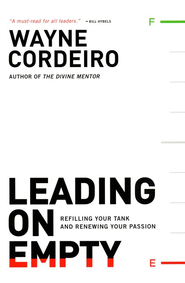 Wayne Cordeiro, Leading on Empty: Refilling Your Tank and Renewing Your Passion (Minneapolis; Bethany House, 2009), 213 pages, ISBN 9780764203503.
I know this author well. He is my pastor, and I love him. I am 22 years his senior and have been on his pastoral staff since 1995, longer than any other pastor still serving at New Hope Christian Fellowship in Hawaii. New Hope is the largest church in Hawaii with a weekend attendance exceeding 10,000.
When we first started the church in 1995, Wayne taught (and still does) a course on doing ministry at 5:30 on Tuesday morning. Early starts tend to separate the serious student from those less inclined. I took the course three or four times, and learned several things about Wayne: the first was that my Bible came alive as he taught. I saw wonderful things that I had never seen and my Bible’s pages were aglow while class was in session; the second was that Wayne was an unusually disciplined man who started early every day and on every task. I envied his discipline and drive. I still do.
When Wayne started this church, I was his backup speaker, and had a sermon all ready to go should he not be able to preach on any Sunday. I was never needed. He never missed a service. The number of our 90 minute Sunday services rapidly grew to five each weekend – two on Saturday evening and three on Sunday morning. Wayne’s ability to communicate led to invitations to speak beyond our church and he traveled far and wide to satisfy the demands that came his way. He began to write to meet the demands he faced.
I have read all or most of Wayne’s earlier books, and I have listened to him in person, on the radio and television countless times. I probably write 50 articles a year for newspapers and magazines, and the lead thought for most of these comes from something Wayne says on a Sunday morning.
A few years ago, Wayne ended up against the wall. His energy level was zero, and the demands he faced were overwhelming. I knew it was coming, and tried any number of times to suggest or hint at ways to diminish the draining I knew he had to be facing. But like so many of us in our late 40s and early 50s, we can do it all and better than anyone else. I know I felt that way, and I ended up with a stroke at 58, a heart attack at 61 and a triple by-pass at 67.
Leading on Empty is Wayne’s story of how his tank ran dry, and what he did to renew his passion for the Lord and life. Its content is excellent, he writes well, transparently and his principles are applicable to professions and careers beyond the ministry.
Wayne sought professional help and learned many things we really all know but so often ignore. He learned that solitude and silence are where you refine your soul, where you learn the difference between a concern and a responsibility. We must learn to take our concerns to Jesus, and invest our emotions and energies in our responsibilities.
We must settle that for which we are accountable if we are to be significant to others and to ourselves. We need to define what comprises the five percent of our life which only we can do, and then to do those tasks well since the condition of that five percent will determine the validity of the other 95 percent of our effort.
Wayne teaches us to list six items that comprise that five percent, and notes your choices will shape your soul before God. If you or I could do life or a portion over again, what would we do differently? And then, what will we do so that the next 10 years brings us a sense of fulfillment and not emptiness?
Toward the middle of the book, Wayne writes that “Faith is living in advance what we will only understand in reverse”. I stopped to think about this sentence – the highlight of the book to me.
I found myself thinking about my calling. What did God call me to in the beginning? How about you? Have you answered that call? Will you and how should you? How do you? What can I, might I, and should I do at my point in life?
Wayne concludes by presenting four courses we face in life and the challenge to choose the best one: “A Life of Reaction;” “A Life of Conformity;” “A Life of Independence” and “A Life of Intentionality.” He stresses that there are some things on which we should never give up.
He ends with recommending that we plan sabbaticals and Sabbaths as part of our lives. If we really trust God as our provision, we can spend some time with Him, to learn to take the time to do things that we love the most, to sleep when we should sleep, to stop trying to correct those things which are not our concern, and to trust Him.
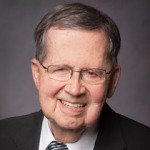
I am the old man on Wayne’s staff, and I love him because I learn so much from him. I learn all the time. I miss him when he is off somewhere and not in my pulpit. His book is a gem, a resource that – if lived out – will add to your joy, your value and longevity. Taste and see.
Reviewed by H. Murray Hohns