

Larry Christenson, How to Speak in Tongues

What did God have in mind for you when he gave the gift of tongues to the church? What can you do to prepare yourself to receive this blessing? An excerpt from Larry Christenson’s classic work, Answering Your Questions About Speaking in Tongues.
 What happens afterward in the lives of the people who pray for and receive the gift of tongues with some help or encouragement? If the gift becomes knit into their prayer life in a wholesome way, and brings forth the fruit of edification, then we cannot score too seriously the particular way in which they prayed for and received the gift.
Most people, however, can come into this blessing in a simple and natural way, without too much attention to “mechanics.†A few simple steps are often a helpful preparation:
- Search the Scriptures. Be convinced in your own mind and heart that this gift is from God, is intended for the Church today, and is available to you. Consider these clear truths of Scripture:
- God tells us to earnestly desire the spiritual gifts (1 Cor. 14:1).
- God delights to give good gifts to His children (Matt. 7:11).
- The baptism with the Holy Spirit, with the manifestation of speaking in tongues, was for all believers (Acts 2:4; 10:44–46; 19:6).
- This is a gift that every believer can use with benefit. If a member of the church is sick, it is not necessary that every member have the gift of healing; one member with the gift would be sufficient. Every member, however, needs to maintain a private devotional life, and therefore every member can benefit from this wonderful gift. The main blessing of the gift of tongues is in one’s private devotions. The Lord, speaking by the apostle Paul, says, “I want you all to speak in tongues†(1 Cor. 14:5, emphasis added).
- Ask yourself, “Why do I want this blessing?†It is a part of what you may receive through receiving the baptism with the Holy Spirit, and Christ tells us what that is for in Acts 1:8: “You shall be my witnesses.†If you yearn to be a better witness for Christ, for Him to have a deeper grip on your life, this blessing is for you.
- Put it to the Lord in prayer. Tell Him the desire of your heart and ask Him to guide you. You may feel led to wait a time, or you may feel ready at once to seek the blessing.
Often it is a help to seek out someone who already has experienced the blessing, and have that one pray with you (see Acts 8:15). Many people, however, have received it all by themselves in their own prayer closets.
- In order to speak in tongues, you must quit speaking in any other language that you know, for you cannot speak two languages at once. After you have come to the Lord with prayers and petitions in your native tongue, lapse into silence and resolve to speak not a syllable of any language you have learned. Focus your thoughts on Christ. Then simply lift up your voice and speak out confidently, in the faith that the Lord will take the sound that you give Him and shape it into a language. Take no particular thought to what you are saying, for your mind is “unfruitful†during the exercise of this gift. As far as you are concerned, it will be just a series of sounds. The first syllables and words may sound strange to your ear. They may be halting and inarticulate. You may have the thought that you are just making it up. But as you continue to speak in faith, “boldly, confidently, and with enthusiasm†(literal rendering of Acts 2:4), and as the lips and tongue begin to move more freely, the Spirit will shape for you a language of prayer and praise that will be beautiful to the ears of the Lord!
The initial hurdle to speaking in tongues, it seems, is simply the realization that you must “speak forth.†(Many people wait and wait for something to “happen,†not realizing that the Holy Spirit is waiting for them to speak out in faith!) Once this initial hurdle is cleared, however, you will find your spirit wonderfully released to worship the Lord as your tongue speaks this new language of worship.
Next Page
This excerpt is from Larry Christenson, Answering Your Questions About Speaking in Tongues (Bethany House, a division of Baker Publishing Group, ©1968, 2005), pages 129-132. Used by permission.
Once a person has spoken in tongues, he may do so at will thereafter. Two “testings†of this gift seem almost universal, and a word concerning them may save those who are new in the gift some needless anxiety.
The first test usually comes almost at once: It is the temptation to think, “I am just making this up.†This is a natural thought, for the interaction between the believer and the Holy Spirit is so subtle that it is hard to draw a clear line between my speaking and His prompting. The temptation, when this thought comes, is to draw back and deny the gift, or to quit using it. Our ultimate confidence cannot be the experience itself, but God’s Word. He has spoken in the Scripture concerning this gift, and I have come to Him, my heavenly Father, to receive it. He has promised not to give me a stone when I ask for bread (Matt. 7:9). Therefore, I can be confident that what I am speaking is truly His gift of a new tongue. As you continue to use the gift, you will pass through this test and come to the confidence that this gift will become to you all that Scripture promises.
The second test usually comes after one has exercised the gift for a time—perhaps a few weeks or months. The initial joy and enthusiasm that one had in the use of the gift begins to fade. You can still speak in tongues as fluently as ever, but it doesn’t seem to be “doing†anything for you. It’s just a hollow shell, with no inner content. The temptation is to let the gift fall into disuse. This is a temptation one must resolutely resist. Every gift of God involves a stewardship of that gift. One who receives the gift of tongues must from the beginning take this stance: God has given me a gift that I shall use to worship Him all the rest of my life.
There is actually a good reason why God allows the initial enthusiasm to wane. He does not want our use of this gift to be grounded on the shifting sands of our own feelings, but upon the solid rock of His Word.
God wants us to grow to the point where we act according to faith rather than feelings. The great blessing of speaking in tongues is found in its regular and disciplined use over a long period of time—months and years—and not in the passing emotion of a few prayer sessions. It is a tool of prayer that is self-sharpening and improves with use!
PR
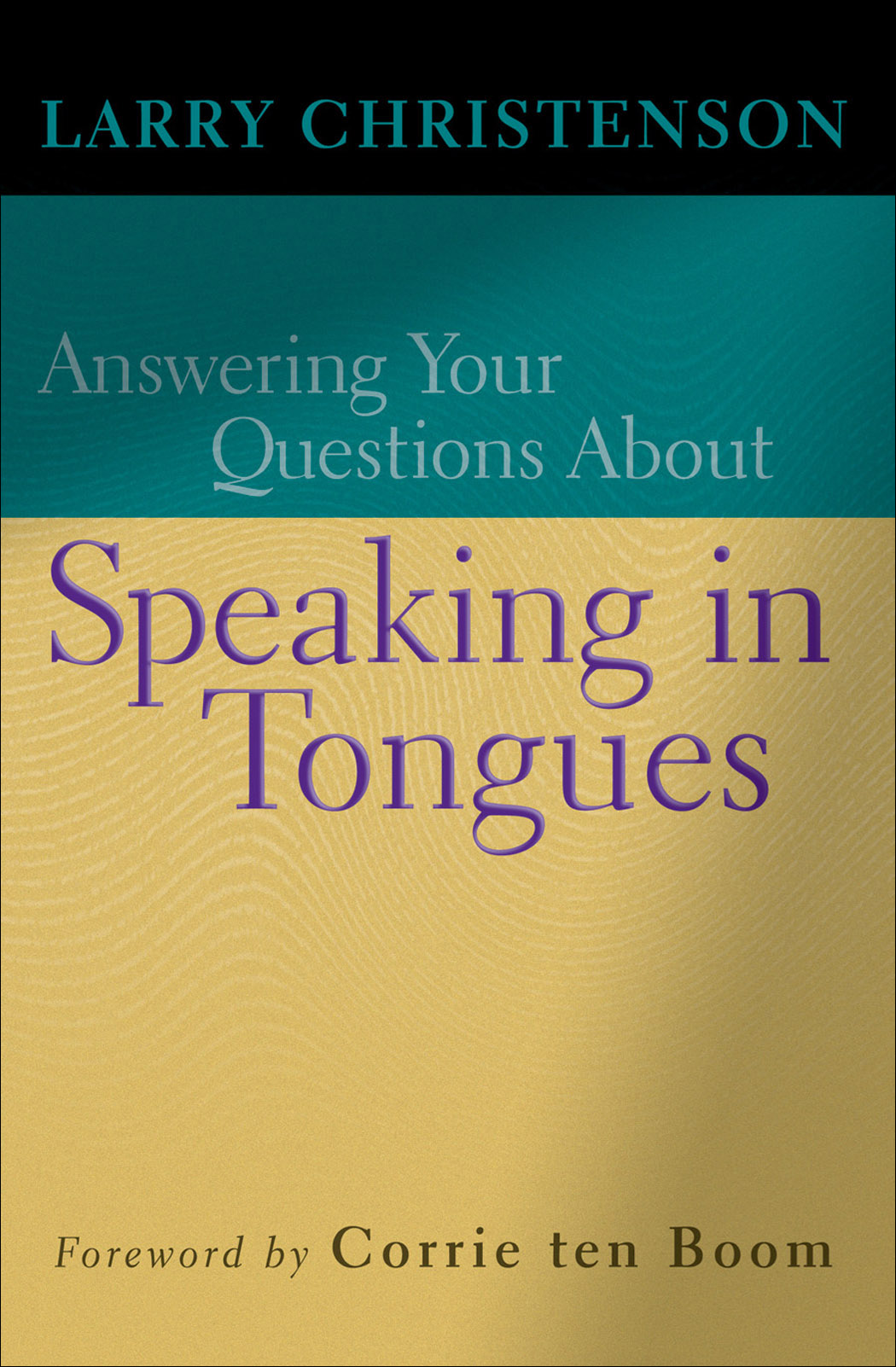
This excerpt is from Larry Christenson, Answering Your Questions About Speaking in Tongues (Bethany House, a division of Baker Publishing Group, ©1968, 2005), pages 129-132. Used by permission.
Further Reading:
“Six Ways the Holy Spirit Will Communicate With You” by Charles Carrin
The word Jesus used for “Helper†has a rich and wonderful meaning in its Greek equivalent, parakletos, and was used in the ancient Olympic Games to identify those who accompanied a marathon runner by shouting encouragement to him. This example of the Holy Spirit and the Christian with the marathon-runner to his paraklete is an excellent illustration. Para = “alongside of;†kaleo = “to call.†Here are six scriptural ways the Holy Spirit wants to accompany our race and shout encouragement.
Listening for God’s Voice and Heart in Scripture: A conversation with Craig S. Keener
In our Western culture we’re addicted to shortcuts; we want everything instant. So we settle for verses out of context because somebody we look up to quotes them. […]
God can speak to us in a lot of different ways. We should pray that we will hear Him, then read the Bible to see what we can learn about God and how He acts in real human situations. Some of those will surely relate to us and to the world we live in.