
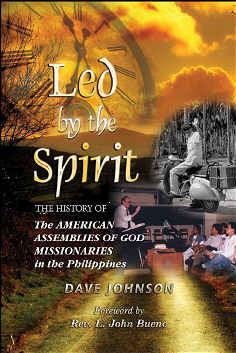
Led by The Spirit: The History of the American Assemblies of God Missionaries in the Philippines, Preface and Introduction


This excerpt from Led by the Spirit is the Preface and Introduction. Missionary-scholar Dave Johnson has brought together a chronicle of over 300 Pentecostal missionaries serving in the Philippines from 1926 through the first decade of the new Millennium.
Â
Preface
Like many other books, this volume was written to fulfill a perceived need. While serving as country moderator in the Philippines for the Assemblies of God World Missions (AGWM) from 2002 through 2003, I sometimes asked myself how my predecessors might have handled similar situations to those I was facing. Then, looking around at the churches and institutions that former missionaries had built and passed on, I found myself asking who these missionaries were. I had few answers to my questions. My wife, Debbie, and I both began to sense that God was directing us to do something about it. The book you hold in your hands is the result.
My intent here is to describe what God has done through the United States (U.S.) Assemblies of God missionaries who served or are serving in the Philippines, with the understanding that God accomplishes His purposes through flawed people. The philosophy used in writing this book is to present an accurate, comprehensive, and balanced account of the work of the Assemblies of God Missionary Fellowship in the Philippines that neither lionizes nor libels those involved in order that God is revealed as the Hero of the story.
The limitations are numerous. The personnel and policies from the AGWM home office in Springfield, Missouri, will only be included as they relate to the work in the field. The activities of the missionaries while home for itineration or other reasons are beyond the scope entirely. The relationship between the missionaries and the Philippines General Council of the Assemblies of God (PGCAG) was and remains symbiotic and, therefore, has some overlap. Since the history of the PGCAG is not the focus of this story, its history will only be recorded in places where it intersects with that of the U.S. missionaries. The rest of their story will have to be told elsewhere. Also not included here is the work done by Assemblies of God missionaries from other countries.
Additionally, a number of international ministries such as the Asia Pacific Theological Seminary (APTS) are all based in the Philippines. Since the focus of the book is limited to the Philippines, the activities that missionaries assigned to these ministries engaged in outside of the country are beyond the scope of this book. The valued work of missionary associates is not included mostly because of space limitations but also because of lack of research materials available.
To achieve a proper balance and accurate history, problems that occurred on the field are dealt with throughout the book. There are, however, some exceptions. I am well aware that there was a major financial scandal that took place in the AGMF office in 1978 in which a minimum of thirty thousand dollars was either lost in bad business deals or embezzled. The story is not included here for legal reasons. In some cases, moral failures that would adversely affect living family members if they were discussed will remain undisclosed. Other problems related to missionaries currently serving on the field remain confidential because the revelation of such would disrupt the excellent current unity of the field. These issues will be left to future historians.
This volume is offered with the hope that it will contribute both to the historiography of the Assemblies of God World Missions in general and to the Assemblies of God work in the Philippines in particular. I also pray that God will be glorified through this effort.
Dave Johnson
Daraga, Albay, Philippines
November, 2008
Introduction
The story of the Assemblies of God Missionary Fellowship in the Philippines flows out of the well-known 1906–1909 Azusa Street revival in Los Angeles, California. During this time, thousands of people from all strata of life were saved, healed, and baptized in the Holy Spirit. At Azusa Street, neither race nor social status was important as all were equally convicted of sin, set free through forgiveness in Jesus’ name, and filled with the Spirit’s power.
Speakers at the revival emphasized several theological themes: Jesus as Savior, Healer, Baptizer in the Holy Spirit, and soon-coming King. They also emphasized a countercultural perspective for that era: that all races were equal before the cross of Christ. This newfound unity between the races may have paved the way for an Assemblies of God missions vision that emphasized the dignity, gifting, and callings of people around the world in the Lord’s harvest. The resulting strategy focused on developing institutions that trained and released national leaders. These leaders, in turn, multiplied missionary efforts hundreds of time over through dynamic Spirit-empowered evangelism and church planting.
Word spread about what God was doing at Azusa Street, and people came from around the world to see what was happening. Many veteran and new missionaries came and experienced the dynamic of the baptism in the Holy Spirit and then left for the mission fields around the world with the conviction that the Holy Spirit baptism empowered believers to carry the gospel to the ends of the earth.
The birth of the Assemblies of God and its missions program should be understood within its historical context. The nineteenth century had seen great growth in the spread of the gospel as missionaries, primarily from the Western nations, had circled the globe. This was aided, at least in part, by the expansion of the Western colonial powers. There were benefits and abuses with colonialism, and the United States experience in the Philippines was no exception. The underlying colonial mentality was that Western culture was superior to all others, an attitude to which some missionaries, being products of their times, were not immune. This superiority began to be unmasked when, in 1914, the year in which the Assemblies of God was founded, the Western world was plunged into the horrors of World War I.
As early as the General Council meeting in 1915, the Assemblies of God went on record as calling for the establishment of indigenous churches after the New Testament pattern.2 These churches would be self-governing, self-supporting, and self-propagating. By 1915, the Movement was also establishing the pattern of appointing missionaries. Its earliest application form was simple and straightforward, asking questions about the prospective missionary’s experience with salvation and the  baptism in the Holy Spirit, as well as inquiring if the belief in divine healing allowed for visiting the doctor. Candidates were required to state that they were willing to encourage local churches to support them, and that they would also be willing to ultimately trust God for His provision.
The present missionary movement of the Division of Foreign Missions is the outgrowth of precise missionary concepts undoubtedly authored by the Holy Spirit and implanted in the hearts of early pioneers who knew the New Testament but were in no sense missiologists. However, the things they said, the papers they wrote, the concepts they adopted, the dreams they dreamed, are still being carried out today. The present worldwide movement and fraternal fellowship numbering in the millions are the product of a few principles announced by these pioneers and incorporated in the bylaws of the General Council of the Assemblies of God.3
The identity of those who followed those dreams to the Philippines, their actions, and their results will unfold in the chapters that follow.
PR
This chapter is an excerpt from Dave Johnson, Led By The Spirit: The History of the American Assemblies of God Missionaries in the Philippines (Pasig City, Philippines: ICI Ministries, 2009). Used with permission.
Notes
[Editor’s note: At the time of online publication, an error was discovered with the end notes for the Introduction. Please see the original hardcopy edition or contact David Johnson for clarification.]
Further Reading:
Read Malcolm Brubaker’s review of Led by the Spirit in the Summer 2010 issue of The Pneuma Review: /dave-johnson-led-by-spirit/
Download the full book (in PDF) at: https://www.academia.edu/34297392/LED_BY_THE_SPIRIT.pdf
Find more excellent books from APTS Press, home of the Asian Journal of Pentecostal Studies.