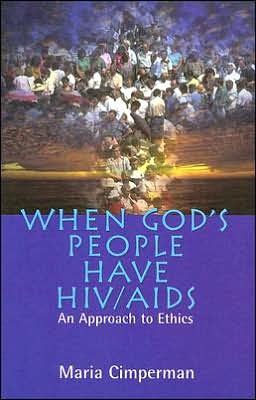
Maria Cimperman: When God’s People Have HIV/AIDS

 Maria Cimperman, When God’s People Have HIV/AIDS: An Approach to Ethics (Maryknoll, New York: Orbis Books, 2005), 159 pages, ISBN 9781570756238.
How should Christians affected by HIV/AIDS be understood? Maria Cimperman, an Ursuline sister, challenges the church to view those affected or threatened by the pandemic as God’s children in need of help—just as Christ would see them. She advises the Christian community to embrace them, love them, and work tirelessly to eliminate the source of their suffering.
The book, the content of which was Cimperman’s doctorial dissertation, presents touchable realities on HIV/AIDS within the human community. It offers more of practical experiences and encounters on the topic rather than theoretical formulation. In her introduction, she explains the experiences that pushed her to research on HIV/AIDS as a theologian. She says it was born out of the necessity to address the issue after she interacted with people affected by the pandemic.
A discussion of the meaning of human existence as understood in the context of Christian revelation is offered. Cimperman develops a theological anthropology that engages human identity on the basis of relationship with God, others, and self. For her, suffering is so central that any decision on HIV/AIDS must be based on the reality of experience. Cimperman sees suffering as something that creates in us Christ’s love, hope and liberty. Christ’s love calls us to a response that involves sacrifice.
We are to be active agents of hope in the world of HIV/AIDS through relationships. She argues that for our response to be effective virtues must play a leading role. Hope, fidelity, justice, and prudence are discussed as part of the virtues that the Christian community cannot leave behind while responding to HIV/AIDS. Spirituality and morality must be integrated in Christian discipleship in order to offer an adequate response to the pandemic.
I find the presentation of real cases of people responding to HIV/AIDS in the last chapter quite helpful. Noerine Keleba’s story moves me a great deal. The suffering she encountered due to the loss of her husband through HIV/AIDS stirred her to begin The AIDS Support Organization (TASO). Her words arouse a needed sense of concern that is worth noting. She says they met to “cry and pray together,†and focused on the practical issues that affected their lives.
This book is a great dedication to those struggling to do away with HIV/AIDS through the elimination of gender inequality and poverty. The author sees the two as the main cause of the quick spreading of HIV/AIDS and puts a lot of emphasis on them. They are worth taking serious.
The book contains well-researched and documented information with a great number of footnotes. I have to admit that the book is an eye opener, revealing real issues that need to be addressed if our fight against HIV/AIDS is going to bear meaningful fruit. It contains applications to many moral issues, with a great call to put into practice the necessary virtues that will end the HIV/AIDS pandemic. It is a book full of Christian ideals, thus recommendable to pastors, theologians, Christian ministries, Christian organizations, and even individual Christians involved or aspiring to be involved in addressing HIV/AIDS and related issues.
Reviewed by Michael Muoki Wambua