
Pentecostal Hermeneutics: Approach and Methodology

Introduction
Defining an ultimate Pentecostal hermeneutic is not an easy thing. This is because Pentecostalism by itself is a diverse phenomenon consisting of different types of groups. There is no homogeneity in Pentecostal grouping because different Pentecostal factions are established within different traditions,[1] even though the underlying theological formation is the same. This diversity in traditions brings with it varied theological approaches and thinking when establishing Pentecostal hermeneutics. But as Kenneth Archer observes “it is this diversity along with Pentecostalism’s ability to adapt without losing its essential beliefs and practices that has aided its growth.â€[2]Pentecostal movements in different parts of the world have different factors behind their origins, but most of them have similar social-political and religious grounding. The early American Pentecostal movements, as Archer observes, have their basis on the post civil war era, which comprised of industrialization, urbanization and mass migrations. As the American society sought to discover a new identity, most spiritual movements, and especially Protestants, saw the possibility of moral reform through spiritual revival built on private action and personal responsibility.[3] It was out of these revivalist movements and social chaos that characterized post civil war America that American Pentecostalism was born. Similarly, as Ogbu Kalu argues, African Pentecostalism was born out of the African postcolonial identity crisis.[4] As Africans sought their true identity and responded to the white missionary ecclesiological structures and hermeneutics, a new approach to worship that was pneumatic in nature was born. It should however be observed, even in light of Kalu’s assertion that African Pentecostalism is not an extension of American Pentecostalism,[5] African Pentecostalism has been and continues to be highly influenced by American Pentecostalism. In both cases, Pentecostalism emerged as movements protesting the increasing evils in their immediate societies and the presumed “coldness†of the then mainline churches.[6]

Central to the Pentecostal belief and theology is the conversion experience and the infilling of the Holy Spirit. Pentecostals see holy living as an essential duty of the Christian. This holy life can only be obtained through the individual’s submission to the authority of Jesus Christ. Conversion is a personal choice and calls the individual Christian to personal responsibility. Every believer needs to maintain a life of holiness. This holiness cannot be attained through mere abstinence to sin, but through the guidance of the Holy Spirit hence the need for the baptism of the Holy Spirit, an experience that assures the indwelling of the Spirit of God in the believer. The Spirit gives the believer power over sin and enables them to proclaim the Gospel with power, testifying the saving grace of God through Jesus Christ. Speaking in other tongues is the main evidence of one’s baptism in the Spirit. These similarities in origin and doctrine become the common denominator in which Pentecostal hermeneutics can be discussed. This paper attempts to explore the general hermeneutical approach, methodology and theological direction that the whole of Pentecostalism embraces.
Pentecostal Theology and Interpretation
Hermeneutics has been defined as both the science and the art of interpretation.[7] “As a science, it enunciates principles, investigates the laws of thought and language, and classifies its facts and results. As an art, it teaches what application these principles should have, and establishes their soundness by showing their practical value in elucidation of the more difficult scriptures.â€[8] Hermeneutics involves drawing meaning from the immediate context of the literature and at the same time it “is the search for the meaning of the text here and now.â€[9] Thus we can clearly observe that biblical interpretation has two main dimensions. The first one seeks to find out the original meaning of the text; the one that the author intended for the first readers. The second one looks at the meaning that the readers of the Bible might attach to it. This second dimension shows that the environment and the experiences of the interpreter largely influence the meaning he/she attaches to Scriptures.
A leading influence both in environment and experience is the theological orientation that a Bible reader holds in his mind. As Kevin Vanhoozer rightly observes, the “reader [of the Bible] is no tabula rasa or blank slate,â€[10] no one approaches the text without some presuppositions. The same sentiment, and in reference to Pentecostal hermeneutics, is expressed by Arrington when he states: “The frame of reference and theological orientation out of which the Bible is studied influences one’s interpretation of scripture.â€[11] Such an observation advises us that if we are to precisely understand Pentecostal hermeneutics, we must first endeavor to rediscover their theological premise.
At the centre of Pentecostal theology is the discipline of reading the Bible and the baptism of the Holy Spirit commonly explained through the latter rain motif. Let us tackle each individually for a better view of the basis for Pentecostal hermeneutics and theology.
The Discipline of Bible Reading
The reading of the Scripture is highly esteemed in Pentecostal tradition. Bible reading is interwoven with prayer. The Bible is read until it becomes part and parcel of the individuals thought system and daily expressions. It should however, be observed that the Bible is not studied as an academic work but as a devotional material. As Davies argues, Pentecostals utilize the Bible as a resource for divine encounter. They “read the Bible not to grasp it; but so that God can grasp them through it.â€[12] The Bible is seen not only as the word of God but also as the full representation of the mind and plan of God. God is seen to be alive in the scriptures and thus an encounter with the scripture is regarded as an encounter with the living God himself.
The earliest form of Pentecostalism held this divine essence of the scripture to the point that they regarded the human authors of the Bible as passive instruments in the process of writing the scripture. They saw them only as instruments that recorded what God dictated. Such a view led to neglecting the context of the human authors when interpreting the Bible. However, the latter development of Pentecostal interpretation recognized human authorship as part of the process that God used to communicate his will to the people. This later development introduced an “incarnational†understanding of the Bible. The scriptures, like Christ Jesus, were seen to be fully divine and fully human and the two natures as inseparable.[13]
Pentecostals regard the Bible as the primary authority for doctrine. While other church traditions would have the Bible, liturgy books, prayer books, and perhaps catechism books, Pentecostals use the Bible as their only source of doctrine. Some Pentecostals value the place of history and tradition in the formation of Christian doctrines. But most Pentecostals regard tradition and creeds only as memorabilia of the lifeless past and not part of scripture or church authority.
According to Pentecostals, Bible doctrines find their significance in the everyday application in the believer’s life, not in its intellectual relevance.
The Latter-rain Motif
The latter-rain motif has to do with the outpouring of the Holy Spirit upon the present day Christians as it happened in Acts 2. The outpouring of the Spirit is seen not as a phenomenon for the church in the book of Acts, but for the entirety of the New Testament church in every generation. The latter rain reflection helps capture the apostolic faith and restores the gifts of the Holy Spirit to the present day Pentecostal Christian. Miracles, signs and wonders accompany the Sprit-filled evangelizing believer.
Pentecostals demonstrate a firm belief in the dispersion of the latter rain outpouring, which avails the end time harvest prophesied in the book of Joel. This motif plays a key role in the formation of Pentecostal theology and community. The latter rain motif is founded in the early Pentecostals proclamation and as Archer observes “it provides the Pentecostal community with a stable conceptual framework through which they interpret God’s involvement with the whole of human history and provide the broad framework in which Pentecostal worldview is constructed.â€[14]
Pentecostal Hermeneutics Today: Approach and Methodology in perspective
The theology of Pentecostalism has grown from its interpretative approach and historical narrative as a community. But to capture their present interpretative approach and methodology, we need to outline the historical development briefly.
The rise of Pentecostalism brought with it a new approach to biblical interpretation. Contrary to the common sense realism approach,[15] the dominant hermeneutical approach at the time Pentecostalism was born;[16] Pentecostals employed a new hermeneutical method that entwined Bible reading and practical living. Interpretation like inspiration was seen to be primarily the work of the Holy Spirit. Individual reading of the Bible was highly encouraged. Pentecostal hermeneutists at this era argued that one did not need to be a Bible scholar to be able to understand the Bible.
The risk of misinterpretation led Pentecostal leaders and Bible scholars to introduce the inductive-synthetic method of Bible study. This approach emphasized the importance of approaching the Bible as one whole book, built on one theme, whose message is mediated through language—and thus considered the grammatical formation of the scripture.[17] It is important to observe here is that Pentecostals in that era stressed a literal understanding of scripture that led to responsible living and a good relationship with God. Having an articulate, intellectual understanding of God or the scriptures was not of prime importance to them. The authority of scripture and practical experience were both set on par and seen as the center for Christian living.
This was all established by early Pentecostal fathers and has remained their key to interpretation. Their theological formulation were faced with a lot of criticism from the rest of the Christian fraternity, thus as Arrington observes, the resulting “Pentecostal study of scripture was approached with a view to defend the doctrines espoused by the earliest Pentecostals.â€[18] Even with the development of Pentecostal scholarship and theological training of Pentecostal leaders, the Pentecostal community has continued to read the scripture from a “Pentecostal perspective.â€[19] That way a dialect encounter between the text and the community help produce meaning in their interpretative methodology.
Considering their theology and the nature of their communal formation, Pentecostal hermeneutical approach is said to have two major dimensions: Pneumatic and experiential.
Pneumatic Approach
When we say that an interpretation is pneumatic we mean that the interpreter largely relies on the direction of the Holy Spirit to come to the full understanding of the text under study. Pentecostals believe that the human authors of the scripture were inspired by the Holy Spirit to write the Bible and thus in turn the present day interpreter should also rely on the same inspiration in order to rightly interpret the Scripture. The Holy Spirit is seen as the “common context in which the author and the reader can meet to bridge the historical and cultural gulf between them.â€[20] This does not mean that they do not respect scientific approaches to interpretation. Pentecostals do not entirely reject the scientific methods of exegesis. They however affirm that there are deeper deposits in the scripture that can only be understood through the medium of faith. To them, faith is the means by which the Bible was written and should remain as the context for its understanding.[21]
An encounter with God through the Holy Spirit is main sphere of cognition in Pentecostal hermeneutics. The Spirit-believer relationship is the basic tool for both spiritual and practical knowledge. As Arrington illustrates, “Pentecostals see knowledge not as a cognitive recognition of a set of precepts but as a relationship with the one who has established the precepts by which we live.â€[22] The same observations are made by David Jones. He asserts: “for Pentecostals all knowledge is grounded in God and God is known through encounter.â€[23] This experiential-relational knowledge becomes the basis for Pentecostals’ emphasis on the infilling and baptism of the Spirit.
The role of biblical narrative is an imperative concept in Pentecostal hermeneutics that needs to be explored. For Pentecostals, the Bible is a story of redemption. It presents the story of salvation in Christ Jesus through the Holy Spirit. It is a story that has both a past and a present continuous presence. One needs to be connected with this salvation story in order to experience salvation. With this view in mind, Janet Powers states: “Pentecostals look to biblical narratives to discover a pattern of experience and assume that this narrative has normative theological value.â€[24] Powers further asserts that the continuity of the biblical narrative from its past through the present and into the future avails a significant relevance to the Pentecostal hermeneutist. Since the basis of the salvation story is the kingdom of God, the futuristic benefits and the power of the kingdom are available in the present through the Holy Spirit, the author of Pentecost.[25]
Experiential Approach
Most Pentecostal do what Davis calls “‘agendad reading’ of the Bible-reading with an intended result and goal in mind.â€[26] To them, the Bible has value when it enriches the reader’s personal spiritual expectations and becomes relevant to his immediate needs. To the Pentecostal, the Bible becomes the word of God for the individual when it is read and appropriated according to his immediate context. To them the power of the Bible is best realized when read and applied. The Bible’s transformative influence is felt only when it is read. Thus for the Pentecostal, reading of the Bible should be part of the believer’s lifestyle.
Experience then becomes an important ingredient in the understanding of the scripture in Pentecostalism. Doctrine and experience are set at par, but experience draws more attention than doctrine. The believer wants to ‘feel’ God in his life. The experience approves the authenticity of the doctrine. This is what Powers observes when he affirms: “Pentecostal hermeneutics offers a paradigm which asserts that right experience leads to the right doctrine, so Pentecostals are much more concerned with locating their experiences in biblical narrative than determining theological prepositions based on biblical text.â€[27] The Pentecostal does not go to the Bible to develop a theology; he goes to the Bible to develop a lifestyle and to experience God.
The experiential interpretation mode however, presents a major challenge that the Pentecostal needs to take seriously, namely selective reading. When the primary concern is what the passage means to the individual personally, then verses that hold less meaning are ignored. Due to their Spirit baptism motif, conversion motif and perhaps the ‘by faith’ motif, most Pentecostals have increasingly put their dependency on texts that emphasize such motifs. Such a bias in my opinion needs to be addressed. Pentecostals needs to be encouraged to read all scriptural texts, even those that do not resonate with their immediate theological conjectures or experiences. Such a goal can be achieved through communal Bible expositions. Perhaps this is where the academy needs to come in and help to shape the Pentecostal community.
Personal Observations and Conclusion
I agree with Randolph Tate[28] when he affirms: “just as the author brings his or her worldview and understanding of reality to a text, allowing the text to mirror at least some elements of that worldview and reality, so the reader brings to the text his or her worldview and conception of reality.â€[29] Reading the Bible should not be a monological process (a process by which the text alone speaks to the reader), but a dialogical one (a process in which the text and the reader engage in an ongoing dialogue). The reader should discover himself in the text, giving away his human failures and receiving divine direction from the text. Asking questions from the text and allowing the text to ask him questions. This is a concept that Pentecostalism has captured well. Pentecostals bring their experiences and challenges to the scripture, and then allow these experiences to dialogue with the text in the presence of the Holy Spirit. They believe that the same Spirit that guided in the writing of the scripture is the same Spirit present in their lives and thus he guides them in understanding the same scriptures he helped write, and helps them apply the same in their lives. To me, this is the best way of appropriating praxis as a crucial part of hermeneutical procedure. The Pentecostal community looks at the Bible to locate their life story and find answers to their life challenges.
Pentecostals read scriptures within a community. The individual Bible reader does not approach it with an independent mind but with a mind guided by the common beliefs of the larger community. The reader and the Holy Spirit meet at the text and engage in a dialogue. Central to Pentecostal theology is the idea that salvation entails a relationship between the human being and God. There is no better place for this relationship to be enhanced than in the scriptures. The following figure demonstrates the Pentecostal hermeneutical process.
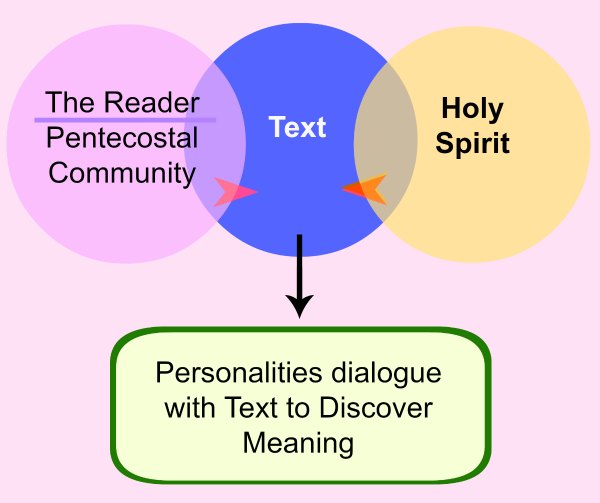
In such an approach to biblical interpretation, God in the person of the Holy Spirit plays his role as a teacher or counselor in aiding the individual Christian to understand the word of God. The Holy Spirit, being the author of the text, is the best person to aid in the interpretation of the same text. There is no better way to understand a message than to hear it from the original author. Thus the reliance on the Holy Spirit to interpret the scriptures as practiced by Pentecostals, in my view, is highly commendable. Therefore, I believe a hermeneutical circle that involves the Spirit, the Text, and the individual Bible reader is a strong approach to biblical interpretation.
PR
Bibliography
Archer, Kenneth J. A Pentecostal Hermeneutics for the Twenty-first Century: Spirit, Scripture and Community. New York: T&T Clark International, 2004.
Arrington, F.L “Hermeneutics: Historical Perspectives on Pentecostals and Charismatic,†in Dictionary of Pentecostal and Charismatic Movements, eds. Stanley M. Burgess. Grand Rapids, Zondervan, 1988.
Davis, Andrew. “What Does it Mean to Read the Bible as A Pentecostal?†Journal of Pentecostal Theology. Vol. 18 No.2 (2009): 216-229.
Jones, David. “Yielding to the Spirit: The Dynamics of Pentecostal Praxis,†in The Globalization of Pentecostalism: A Religion Made to Travel, eds. Murray W. Dempster. Oxford: Regnum Books, 1993.
Kalu, Ogbu. African Pentecostalism: An Introduction. Oxford: Oxford University Press, 2008.
Mickelsen, Berkeley. Interpreting the Bible. Michigan: William. Eerdmans Publishing Company, 1989.
Powers, Janet. “Your Daughters Shall Prophesy: Pentecostal Hermeneutics and the Empowerment of Women,†in The Globalization of Pentecostalism: A Religion Made to Travel, eds. Murray W. Dempster. Oxford: Regnum Books, 1993.
Ramm, Bernard. Protestant Biblical Interpretation. Boston: W.A. Wilde Company, 1950.
Tate, Randolph. Biblical Interpretation: An Integrated Approach. Peabody, Massachusetts: Hendrickson Publishers, 1991.
Terry, Milton S. Biblical Hermeneutics. Grand Rapids: Zondervan Publishing House, 1981.
Vanhoozer, Kevin J. Is There a Meaning in this Text? Grand Rapids, Michigan: Zondervan Publishing House, 1998.
[1] Some scholars have however tried to group Pentecostals according to their main theological subscriptions. For example there are classical Pentecostals who are established within the Wesleyan and Keswick traditions, the oneness Pentecostal characterized by their Unitarian theology, and the Neo-Pentecostals who are charismatic and trans-denominational. See F.L Arrington, “Hermeneutics: Historical Perspectives on Pentecostals and Charismatic,†in Stanley M. Burgess, ed., Dictionary of Pentecostal and Charismatic movements (Grand Rapids: Zondervan, 1988), 377.
[2] Kenneth J. Archer, A Pentecostal Hermeneutics for the Twenty-first Century: Spirit, Scripture and Community (New York: T&T Clark International, 2004), 11.
[3] Kenneth J. Archer, A Pentecostal Hermeneutics for the Twenty-first Century: Spirit, Scripture and Community, 12.
[4] Ogbu Kalu, African Pentecostalism: An Introduction (Oxford: Oxford University Press, 2008), vii-ix.
[5] Kalu, African Pentecostalism: An Introduction, vii.
[6] See Kalu, African Pentecostalism: An Introduction. And Archer, A Pentecostal Hermeneutics for the Twenty-first Century: Spirit, Scripture and Community, 16.
[7] See Bernard Ramm, Protestant Biblical Interpretation (Boston: W.A. Wilde Company, 1950), and Berkeley Mickelsen, Interpreting the Bible (Grand Rapids: Eerdmans Publishing Company, 1989).
[8] Milton S. Terry, Biblical Hermeneutics (Grand Rapids: Zondervan Publishing House, 1981), 20.
[9] Enest Munachi Ezeogu,“The Crucial Role of Biblical Scholarship in the Development of African Christian Theology,†http:/www.theologyinafrica.com/confrence/ppfconf/ppfconf.php (accessed on October 13, 2010).
[10] Kevin J. Vanhoozer, Is There a Meaning in this Text? (Grand Rapids: Zondervan Publishing House, 1998), 149.
[11] F.L. Arrington, “Hermeneutics: Historical Perspectives on Pentecostals and Charismatic,†in Stanley M. Burgess, ed., Dictionary of Pentecostal and Charismatic movements (Grand Rapids: Zondervan, 1988), 376.
[12] Andrew Davis, “What Does it Mean to Read the Bible as A Pentecostal?†in Journal of Pentecostal Theology. Vol. 18 No.2 2009. Brill. PAGE 223 (216-229).
[13] F.L. Arrington, “Hermeneutics: Historical Perspectives on Pentecostals and Charismatic,†in Stanley M. Burgess, ed., Dictionary of Pentecostal and Charismatic movements (Grand Rapids: Zondervan, 1988), 380.
[14] Archer, A Pentecostal Hermeneutics for the Twenty-first Century: Spirit, Scripture and Community, 16.
[15] The common sense realism employed empirical- scientific method to interpret scripture. See Archer, A Pentecostal Hermeneutics for the Twenty-first Century: Spirit, Scripture and Community, 35-38.
[16] This relates specifically to the north American Christianity were hermeneutical studies were advanced at that time.
[17] See Kenneth J Archer, A Pentecostal Hermeneutics for the Twenty-first Century: Spirit, Scripture and Community, 48-62.
[18] F.L. Arrington, “Hermeneutics: Historical Perspectives on Pentecostals and Charismatic,†in Stanley M. Burgess, ed., Dictionary of Pentecostal and Charismatic movements (Grand Rapids: Zondervan, 1988), 379.
[19] Kenneth J. Archer, A Pentecostal Hermeneutics for the Twenty-first Century: Spirit, Scripture and Community, 99.
[20] F.L. Arrington, “Hermeneutics: Historical Perspectives on Pentecostals and Charismatic,†in Stanley M. Burgess, ed., Dictionary of Pentecostal and Charismatic movements (Grand Rapids: Zondervan, 1988), 382.
[21] F.L. Arrington, “Hermeneutics: Historical Perspectives on Pentecostals and Charismatic,†in Stanley M. Burgess, ed., Dictionary of Pentecostal and Charismatic movements (Grand Rapids: Zondervan, 1988), 376.
[22] F.L. Arrington, “Hermeneutics: Historical Perspectives on Pentecostals and Charismatic,†in Stanley M. Burgess, ed., Dictionary of Pentecostal and Charismatic movements (Grand Rapids: Zondervan, 1988), 382.
[23] David Jones, “Yielding to the Spirit: The Dynamics of Pentecostal Praxis,†in Murray W. Dempster, ed., The Globalization of Pentecostalism: A Religion Made to Travel (Oxford: Regnum Books, 1993), 74.
[24] Janet Powers, “Your Daughters Shall Prophesy: Pentecostal Hermeneutics and the Empowerment of Women,†in Murray W. Dempster, ed., The Globalization of Pentecostalism: A Religion Made to Travel (Oxford: Regnum Books, 1993), 317.
[25] Ibid.
[26] Also Andrew Davis, “What Does it Mean to Read the Bible as A Pentecostal?†in Journal of Pentecostal Theology. Vol. 18 No.2 2009. Brill. PAGE 220 (216-229).
[27] Janet Powers, “Your Daughters Shall Prophesy: Pentecostal Hermeneutics and the Empowerment of Women,†in Murray W. Dempster, ed., The Globalization of Pentecostalism: A Religion Made to Travel (Oxford: Regnum Books, 1993), 317. See also Andrew Davis, “What Does it Mean to Read the Bible as A Pentecostal?†in Journal of Pentecostal Theology 18:2 (2009), 216-229 (especially page 220).
[28] Even though Tate’s arguments somehow treats the Bible like any other piece of literature, a view that I strongly refute since I believe in the authority of the scripture, I find his integrated approach as a good model for doing hermeneutics. I am in essential agreement with the integrated approach he advocates for. Meaning is most clearly derived from a conversation with all three partners—the author, the text, and the reader—taking their rightful place in the dialogue.
[29] Randolph Tate, Biblical Interpretation: An Integrated Approach (Peabody, Massachusetts: Hendrickson Publishers, 1991), 146.